
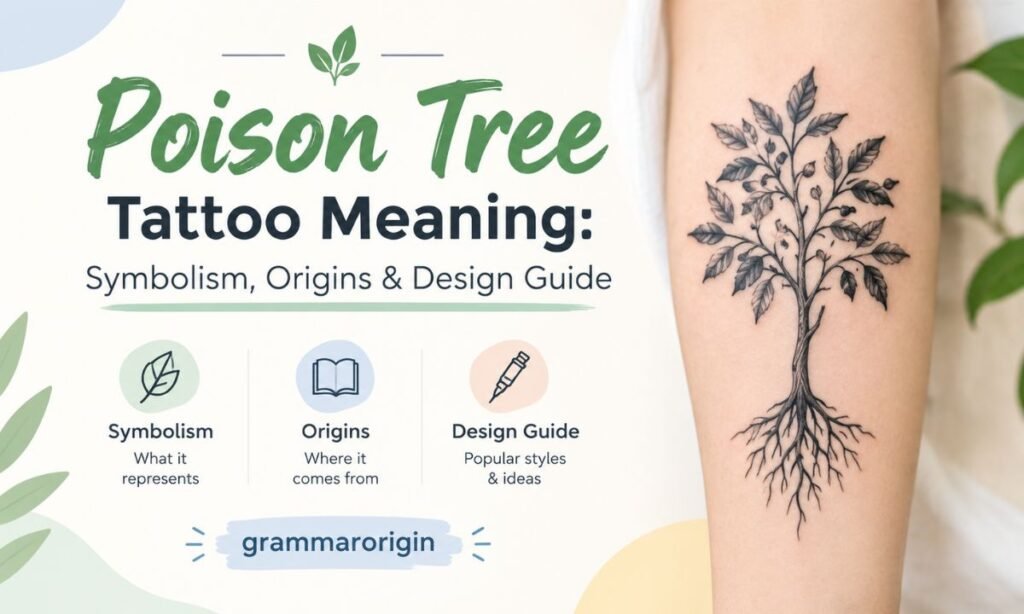
A poison tree tattoo isn’t just a dark, twisted piece of ink — it’s a marker for something people have actually lived through. Understanding the poison tree tattoo meaning helps explain why this design keeps showing up on forearms, ribs, and backs across such different people.
At its heart, this tattoo traces back to a 200-year-old poem about anger nobody wanted to say out loud. The rest of this guide walks through where it came from, what it represents today, and how to choose a version that actually fits your story.
Quick answer: A poison tree tattoo represents suppressed anger, hidden resentment, and the emotional fallout of staying silent instead of speaking up. It comes from William Blake’s 1794 poem “A Poison Tree,” and most people wear it as a sign of self-awareness, survival, or hard-won emotional growth — not darkness for its own sake.
What Is a Poison Tree Tattoo?
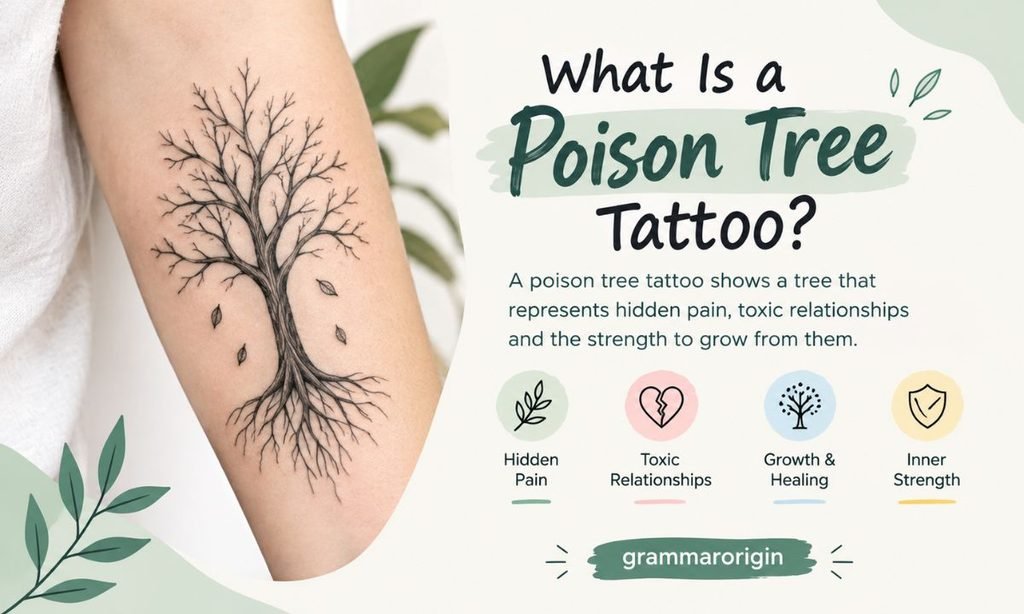
A poison tree tattoo shows a tree that has gone wrong on purpose — bare branches, cracked bark, roots that look like they’re gripping rather than growing.
It isn’t meant to look pretty. The whole point is tension: something natural that’s been twisted by what it was fed.
Most versions include one or two of the same visual cues: leafless limbs, a single glowing piece of fruit, or roots that spread further than they should. Artists lean into that contrast between a tree’s usual meaning — life, growth, shelter — and what happens when it’s been poisoned from the inside instead.
That contrast is exactly what makes the design so easy to read at a glance, even for people who’ve never heard of the poem behind it.
The Origins: William Blake’s “A Poison Tree” (1794)
The design comes from a short poem by English poet William Blake, published in 1794 as part of his collection Songs of Experience.
The poem sets up a simple comparison. When the speaker gets angry at a friend, he says so, and the anger fades. When he gets angry at an enemy, he keeps quiet, and that silence slowly turns into something else entirely.
| Stanza | What Happens (in plain terms) |
| 1 | Anger at a friend gets spoken and disappears; anger at an enemy gets hidden and stays |
| 2 | The hidden anger is fed with fear and fake pleasantness until it takes root |
| 3 | The buried resentment grows into a tree that produces a tempting piece of fruit |
| 4 | The enemy takes the fruit, and the consequence plays out exactly as the buried anger intended |
Blake wasn’t writing a horror story. He was pointing out something uncomfortable — that resentment we refuse to name doesn’t go away, it just changes shape.
That idea didn’t start with Blake either. The Tree of Knowledge in Genesis carries the same warning about beautiful things hiding a cost. Norse mythology has a serpent gnawing at the roots of the world tree, Yggdrasil, while it still looks alive on the surface. Buddhist teaching makes a similar point about anger poisoning the person holding onto it more than anyone else.
Blake gave all of that a single, sharp image — and tattoo culture picked it up almost two centuries later.
Poison Tree Tattoo Meaning: Core Symbolism
The symbolism attached to this tattoo isn’t random. A handful of themes show up again and again, no matter who’s wearing it.
| Symbolism | What It Represents |
| Suppressed anger | Feelings that turn destructive once they’re kept inside long enough |
| Betrayal | Pain from broken trust, deceit, or a relationship that soured |
| Self-awareness | Naming a dark pattern instead of pretending it isn’t there |
| Warning | A personal reminder not to let resentment build again |
| Transformation | Proof of what someone survived, not just what hurt them |
| Duality | The gap between how a person looks calm and how they actually feel |
What separates this design from a generic dark tattoo is that it doesn’t glorify anger. It puts it on display so the wearer can own it, rather than keep hiding it the way the poem describes.
Also Read This ICL Meaning
Who Gets a Poison Tree Tattoo — and Why
This design rarely gets chosen on a whim. Most people who get it can point to a specific reason.
- People who grew up hiding their emotions — households where showing anger openly wasn’t allowed, so they learned to smile instead
- Survivors of betrayal or toxic relationships — the tattoo marks both the damage and the decision to move past it
- Readers and writers drawn to Blake’s work — the literary weight matters as much as the visual
- People in some stage of emotional recovery — using the design as proof they recognized a pattern and chose to change it
One thread runs through almost every reason on that list: the tattoo isn’t celebrating bitterness. It’s acknowledging it long enough to let it go.
Poison Tree Tattoo Meaning in Different Contexts
The core meaning stays the same everywhere, but the emphasis shifts depending on who’s wearing it and where.
Poison Tree Tattoo Meaning for Women
For many women, this design leans toward reclaiming a story rather than warning about one. It often follows the end of a relationship or friendship where staying quiet did real damage.
Softer styling choices — fine lines, a single bloom worked into the branches, muted color washes — are common, but the underlying meaning about buried emotion and eventual growth doesn’t change.
Poison Tree Tattoo Meaning in the Bible
The closest biblical parallel is the Tree of Knowledge from Genesis, where fruit that looks harmless carries a consequence nobody sees coming until it’s too late.
Blake wasn’t quoting scripture directly, but the echo is intentional — hidden temptation, a tempting exterior, and fallout that can’t be undone once it starts.
Poison Tree Tattoo Meaning in Simple Terms
Stripped down to one sentence: bottled-up anger doesn’t disappear, it grows into something that eventually causes harm.
That’s really the entire poem in a single idea, and it’s why the tattoo translates so easily even to people who’ve never read a line of Blake.
Poison Tree Tattoo Meaning and Family
Within a family context, the design often points to old patterns — resentment passed down, conflicts nobody addressed directly, or a specific relationship that stayed unresolved for years.
It’s less about one incident and more about a slow buildup that took a long time to name.
Poison Tree Tattoo Meaning in Romantic Relationships
In a romantic context, the tattoo usually marks betrayal, a breakup that involved dishonesty, or a period where love turned into something draining instead of supportive.
Some wearers add it right after the relationship ends; others get it years later, once they’ve had time to actually process what happened.
Poison Tree Tattoo Meaning on the Forearm
The forearm is the single most requested placement for this design, and the reasoning is straightforward: it stays visible to the wearer constantly and to other people in most everyday situations.
That visibility mirrors the tattoo’s message directly — confronting a feeling instead of keeping it out of sight.
Poison Tree Tattoo Meaning and Mental Health
Therapists and mental health advocates have picked up on this symbol because it captures a well-documented pattern: emotions that get avoided tend to resurface stronger, not weaker.
Worn this way, the tattoo becomes less of a warning and more of a daily nudge to address things directly instead of letting them sit.
Poison Tree Tattoo vs Other Dark Tree Tattoos
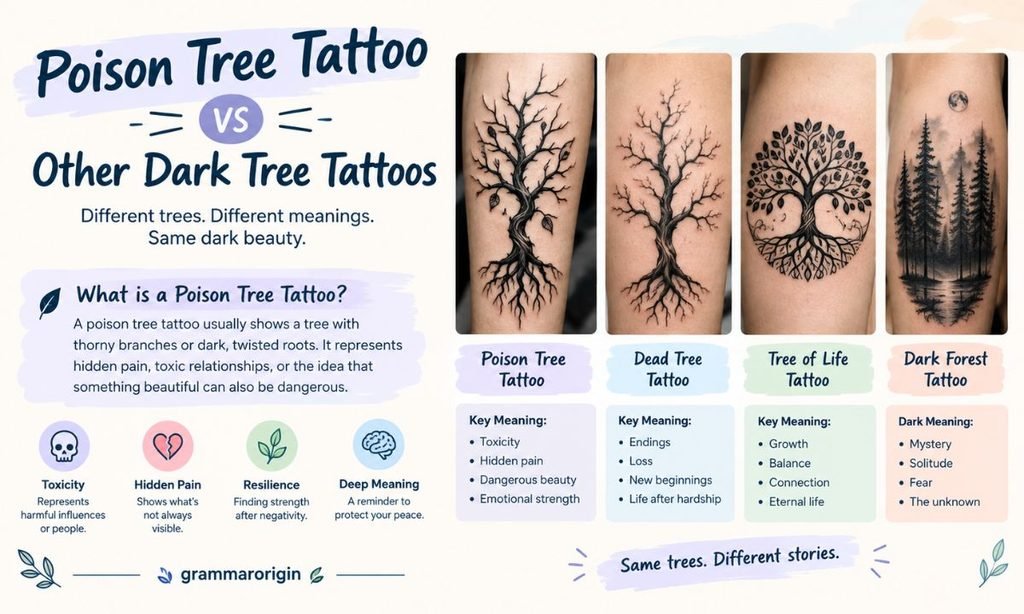
Not every twisted tree tattoo means the same thing. Here’s how the poison tree compares to designs it often gets confused with.
| Tattoo Type | Core Meaning | Visual Tell |
| Poison Tree | Suppressed anger turning destructive | Dark tree with one bright or corrupted fruit |
| Dead Tree | Loss, grief, an ended chapter | Bare, leafless, no fruit |
| Tree of Life | Growth, family, connection | Full, symmetrical canopy and roots |
| Weeping Willow | Sadness, mourning | Drooping, flowing branches |
| Tree with Serpent | Temptation, betrayal | Snake wrapped visibly around the trunk |
The detail that sets the poison tree apart is that fruit. Other dark tree designs describe an ending; this one describes a process — anger that’s still actively growing into something.
Popular Design Variations
The concept behind this tattoo stays consistent, but artists take it in very different visual directions.
Black and Grey Gothic Style
Twisted, leafless branches rendered in heavy shadow. This is the most traditional approach — serious and visually blunt, often paired with a raven or a full moon for atmosphere.
Blake-Inspired Illustration
Some wearers work small fragments of the poem’s imagery — not full lines of text, given copyright concerns — directly into the branches or roots, making the literary connection explicit.
Also Read This ICL Meaning
Half-Dead, Half-Living Tree
One side blooms while the other decays. It’s a direct visual of duality: healing sitting right next to the damage that came before it.
Serpent and Fruit Motif
A snake coiled through the branches next to a glowing apple pulls in both Blake’s imagery and the older biblical reference in one design.
Heartfruit Design
Here, the forbidden fruit takes the shape of a heart, shifting the meaning toward love that turned harmful rather than anger in general.
Minimalist Line Art
A sparse, single-line outline of a bare tree. This version carries the symbolism without the heavier gothic weight, and it ages well on smaller placements.
Watercolor Style
Fluid color washes replace sharp shadow work. Deep reds and inky blacks give the design an emotional, almost bruised feel rather than a strictly gothic one.
Symbolic Elements Combined with Poison Tree Tattoos
Most wearers don’t stop at the tree itself. Adding a second element sharpens exactly what the tattoo is meant to say.
| Added Element | What It Adds to the Meaning |
| Raven or crow | Watchfulness, transformation, an omen the wearer chose to face |
| Snake | Betrayal, deception, or the biblical echo of temptation |
| Skull | Mortality, finality, or a chapter that’s genuinely closed |
| Full moon | Secrets or emotions only visible once things go quiet |
| Falling leaves | Letting go of anger that’s been carried for too long |
| Broken lock or chain | Release — finally letting out what had been held back |
None of these are required. They’re used to narrow the story down when the tree alone feels too general for what the wearer actually wants to say.
Color Meanings in Poison Tree Tattoos
Color shifts the tone of this tattoo more than almost any other design choice.
| Color | Symbolic Meaning |
| Black and grey | Internal, reflective, the most common and grounded choice |
| Deep red | Passion or slow-burning resentment, sometimes shown only in the fruit |
| Dark green | Toxic growth left unaddressed for a long time |
| Purple | Transformation, introspection, or spiritual undertones |
| Muted earth tones | Resilience and survival after the initial damage |
| Gold or yellow accents | A moment of clarity or the start of healing |
Black remains dominant because it matches the poem’s tone — something buried, not something shouted.
Best Placement Options for a Poison Tree Tattoo
Where the design sits on the body changes how personal or public it feels.
| Placement | What It Communicates |
| Forearm | Visibility and openness — not hiding the story |
| Ribs | Private, meant for the wearer more than an audience |
| Back | A larger statement piece, room for full roots and canopy |
| Chest | Emotional weight held close, literally over the heart |
| Wrist or ankle | A quiet, everyday reminder rather than a bold statement |
| Behind the ear | Small, easy to reveal or conceal depending on the day |
There’s no wrong choice here. The placement usually just follows how visible the wearer wants the meaning to be.
Psychological Dimension: Why This Symbol Resonates So Deeply
Modern psychology backs up what Blake wrote centuries earlier — emotions that get suppressed don’t vanish, they resurface, often in ways that are harder to manage than the original feeling.
Carl Jung’s idea of the shadow self fits neatly here too. Denying a part of yourself doesn’t remove it; acknowledging it is usually the first real step toward working through it.
That’s what this tattoo captures visually. It puts a buried feeling on the surface instead of letting it stay hidden, which is precisely the opposite of what the poem’s speaker does.
Common Mistakes to Avoid
A few avoidable missteps come up often with this particular design.
- Skipping the meaning entirely — a generic dark tree without any of the poem’s visual cues can just read as an unrelated gothic piece
- Overcrowding the design — trying to illustrate the whole poem scene by scene tends to bury the symbolism instead of highlighting it
- Rushing the placement decision — because this design carries real personal weight, where it goes matters more than it would for a purely decorative tattoo
- Choosing an artist without fine-line experience — the roots and branch detail need a steady, practiced hand
Taking even a day to sit with the choice usually prevents most of these.
Cost and Time to Complete
Pricing and timing depend heavily on size and detail level, but there’s a rough pattern worth knowing before booking a session.
A simple minimalist line-art version typically takes 2 to 4 hours in a single sitting. A detailed gothic piece with roots, shading, and added elements like a raven or snake can run 8 to 12 hours, often split across two or more sessions.
Cost tracks the same way — smaller, simpler designs cost less per hour of work, while a full back piece with fine detail sits at the higher end of most studios’ pricing.
Questions to Ask Your Tattoo Artist

Before committing, it’s worth going into the consultation with a short list ready.
- Have you worked with fine-line botanical or gothic tree designs before?
- Can the roots and branch detail hold up over years, given my skin and the placement I want?
- Would you recommend black and grey only, or does color actually suit this particular design?
- How many sessions will a piece this detailed realistically need?
- Can we adjust the fruit or added element so the meaning stays personal rather than generic?
A good artist will have straightforward answers to all five without hesitation.
Frequently Asked Questions
What does a poison tree tattoo mean?
It represents suppressed anger and hidden resentment that grows destructive when left unspoken, based on William Blake’s 1794 poem “A Poison Tree.”
Is a poison tree tattoo a negative symbol?
Not really. It acknowledges a difficult emotion rather than celebrating it, and most wearers see it as a step toward healing rather than a warning sign.
Do I need to know William Blake’s poem to get this tattoo?
No. Plenty of people connect with the imagery on a personal level without any literary background, though reading the short poem does add context.
What does the apple or fruit represent in this design?
It represents the eventual, often destructive result of anger that’s been left to grow unchecked instead of being addressed early.
Can a poison tree tattoo have a positive meaning?
Yes. Many wearers choose it specifically to mark emotional growth, survival of a difficult period, or the decision to stop bottling things up.
What’s the best placement for a poison tree tattoo?
The forearm is the most popular choice for visibility, while the ribs, wrist, or behind the ear suit people who want the meaning to stay more private.
Does this tattoo work well for a first tattoo?
It can, but because the symbolism runs deep, many people prefer to get it once they’ve actually lived through the experience it represents.
Final Thoughts
A poison tree tattoo carries more weight than its dark visuals suggest at first glance. Rooted in a 200-year-old poem, it still speaks directly to anyone who’s ever bottled up anger instead of naming it.
Whichever version someone chooses — gothic, minimalist, or built around a personal story — the poison tree tattoo meaning stays the same at its core: what we hide doesn’t disappear, it grows, and this design is proof that someone finally chose to face that instead of looking away.

1 thought on “Poison Tree Tattoo Meaning: Symbolism, Origins & Design Guide”