
You heard someone call you “green” and now you’re wondering what it actually means. Is it an insult, a compliment, or just casual slang? Green slang meaning usually points to one simple thing — being new or inexperienced at something.
But “green” can also mean money, jealousy, eco-friendly habits, or even a perfect gaming shot in 2026 slang. This guide breaks down every meaning, where the term comes from, real chat examples, and exactly how to use it the right way.
What Does It Mean to Be “Green” — Slang Meaning in Text
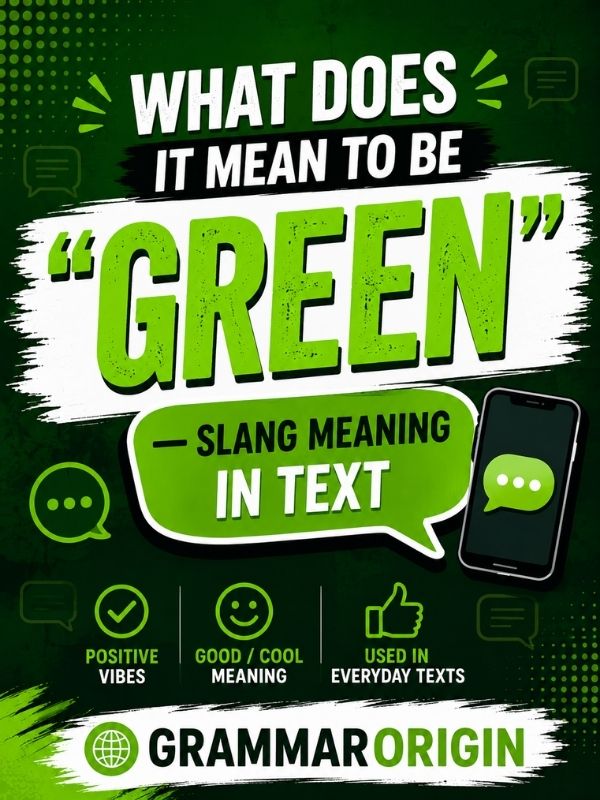
Short answer: In texting and chat slang, calling someone “green” usually means they’re new, inexperienced, or naive at something — like a rookie who hasn’t learned the ropes yet. It can also refer to money, jealousy, or being eco-conscious, depending on context.
The word carries several layers, but the core idea across most of its slang uses is freshness — a fresh plant, a fresh dollar bill, a fresh face on the team. That’s why “green” so easily slides into meaning “new” or “inexperienced.”
Is It Slang, Acronym, or Abbreviation?
“Green” is not an acronym or abbreviation — it’s a straightforward slang usage of an everyday English word. Unlike terms like “LOL” or “BRB,” there’s no letter-by-letter meaning to decode. It’s simply the color word “green” being used metaphorically, the same way “fresh,” “rookie,” or “newbie” get repurposed in casual conversation.
What It Means in Everyday Chat
In day-to-day texting, “green” pops up in a few common ways:
- “You’re so green” — you’re new to this, you don’t know the rules yet.
- “He’s green” — he lacks experience.
- “I’m green with envy” — a classic idiom for jealousy.
- “Got any green?” — slang for cash, or in some circles, weed.
Context is everything. The same word can flip meaning entirely depending on who’s texting, what platform they’re on, and what the conversation is actually about.
What Does “Your Green” Mean?
Short answer: “Your green” almost always refers to your money — your cash, your earnings, or your budget. Less commonly, depending on the group chat, it can mean “your inexperience” or, in certain slang circles, “your weed.”
The phrase leans heavily on the money association because “green” has been American slang for cash since paper currency turned green-backed. So when someone texts “protect your green” or “where’s your green at,” they’re almost certainly talking about finances — not innocence or plants. It’s worth checking the surrounding sentence, though: “your green is showing” in a gaming or sports context usually means your inexperience is obvious, not your wallet.
Other Meanings of “Green” in Slang
“Green” is one of those rare words that carries multiple, completely unrelated slang meanings depending on context. Here’s a breakdown of the most common ones.
Green as Slang for Money
This is the oldest and most widespread meaning. U.S. dollar bills have been green since the 1860s, so “green,” “greenbacks,” and “green paper” all became natural stand-ins for cash. You’ll hear this in hip-hop lyrics, business talk, and everyday phrases like “show me the green” or “that job pays good green.”
Green as Slang for Jealousy/Envy
“Green with envy” is a centuries-old idiom, popularized in English literature (Shakespeare used “green-eyed jealousy” in Othello). Today it’s shortened in casual chat to just “green,” as in “ngl I’m a little green rn” — meaning “not gonna lie, I’m a bit jealous right now.”
Green as Slang for Eco-Friendly
In sustainability and lifestyle conversations, “green” simply means environmentally friendly — green energy, green living, green products. This meaning is common in marketing, news, and everyday talk about climate-conscious choices, and it’s the least likely to be confused with the other slang uses since it’s usually paired with words like “eco,” “sustainable,” or “clean.”
Green as Slang for Weed/Drugs
Short answer: Yes, “green” is also a common slang term for marijuana/cannabis, especially in casual or coded conversations.
This usage comes directly from the plant’s color and is widely recognized in both online slang dictionaries and everyday conversation among people who use cannabis-related terms. Phrases like “got any green” or “smoking green” fall into this category. Context clues — who’s texting, the rest of the conversation, emojis like 🍃 — usually make this meaning clear versus the money or newbie meanings.
“Green” in 2026 Gaming Slang (Perfect Shot Meaning)

Short answer: In 2026 gaming culture, especially in rhythm games, shooters, and mobile titles, “green” often means a perfect or ideal shot/hit — a flawless, top-tier result flagged by a green indicator, checkmark, or highlight on screen.
Many games use green as a visual cue for the best possible outcome — a “green light” hit, a perfect-timing note, or an accuracy rating shown in green versus yellow or red for lesser results. This has carried over into gamer slang, where players say things like “that was green” or “get that green” to mean a clean, mistake-free play. It’s become especially common in Gen Z and Gen Alpha gaming communities on platforms like Discord and TikTok gaming clips, where color-coded performance feedback (green = perfect, yellow = good, red = miss) is now second nature. If you see “green” used in a gaming clip caption or comment section in 2026, it’s very likely referencing this precision/perfect-hit meaning rather than money or inexperience.
Green Slang Meaning on Urban Dictionary
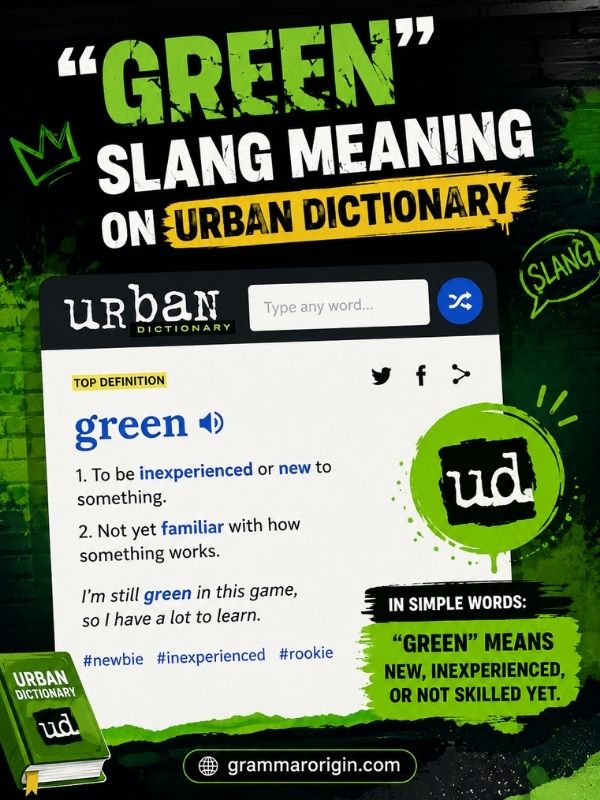
Short answer: Urban Dictionary entries for “green” mostly center on three definitions: marijuana, money, and being inexperienced/naive, with user-submitted examples reflecting casual, often humorous everyday usage.
Because Urban Dictionary is crowdsourced, definitions vary by contributor and can be more explicit or slang-heavy than dictionary sources. The most upvoted entries typically confirm the same core meanings covered in this guide — cash, weed, and rookie status — along with example sentences pulled from real conversation. It’s a useful reference for slang trends, but since anyone can submit a definition, it’s worth cross-checking unusual or extreme claims against more established sources.
MORE RELATED POSTES CLICK ME
Where People Use “Green” Slang
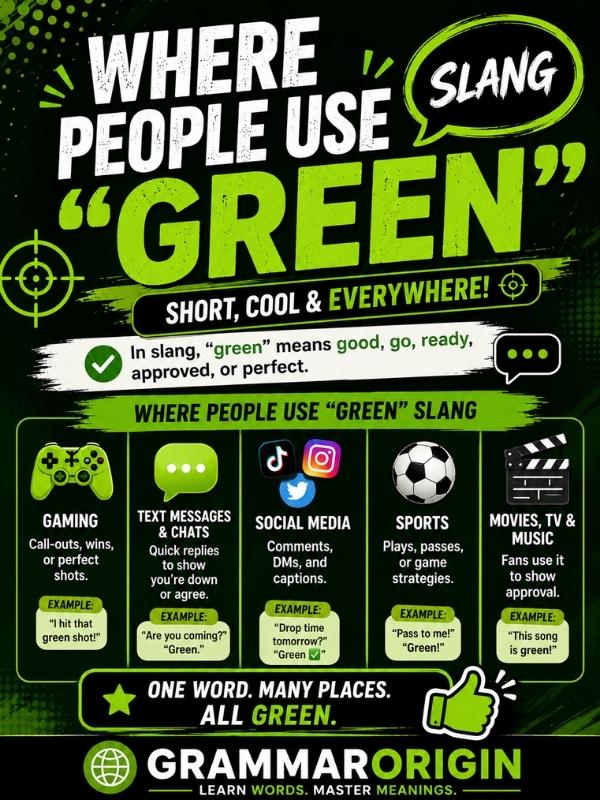
“Green” slang shows up differently depending on the platform, mostly shaped by each app’s culture and typical audience.
TikTok
On TikTok, “green” frequently ties into gaming clips, comment sections, and trend audio — especially the 2026 “perfect shot” gaming meaning and money-flex content (“secure the green”).
Snapchat
On Snapchat, “green” tends to stay casual and personal — friends teasing each other about being “green” (new/naive) to a friend group, inside joke, or relationship situation.
On Instagram, especially in captions and comments, “green” often connects to eco-friendly lifestyle content or money/success flexing in captions about hustle and finances.
WhatsApp usage skews toward direct, one-on-one or small group chats, where “green” is more likely used literally — talking about money, plans, or even WhatsApp’s own green branding as a joke.
SMS (Text Messages)
In plain text messages, “green” is usually the most literal and least trend-driven — closer to standard English idioms like “green with envy” or “still green at this job” than internet-specific slang.
Real Chat Examples
Here’s how “green” plays out in real conversation across different meanings:
- Money: “Bro just dropped so much green on that new setup 💵”
- Inexperience: “Don’t mind him, he’s still green — started last week.”
- Envy: “Ngl seeing your vacation pics has me green rn 😅”
- Gaming: “That was so clean, straight green the whole run 🎯”
- Weed (coded): “You got that green for later?”
- Eco-friendly: “Switched to a green energy plan, feels good honestly.”
Reading the full sentence — not just the word “green” — is the fastest way to know which meaning is intended.
How to Reply When Someone Says “Green”
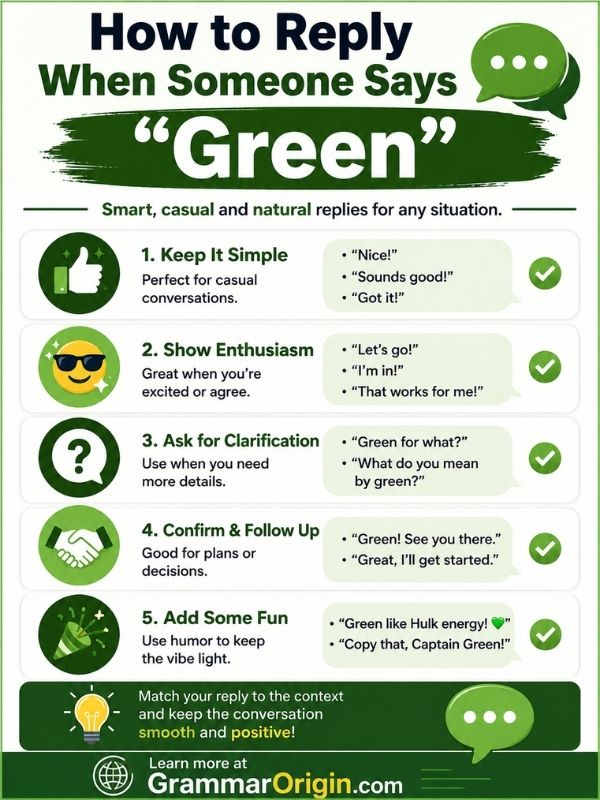
If someone calls you “green” or brings it up in chat, your reply depends on the tone. Here are options for each vibe.
Funny Replies
- “Green? I prefer ‘work in progress’ 😂”
- “Say less, I’ll be greener than a salad by next week.”
Casual Replies
- “Yeah lol still figuring it out.”
- “Fair, I’m new to this ngl.”
Friendly Replies
- “Haha true, teach me then 😄”
- “Guilty, but I’m learning fast!”
Neutral Replies
- “Yep, first time doing this.”
- “Makes sense, I just started.”
The safest move if you’re unsure of the tone is a light, self-aware reply — it works whether “green” was meant playfully or as a genuine observation.
Is “Green” Rude or Offensive?
Short answer: No, calling someone “green” is generally not offensive — it’s a mild, mostly playful way to describe inexperience. It can feel slightly condescending in a serious or professional setting, but it isn’t considered an insult or slur.
Compared to harsher put-downs, “green” is closer to “rookie” or “newbie” — descriptive rather than mean-spirited. The tone usually comes from context: said with a laughing emoji among friends, it’s harmless banter; said flatly by a boss in front of coworkers, it can sting a little more. As with most slang, delivery and relationship matter more than the word itself.
Should You Use It in School or Work?
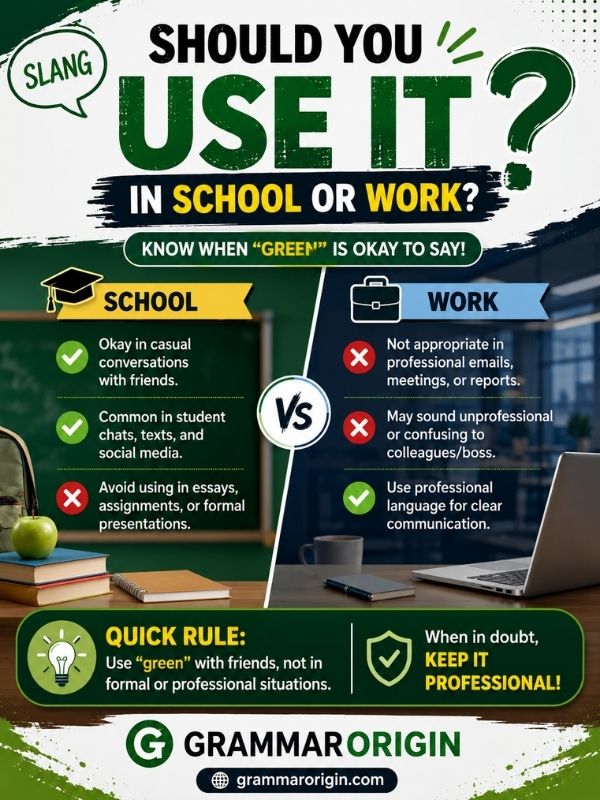
Short answer: It’s fine in casual conversations with friends or peers, but it’s best to avoid using “green” in formal school or workplace communication — emails, reports, presentations — where plain, professional language reads better.
In informal settings, like chatting with classmates or coworkers you’re close with, “you’re still green at this” can come across as friendly and relatable. In formal settings, though, terms like “still developing,” “early in the learning curve,” or “new to the role” communicate the same idea without sounding slangy or, in some cases, dismissive. When in doubt, match the formality of the person and platform you’re talking to.
What Does Being “Green” Mean at Work?
Short answer: At work, being called “green” means you’re a new employee or someone with limited experience in that role, industry, or task — not yet fully trained or seasoned.
This usage is common in professional slang across industries — retail, corporate offices, trades, even military and sports settings. A “green” employee typically needs more guidance, makes more first-time mistakes, and is still learning company processes. It’s not usually meant as an insult; it’s more of a status description, similar to “rookie” or “junior.” Over time, as someone gains experience, they’re described as having “grown out of being green” — a natural, expected stage rather than a permanent label.
Who Uses This Term?
Age Groups
“Green” as a slang term spans generations, but its specific meaning shifts. Older speakers lean toward the traditional “inexperienced” and “money” meanings, while younger users — teens and young adults — layer in gaming, TikTok trends, and internet-specific usage.
Gen Z Usage — “What Does Green Mean in Gen Z Slang?”
Short answer: In Gen Z slang, “green” most often refers to being new/inexperienced (“still green”), jealous (“green with envy,” shortened to just “green”), or, in 2026 gaming culture, a perfect/ideal shot or play.
Gen Z tends to compress idioms into single words — so instead of saying “I’m green with envy,” they’ll just say “I’m so green rn.” This generation is also the driving force behind the gaming-related “green = perfect hit” meaning, spread mainly through TikTok clips and Discord gaming servers.
Platforms
As covered earlier, TikTok and gaming platforms lean toward trend-driven meanings (perfect shots, flexing money), while WhatsApp and SMS lean toward traditional, literal usage.
Frequency
“Green” isn’t as high-frequency as slang staples like “no cap” or “bet,” but it’s a steady, evergreen (pun intended) term that shows up regularly across money talk, gaming chat, and everyday idioms — making it more of a foundational slang word than a passing trend.
Origin & Etymology of “Green” Slang
The color “green” has carried symbolic meaning in English for centuries, long before internet slang existed. “Green with envy” traces back to classical and Shakespearean literature, where green was associated with sickness and jealousy. “Green” for inexperience comes from the natural world — green (unripe) fruit or green (young, freshly grown) plants aren’t fully developed yet, so the metaphor extended naturally to people who are new or unready. The money meaning is more recent and distinctly American, tied directly to the green ink used on U.S. paper currency starting in the 1860s.
Internet Culture Influence
What internet and chat culture added wasn’t a new meaning so much as compression and remixing — turning full idioms into single-word slang (“green” instead of “green with envy”), and creating entirely new associations, like the 2026 gaming usage tied to color-coded performance feedback (green = perfect, red = miss).
Is the Origin Clear?
For most meanings — money, envy, inexperience — yes, the origins are well-documented and traceable through historical English usage. The gaming and weed-related meanings are more informally established, spread through community usage and internet culture rather than a single clear source, which is typical for modern slang.
Common Idioms & Phrases With “Green”
- Green with envy — extremely jealous
- Green light — permission to proceed
- Green thumb — skilled at gardening
- Green behind the ears (variation of “wet behind the ears”) — very inexperienced
- Show me the green — show me the money
- Go green — adopt environmentally friendly habits
- In the green — profitable, not in debt (opposite of “in the red”)
- Green flag — a positive sign in a relationship or situation (the opposite of a “red flag”)
These idioms show how flexible “green” is — it stretches across money, nature, permission, environment, and relationships, all from one root color word.
“Green” Slang Meaning in Urdu
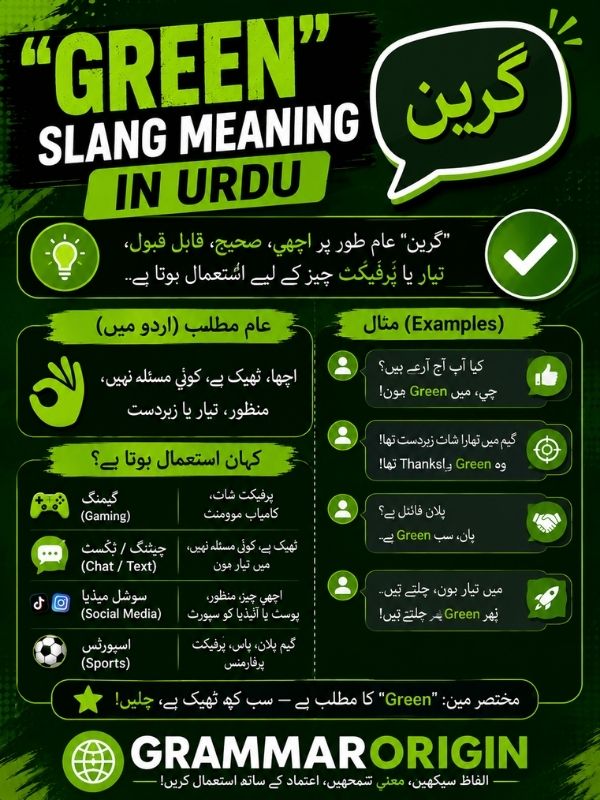
Urdu-speaking chatters, especially in mixed English-Urdu texting, use “green” (“سبز” – sabz) in a few similar ways:
- پیسے (Paise/Money): “Green” is casually understood as cash, similar to English slang — “uske paas bohat green hai” (he has a lot of green/money).
- Naya/Inexperienced (نیا): Someone new to a job or task might be called “green,” borrowed directly from English office and gaming slang, especially among younger, bilingual speakers.
- Environment (ماحول دوست): In formal or news contexts, “green” (“go green,” “green energy”) is used the same way as in English — referring to eco-friendly practices.
In everyday Urdu-English code-switching (common on WhatsApp and Instagram among Pakistani and Indian users), “green” is often borrowed straight from English slang rather than fully translated, especially among younger, urban, bilingual speakers.
Real-World Usage Example
Imagine a group chat among coworkers:
Ali: “New intern asked where the printer paper is… again 😅”
Sara: “Lol he’s still so green, give him a break.”
Ali: “Fair, we were all green once.”
Here, “green” clearly means inexperienced, used gently and without malice — a good real-world example of how the word functions in casual, everyday professional banter.
Comparison Table: “Green” vs Newbie, Rookie, Fresh, Greenhorn
| Term | Core Meaning | Tone | Common Setting |
| Green | Inexperienced, new, or unready | Neutral to playful | Chat, work, gaming, idioms |
| Newbie | New to an online community, game, or platform | Casual, sometimes teasing | Gaming, forums, online communities |
| Rookie | New professional/athlete/employee | Neutral, respectful | Sports, workplaces, military |
| Fresh | New, or stylish/impressive (double meaning) | Positive, trendy | General slang, fashion, social media |
| Greenhorn | Very inexperienced, naive | Old-fashioned, slightly dismissive | Historical, trades, Westerns |
Key takeaway: All five terms describe inexperience, but “green” is uniquely versatile — it’s the only one that also doubles as slang for money, jealousy, weed, and even gaming performance, depending on context.
Frequently Asked Questions
What does “being green” mean in slang usage?
“Being green” means being new, inexperienced, or naive at something — like a rookie who hasn’t learned the ropes yet. It’s one of the most common slang uses of the word.
What does “green” mean when describing a new employee or intern?
It means the employee or intern is still learning the job and hasn’t gained much hands-on experience yet. It’s a normal, expected stage — not a permanent label.
What companies use “green” in their branding to signify eco-friendliness?
Many sustainability-focused brands use “green” in their name or marketing — common in energy companies, organic food brands, and eco product lines — to signal environmentally friendly practices to customers.
How do green certifications affect product choices?
Green certifications (like Energy Star or Fair Trade-style eco-labels) help shoppers quickly identify products that meet specific environmental standards, making it easier to choose sustainable options without researching each brand individually.
What are typical challenges for “green” team leaders?
New (“green”) leaders often struggle with delegating tasks, handling conflict, and building trust with their team early on — challenges that usually improve with time and experience.
What does it mean when a stock or the market is “green”?
In finance slang, “green” means prices are up. If a stock or the market is “green,” it’s trading higher than its previous close — the opposite of “red,” which means it’s down.
Conclusion
“Green” is a small word with a big range of meanings — from money and inexperience to jealousy, eco-friendliness, and even gaming trends. The right meaning always depends on context, platform, and tone.
Whether you’re texting a friend, replying at work, or scrolling TikTok, understanding this slang helps you read the room correctly. Use it casually where it fits, and stick to clearer language in formal settings.