

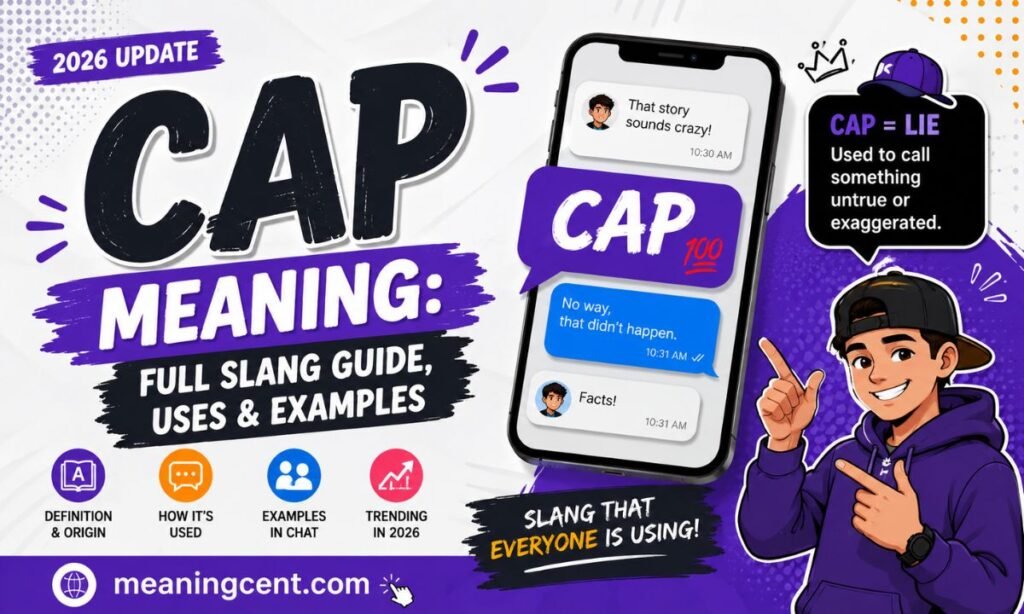
If you’ve seen someone type “no cap” or call something “cap” and had no idea what they meant, you’re not alone. The cap meaning in modern slang is simple: cap means a lie, and no cap means the truth.
This word shows up everywhere now — TikTok comments, group chats, Instagram captions, even casual work chats. Understanding cap meaning helps you follow conversations without getting lost or misreading a joke.
Meaning & Definition of Cap
In slang, cap means a lie or an exaggerated claim, while no cap means someone is being honest.
According to Dictionary.com, “cap” as slang for lying traces back to earlier phrases where “capping” meant bragging or stretching the truth. So when a friend says “that’s cap,” they’re calling something fake or untrue.
Here’s the split in plain terms:
- Cap = lie, fake, exaggeration
- No cap = truth, seriously, for real
Quick examples:
- “He said he ran a marathon in two hours? That’s cap.”
- “This burger is the best thing I’ve eaten all week, no cap.”
Outside of slang, “cap” also has older, literal meanings — a hat, a bottle cap, or a spending limit like a salary cap. Merriam-Webster still lists these as the word’s original senses. The slang usage is newer, and it’s the one people usually search for today.
Cap vs No Cap — Quick Comparison Table
| Term | Meaning | Example |
| Cap | Lie / false statement | “You didn’t really meet him, that’s cap.” |
| No cap | Truth / being serious | “I finished the project early, no cap.” |
| Capping | The act of lying or exaggerating | “Stop capping, I saw the receipt.” |
| Capper | Someone who lies often | “He’s such a capper, don’t trust him.” |
This table is a fast reference if you just need the difference at a glance before diving into the details below.
Background & Origin of Cap
Cap as slang for lying comes from African American Vernacular English (AAVE), where “capping” originally meant bragging or exaggerating rather than telling a straight lie.
Linguists who study Green’s Dictionary of Slang trace “to cap” back to the early 1900s, tied to a wordplay tradition called The Dozens, where people traded exaggerated insults for fun. Over decades, that sense of exaggeration shifted toward meaning an outright lie.
Hip-hop culture picked up the term through the 2000s and 2010s, and rappers used “no cap” to stress they weren’t exaggerating their lyrics. By 2019, the phrase had jumped from music into everyday texting, and TikTok’s growth in 2020 pushed it into mainstream slang worldwide.
Also Read This What Does Opps Mean? Slang, Texting & Cops Meaning Explained
Usage in Different Contexts
Cap changes tone slightly depending on where you see it, but the core meaning — lie versus truth — stays the same.
Social Media
On platforms like TikTok and X, people use “no cap” to add weight to an opinion, like “this song slaps, no cap.”
Chat Conversations
In one-on-one texting, “cap” often calls out a friend mid-conversation, such as “you got an A without studying? Cap.”
Entertainment & Memes
Meme pages use “cap” to react to unbelievable clips or over-the-top claims in a joking way, not always a serious accusation.
Professional Tone (rare)
Outside slang, “cap” shows up formally in phrases like “salary cap” or “budget cap,” meaning a fixed limit rather than anything about honesty.
Meanings Across Platforms
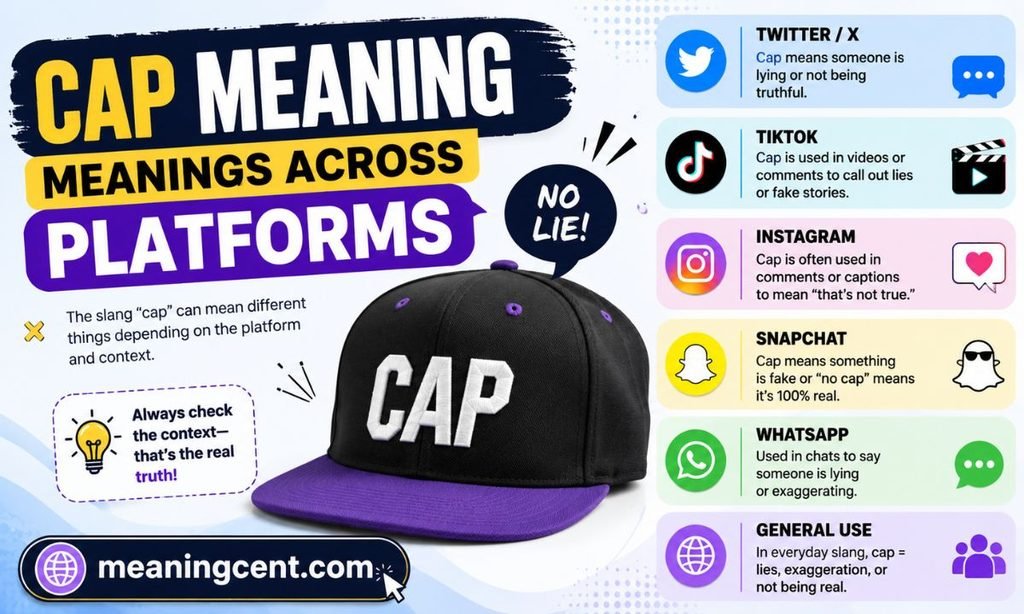
The slang meaning of cap stays consistent across apps, though the tone shifts based on how each platform is typically used.
Used casually in group chats, often to tease someone: “You woke up at 6am? Cap 😂”
Common in captions and comments to add emphasis: “Best trip ever, no cap ✨”
TikTok
One of the most active homes for the term, especially in comment sections reacting to viral videos.
Snapchat
Used in quick, informal replies to stories or snaps, usually short and reactive.
Other Fields Meanings
Cap isn’t only slang — it carries different technical meanings depending on the industry.
- Medical: a cap can refer to a capsule form of medicine
- Finance: a cap is a limit, like a credit cap or price cap
- Sports: a salary cap sets the maximum a team can spend on players
- Aviation: CAP stands for Civil Air Patrol
- Dentistry: a cap is a protective cover placed over a damaged tooth
Context decides which meaning applies, so the same word can mean something completely different in a hospital versus a group chat.
Common Misconceptions & Mistakes
A lot of confusion around cap meaning comes from people mixing up the slang sense with its literal, older meanings.
cap meaning texting
In texts, cap almost always means a lie, not a literal hat or limit — context inside the message makes this clear fast.
cap meaning gen z
Among Gen Z, cap and no cap are everyday slang for lying and truth-telling, used far more casually than older generations might expect.
cap meaning in business
In a business setting, cap usually refers to a limit, such as a spending cap or a cap on hours, and has nothing to do with the slang sense.
cap meaning medical
In medical contexts, a cap typically means a capsule, a protective dental cover, or a covering used in a procedure — again, unrelated to slang.
cap meaning in education
Teachers or students who hear “no cap” in a classroom setting are hearing slang for honesty, not an academic term.
cap meaning lie
This is the core slang definition — cap simply means something untrue or exaggerated.
cap meaning abbreviation
Cap isn’t really an abbreviation in slang use; it’s a standalone word, though in aviation CAP does stand for Civil Air Patrol.
cap meaning limit
The older, literal sense of cap as a limit (salary cap, price cap) still exists and is common in finance and sports writing.
Also Read This What Does Opps Mean? Slang, Texting & Cops Meaning Explained
Similar Terms & Alternatives
Several slang words travel alongside cap in everyday conversation, and knowing them helps you read a chat faster.
| Term | Meaning |
| Cap | Lie or exaggeration |
| No cap | Truth, being serious |
| Fake | Not genuine |
| Bet | Agreement, “okay” |
| Fr (for real) | Honestly, seriously |
| Sus | Suspicious or questionable |
| Mid | Average or unimpressive |
These terms often show up together in the same sentence, so recognizing one usually helps you understand the rest.
How to Respond to “Cap”
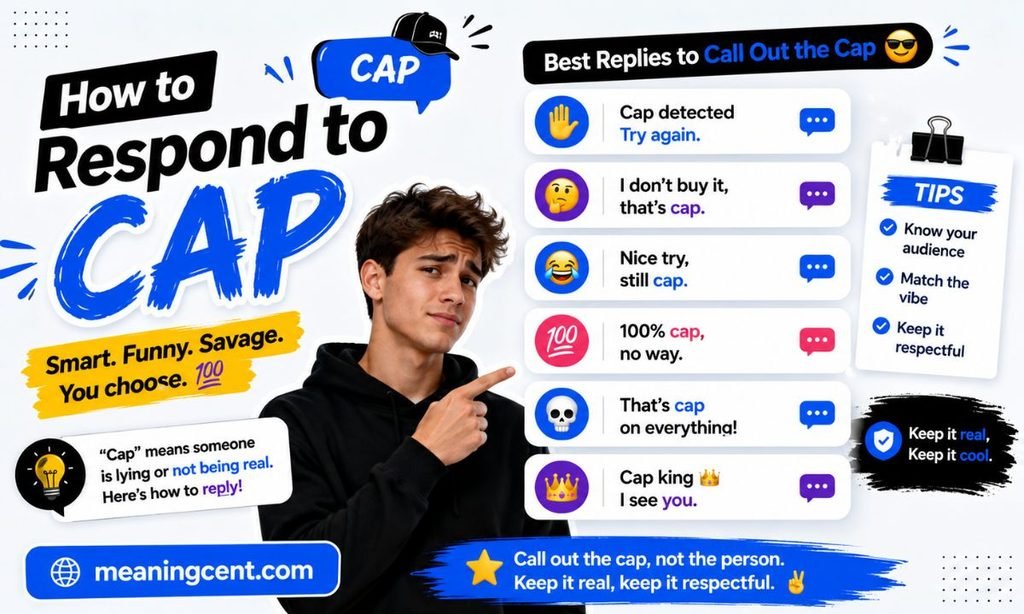
If someone calls out your statement as cap, the easiest way to respond is by confirming honesty or owning the exaggeration.
- “No cap, I’m serious.”
- “Okay fine, maybe that was a little cap.”
- “I’ve got proof, this isn’t cap.”
- “Fr, ask anyone who was there.”
These replies keep the tone light and match the casual nature of the slang.
Differences From Similar Words
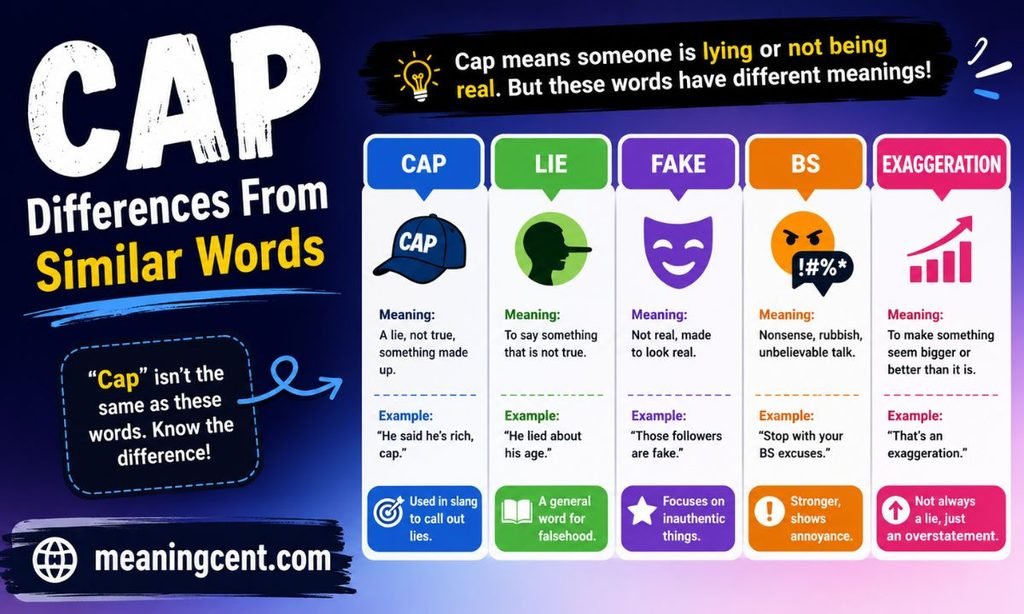
Cap and “lie” mean roughly the same thing, but cap sounds far more casual and is rarely used in formal writing.
- Cap vs Lie: lie is neutral and formal, cap is conversational slang
- Cap vs Fake: fake describes something not genuine, cap describes a false statement
- No cap vs Honestly: both signal sincerity, but no cap is trendier and tied to younger speech
Knowing these small differences helps you pick the right word depending on who you’re talking to.
Relevance in Online Conversations & Dating Apps
Cap and no cap show up constantly on dating apps, where tone and sincerity matter in short text exchanges.
Saying “no cap, you seem really genuine” adds warmth to a message without sounding overly formal. On the flip side, “that’s cap” is a lighthearted way to call out an obvious exaggeration in someone’s bio or opening line, without sounding harsh.
Popularity & Trends Over Time
Cap moved from a niche AAVE term into mainstream global slang over roughly a decade.
| Period | Status |
| 2015–2017 | Mostly limited to hip-hop and AAVE communities |
| 2018–2019 | Spread through Twitter and early meme culture |
| 2020 | Went viral through TikTok trends |
| 2021–2026 | Fully mainstream, used across age groups and platforms |
It remains one of the more stable slang terms, unlike many trends that fade within a year or two.
Final Thoughts
Cap meaning boils down to one simple idea: cap is a lie, no cap is the truth. Once that clicks, the rest of the slang around it — capping, capper, and platform-specific uses — becomes easy to follow.
The word has moved far from its AAVE roots into everyday global texting, and it doesn’t look like it’s fading anytime soon. Recognizing the context, whether it’s a casual chat or a business memo, is really all you need to use it correctly.
Frequently Asked Questions
What does cap mean in slang?
Cap means a lie or an exaggerated claim, most often used to call out something that isn’t true.
What does no cap mean?
No cap means “no lie” or “I’m being serious,” used to stress that a statement is genuine.
Is cap a rude word?
No, cap meaning is informal slang, not offensive, though it can come across as a light accusation of lying.
Where is cap most commonly used?
Cap shows up mostly in texting, social media comments, and casual conversations among younger users.
Can I use cap in professional writing?
No, cap should stay in casual conversation — professional writing should use “limit” or “false claim” instead, depending on context.
What does “stop capping” mean?
It means “stop lying” or “stop exaggerating,” usually said to call out an obvious lie mid-conversation.
Does cap always mean lying?
Not always — outside slang, cap can mean a hat, a limit, or a protective cover, so context decides the meaning.

1 thought on “Cap Meaning: Full Slang Guide, Uses & Examples (2026)”