

Most people search for awe meaning right after seeing the word in a text and pausing for a second. It’s a small word, but it carries a lot of emotional weight depending on where you see it.
This guide breaks down the real awe meaning, its origin, how to pronounce it, and how it shows up differently in texting, psychology, love, and everyday language. By the end, you’ll know exactly what someone means when they use it.
What Does Awe Mean?
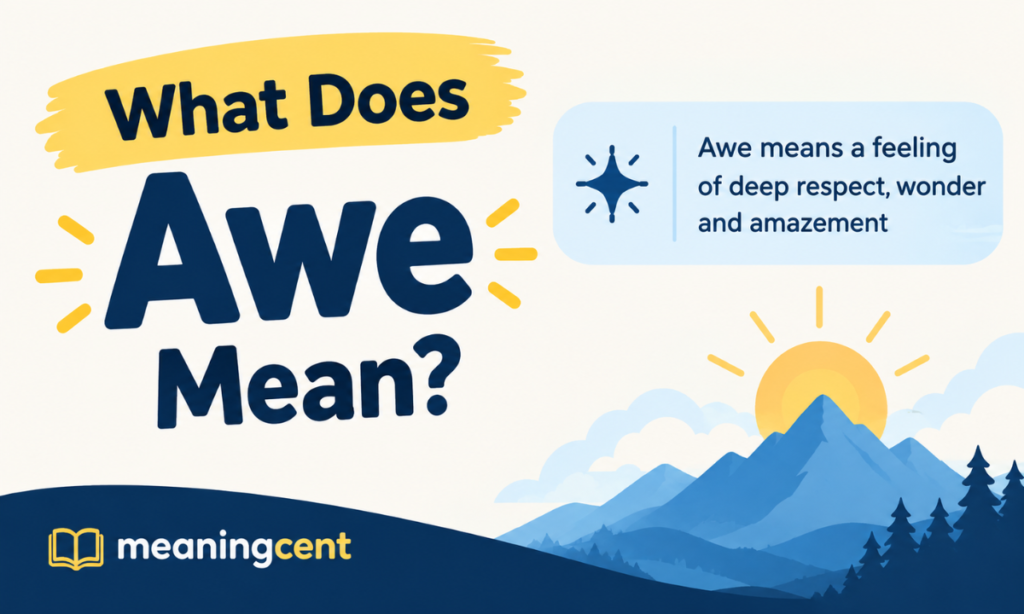
Awe is a feeling of deep wonder, admiration, or respect, usually triggered by something that feels bigger than you. In texting, the awe meaning often softens into simple warmth or affection instead.
That gap between the dictionary meaning and the texting meaning is exactly why so many people search for awe meaning in the first place.
Awe Pronunciation
Awe is pronounced “aw” (it rhymes with “law” or “saw”), with one open vowel sound. It’s a single syllable, not two, which trips up people who see it written near “aww.”
Example: Say it out loud the same way you’d say “raw,” just drop the “r” sound. That’s “aw.”
Primary Meaning
The primary meaning of awe is a strong emotional reaction to something vast, impressive, or moving. Dictionaries define it as a mix of wonder and, at times, a touch of fear or reverence.
Example: “Standing at the edge of the Grand Canyon, she felt pure awe.”
Secondary Meanings
Beyond the core definition, awe can shift to mean admiration, gratitude, sympathy, or emotional appreciation, especially in casual writing. The tone bends toward whatever the conversation calls for.
Example: “Awe, you stayed up just to help me finish this? That’s really kind.”
Quick Examples
Seeing the word in short, everyday lines makes the shift in meaning easier to spot. Formal use leans toward wonder, while casual use leans toward warmth.
Example: “He looked at the mountains in awe” (formal) versus “Awe, that’s so sweet” (casual).
Background and Origin of the Word “Awe”
The word awe comes from the Old Norse term “agi,” which meant terror or dread, and it entered Middle English carrying that same heavy sense of fear. Over the centuries, that meaning softened a lot.
By the time it reached modern English, awe had shifted from pure dread toward a blend of wonder and respect. Both “awesome” and “awful” split off from the same root, yet the two words ended up meaning very different things.
Texting culture pushed the awe meaning even further from its roots. Instead of describing something overwhelming, “awe” started standing in for small, everyday moments of warmth, especially once autocorrect began swapping “aww” for the officially recognized spelling.
Example: A word that once described fear of thunderstorms and ancient gods now shows up under a puppy photo on Instagram.
How Awe Is Used in Different Contexts
The awe meaning shifts depending on who’s saying it and why. Friends, partners, family members, and strangers online all use the word slightly differently.
In Personal Chats
Between friends, awe usually reacts to good news, a kind gesture, or something unexpectedly thoughtful. It works as a short, low-effort way to show you noticed.
Example: Friend: “I got the job!” You: “Awe, I’m so proud of you!”
Also Read This TBC Meaning in Text: Full Form, Uses & Examples Explained
Awe Meaning in Love (Romantic Conversations)
In romantic texting, awe meaning in love usually points to tenderness rather than passion. It’s the “my heart just melted a little” reaction, not a flirty one, and partners use it after a sweet message, a small gift, or a thoughtful memory.
Example: She says, “I kept the movie ticket from our first date.” He replies, “Awe, that’s the sweetest thing.”
Family Conversations
Parents, grandparents, and relatives lean on awe when reacting to milestones, photos, or anything that tugs at the heart. It’s one of the most common replies inside family group chats.
Example: Mom texts, “She took her first steps today!” Dad replies, “Awe, she’s growing up so fast.”
Social Media Comments
Under posts featuring babies, pets, engagements, or acts of kindness, “awe” shows up constantly as a quick, genuine reaction. It takes almost no effort but still communicates real warmth.
Example: A comment simply reading “Awe, this is beautiful” under a graduation photo.
Customer Service
Some brands use a friendly “awe” or “aww” in replies to make interactions feel more human and less scripted. It’s rare in formal business writing but common in casual, brand-voice replies.
Example: “Awe, thank you for the kind review. It made our whole team smile.”
Awe Meaning Across Different Platforms
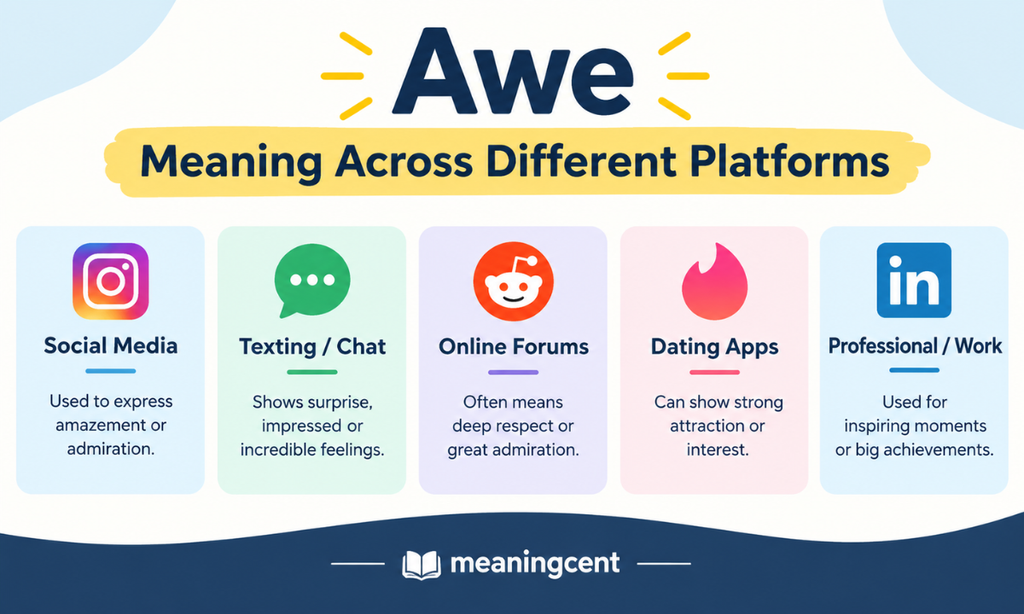
The awe meaning stays fairly consistent across apps, but the way people type it and pair it with emojis changes from platform to platform.
On WhatsApp, awe tends to appear in close, personal conversations rather than public ones. It’s often paired with a heart emoji to soften the tone further.
Example: “Awe, I miss you too.”
Instagram comments use awe heavily under lifestyle, pet, and relationship content, often stacked with exclamation points for emphasis. It functions almost like a compliment shortcut.
Example: “Awe! This is the cutest thing I’ve seen today.”
TikTok
TikTok viewers type “awe” as an instant emotional reaction while watching wholesome or emotional clips. It shows up fast, right in the comment section, mid-scroll.
Example: “Awe, I wasn’t ready for that ending.”
Snapchat
Snapchat conversations use awe casually and briefly, matching the app’s quick back-and-forth style. It’s rarely a full sentence on its own.
Example: “Awe, thanks for thinking of me.”
Also Read This TBC Meaning in Text: Full Form, Uses & Examples Explained
Other Meanings of Awe in Different Fields
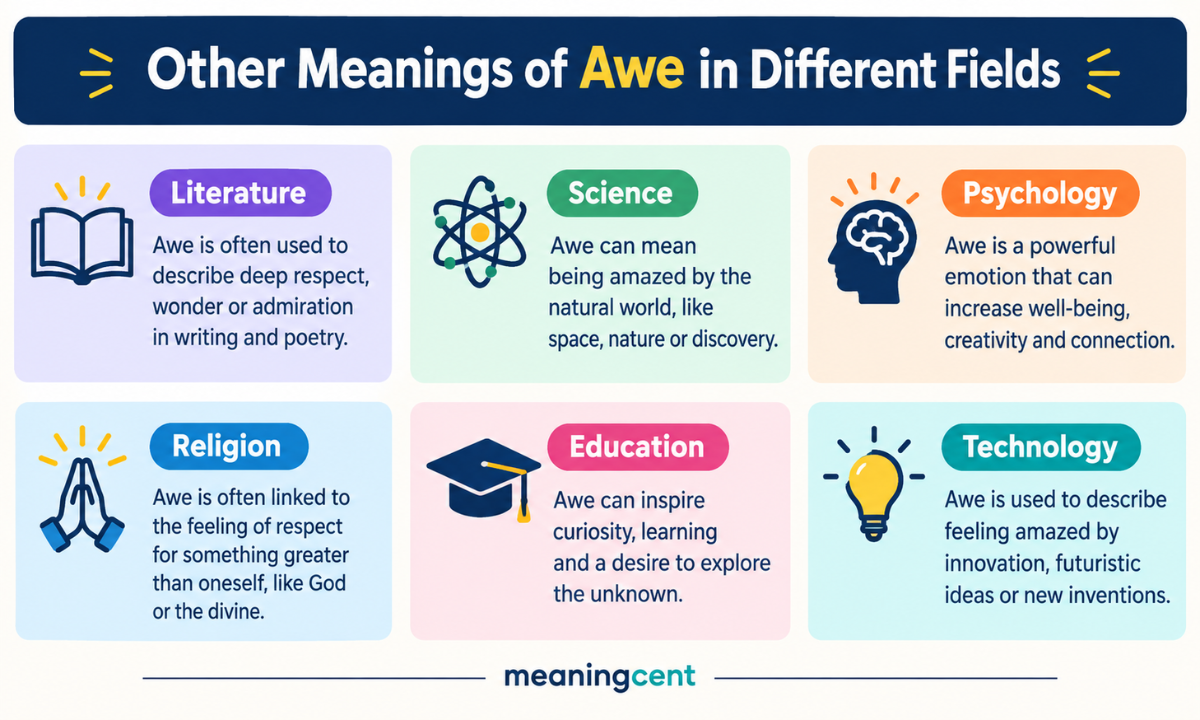
Outside of texting, the awe meaning stays closer to its original, more serious definition.
Psychology
Psychologists classify awe as a self-transcendent emotion, meaning it shifts your focus away from yourself and toward something larger. Researchers Dacher Keltner and Jonathan Haidt were among the first to study it seriously, describing awe as an emotional response to vastness paired with a need to make sense of it.
Studies have linked frequent awe experiences to a “small self” effect, where people feel less self-focused and more connected to others, often becoming more generous and more prosocial as a result.
Example: Watching a total solar eclipse and suddenly feeling how small you are compared to everything else.
Education
Teachers sometimes try to spark awe on purpose, using science experiments, historical stories, or nature walks to boost curiosity. The emotion tends to make new information stick better.
Example: A classroom falling silent the first time they see Saturn’s rings through a telescope.
Religion
In religious and spiritual writing, awe often carries its reverential meaning, a deep respect mixed with humility toward something sacred or greater than oneself. This sits closer to the word’s original Old Norse sense than any texting use.
Example: “The congregation sat in awe during the sermon on creation.”
Literature
Writers use awe to describe characters confronting beauty, power, or danger beyond their control. It’s a common emotional beat in adventure and nature writing especially.
Example: A character described as “frozen in awe” at the sight of a dragon.
Everyday Life
Outside screens, people report feeling awe at concerts, landmarks, or unexpected acts of kindness from strangers. These moments tend to focus on wonder rather than cuteness.
Example: Standing beneath a massive waterfall and forgetting, for a second, what you were about to say.
Common Misconceptions and Mistakes
A few mix-ups around this word come up again and again.
Confusing “Awe” with “Aww”
This is the single biggest mistake people make. “Awe” technically means wonder or admiration, while “aww” is an informal reaction to something cute, and autocorrect blurs the line further by swapping one for the other.
Example: Typing “awe” under a kitten video when “aww” was actually intended.
Awe vs Owe: Not the Same Word
Despite looking similar, owe meaning has nothing to do with emotion. “Owe” means you’re obligated to pay or return something, and the two words only share a resemblance in spelling, not in sound or meaning.
Example: “I owe you $20” (debt) is completely different from “I’m in awe of you” (emotion).
Thinking It’s an Abbreviation
Unlike “LOL” or “BRB,” awe is not an acronym. It’s a standard English word that predates texting by centuries, though capitalized “AWE” in technical documents is an exception, often standing in for an organization-specific term.
Example: A physics report using “AWE” as a project code, not the emotion.
Assuming It’s Romantic
Seeing “awe” in a message doesn’t automatically signal romantic interest. Friends, coworkers, and family members use it just as often as partners do.
Example: A coworker replying “Awe, that’s so thoughtful” after you bring in coffee for the team.
Similar Terms and Alternatives
| Word | Meaning | Common Use |
| Awe | Wonder mixed with respect | Emotional, formal reactions |
| Aww | Reaction to something cute | Pets, babies, sweet gestures |
| Wow | Sudden surprise | Exciting news |
| Amazing | Strong praise | Achievements |
| Precious | Deep affection | Emotional moments |
| Touching | Emotionally moving | Heartfelt stories |
How to Respond to “Awe”
The right reply depends on why someone sent it. A simple “thank you” almost always works, but matching their tone works even better.
Chat Examples
Example 1 Them: “Awe, you remembered!” You: “Of course I did.”
Example 2 Them: “Awe, that means so much.” You: “You’re too sweet.”
Example 3 Them: “Awe, that’s adorable.” You: “Glad you liked it!”
Awe vs Similar Words
| Word | Main Emotion | Typical Trigger |
| Awe | Wonder, reverence | Vast or powerful things |
| Aww | Cuteness, affection | Pets, babies |
| Wow | Surprise | Unexpected news |
| Incredible | Strong admiration | Extraordinary events |
| Beautiful | Aesthetic appreciation | Scenery, art |
Why Awe Matters in Online Conversations and Dating Apps
Texting strips away tone of voice and facial expressions, so a single word like “awe” carries extra weight in showing warmth. On dating apps, the awe meaning usually signals appreciation, not flirtation.
Example: Someone shares a story about volunteering, and their match replies, “Awe, that says a lot about who you are.”
Popularity and Trends Over Time
Search interest in this word has climbed steadily as texting and short-form video comments replaced longer replies. People increasingly look up unfamiliar-feeling words the moment they see them in a chat.
Across platforms, “awe” now sits alongside “aww” and “wow” as one of the go-to one-word emotional reactions. It’s short, easy to type, and instantly understood by the person reading it.
Frequently Asked Questions
What does awe mean in a text message?
It usually expresses warmth, admiration, or an emotional reaction to something sweet or touching. The exact tone depends on the surrounding conversation.
How do you pronounce awe?
Awe is pronounced like “aw,” rhyming with “law.” It’s one syllable, despite looking like it might have two.
Is awe the same as aww?
Not technically. Awe traditionally means wonder or respect, while aww reacts to something cute, though texting often treats them as interchangeable.
What’s the difference between awe and owe?
They sound similar but mean completely different things. Awe is an emotion, while owe means being obligated to pay or return something.
Does awe meaning in love always mean romantic interest?
No. In romantic texting it usually shows tenderness or appreciation, but the same word gets used by friends and family just as often.
Is awe a compliment?
Yes, in almost every casual context it’s a positive response showing admiration, kindness, or appreciation.
Is awe an abbreviation?
No. It’s a genuine English word with centuries of history behind it, not an acronym like LOL or BRB.
Conclusion
At its core, the awe meaning covers everything from deep, reverential wonder to a quick, affectionate reply in a text thread. The word has traveled a long way from its Old Norse roots in fear and dread to its modern role as a warm, low-effort way to show you care.
Whether you spot it on WhatsApp, under an Instagram post, or in a psychology journal, context is what tells you which version of the meaning is in play. Once you know the difference, you’ll never second-guess a text that simply says “awe” again.

1 thought on “Awe Meaning: Definition, Origin, Pronunciation & Use in Text (2026)”