

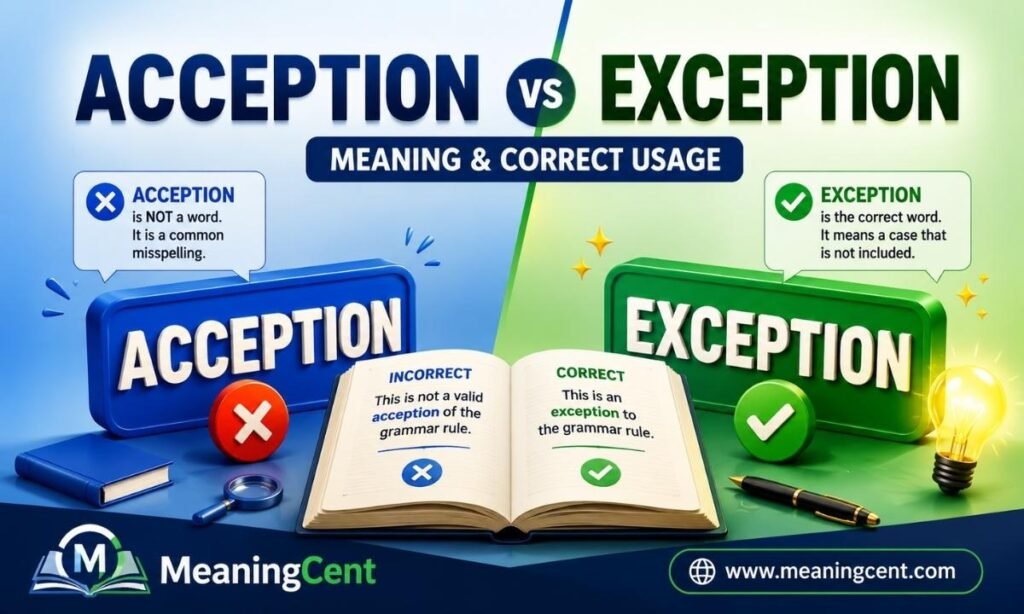
Stuck between acception vs exception and not sure which one belongs in your sentence? You’re dealing with two words that look almost identical on the page but serve completely different jobs. One shows up constantly in everyday writing, while the other barely registers outside a linguistics textbook.
The short answer: exception is what you need almost every time you’re writing about rules, exclusions, or something unusual. This guide walks through both meanings, real examples, and the mix-ups that trip people up most often.
Quick Answer:
Exception is a common noun describing something left out of a general rule. Acception is a rare, formal word tied to the specific sense or meaning of a term.
If you’re drafting an email, a policy, or an essay, exception is almost certainly the word your sentence is asking for.
What Does “Exception” Mean?
Exception points to whatever doesn’t fit the usual pattern — a person, item, or situation that stands apart from a stated rule.
Simple Definition:
An exception is something excluded from a rule that otherwise applies broadly.
Examples of “Exception”
- Every employee clocks in by 9 a.m., with one exception.
- She avoids caffeine, except during exam week.
- The refund policy has no exceptions this quarter.
Each sentence highlights something set apart from what’s normally expected.
Common Phrases With “Exception”
- Make an exception
- With the exception of
- No exceptions
- An exception to the rule
You’ll spot these phrases constantly in contracts, emails, and casual conversation alike.
What Does “Acception” Mean?
Acception is a genuine English word, though it rarely shows up outside academic or linguistic writing.
Definition of “Acception”
- An older sense meaning the act of accepting something
- A specific meaning a word carries in a given context
Example of “Acception” (Linguistic Use)
- In one acception of the term “bright,” it refers to intelligence rather than light.
You’ll mostly encounter this usage in dictionaries, philosophy texts, or theological writing.
Important Note
A lot of writers assume acception is just a spelling variant of acceptance. That assumption is wrong, and it’s worth clearing up early.
Acceptance means agreeing to or receiving something. Acception refers to a word’s particular sense, or an older way of describing the act of accepting. If you mean the former, write acceptance — not acception.
Acception vs Exception: Side-by-Side Comparison
| Feature | Acception | Exception |
| Everyday use | Extremely rare | Very common |
| Core meaning | A word’s specific sense, or archaic “acceptance” | Something excluded from a rule |
| Typical context | Linguistics, theology, philosophy | Business, legal, casual writing |
| Risk if misused | Confused with acceptance or exception | Rarely misunderstood |
| Sample phrase | “In this acception of the word” | “With the exception of Mondays” |
If you’re ever unsure which one fits, exception is the safer bet in nearly every situation.
Why People Confuse Acception and Exception
The mix-up isn’t random — a few specific patterns explain why these words get tangled together so often.
1. Similar Spelling
Both words end in “-ception,” and that shared ending makes the brain assume they’re close relatives.
2. Sound Similarity
Spoken quickly, acception and exception blur together into what almost functions as a homophone pair, especially for non-native speakers relying on pronunciation over spelling.
3. Confusion With “Acceptance”
Plenty of writers actually mean acceptance but type acception instead, since the two look like they could be interchangeable spellings.
Where Does the Confusion Come From? (Latin Root)
Both words trace back to the Latin verb “capere,” meaning “to take” or “to seize.” That shared ancestry is the real reason they feel connected.
Exception comes from “excipere” (to take out), while acception traces to “accipere” (to receive or take toward oneself). The roots explain the family resemblance without making the modern words interchangeable.
Read Also This Of vs Off: What’s the Difference? With Examples
Common Mistakes (And How to Fix Them)
Incorrect:
Everyone followed the dress code, no acception.
Correct:
Everyone followed the dress code, no exception.
Incorrect:
There was one acception made for the new hire.
Correct:
There was one exception made for the new hire.
Incorrect:
He gave his acception of the terms.
Correct:
He gave his acceptance of the terms.
These mix-ups usually happen fast, during typing, so a quick reread catches most of them before publishing.
American vs British English Differences

There’s no spelling split between American and British English for either word. Exception, acceptance, and acception all stay identical on both sides of the Atlantic.
Both varieties treat acception the same way — as a rare, specialized term rather than a regional preference. So this one’s purely a clarity issue, not a geography issue.
When Should You Actually Use “Acception”?
Honestly, almost never in day-to-day writing. It surfaces mainly in a handful of specialized fields.
- Linguistics papers discussing word senses
- Theological or biblical commentary
- Historical or archaic English texts
- Formal dictionary entries explaining a term’s usage
Outside those spaces, reaching for exception (or acceptance, depending on your meaning) keeps your writing clear.
Real-World Usage Scenarios

Seeing these words applied to actual writing situations makes the distinction stick faster than definitions alone.
In Business Writing
Correct: “This policy applies to every client, without exception.” Wrong: “We don’t grant acception to this rule.”
Swapping in acception here would make a business document look like it contains a typo.
In Academic Writing
Correct: “There are few exceptions to this economic theory.” Also correct (rare use): “In one acception of the term, it implies formal agreement.”
Notice how acception only earns its place when the sentence is specifically about a word’s meaning.
In Legal or Customer-Service Writing
Correct: “Refunds are granted only in exceptional circumstances.” Wrong: “Our team does not make acceptions to the return window.”
Legal and support documents lean on precision, so exception is the word that keeps the tone professional and error-free.
Synonyms and Related Words
Synonyms for Exception
- Exclusion
- Anomaly
- Irregularity
- Deviation
- Special case
Related Words
- Except
- Exceptional
- Accept
- Acceptance
- Acceptable
Rotating in these related terms keeps longer pieces of writing from repeating the same word over and over.
Quick Memory Trick
Exception starts with “ex-,” the same prefix you see in “exit.” Something excluded from a rule has effectively exited the pattern.
Acception, on the other hand, hides the word “accept” right inside it. If your sentence is really about agreeing to something, that’s your cue to write acceptance instead.
acception meaning
Acception means either the act of accepting something, in an older sense, or the specific meaning a word takes on in a given context.
It’s a real dictionary entry, just one that’s fallen out of daily use in favor of clearer alternatives like acceptance and meaning.
acception in a sentence
Here’s a natural example: “Scholars debated which acception of the word ‘grace’ applied best to the passage.”
Outside of specialized writing like this, you’d rarely need to build a sentence around acception at all.
acception in english
Within English, acception functions as a noun tied closely to interpretation and word sense. It never developed into a common, everyday term the way exception did.
Most English speakers go their entire lives without needing to use it in conversation or writing.
is acception a word
Yes, acception is a real word listed in unabridged dictionaries, including Merriam-Webster and the Oxford English Dictionary, though many standard dictionaries skip it or mark it as rare.
Its rarity is exactly why spellcheckers and casual readers often assume it’s a typo for exception or acceptance.
acception or acceptance
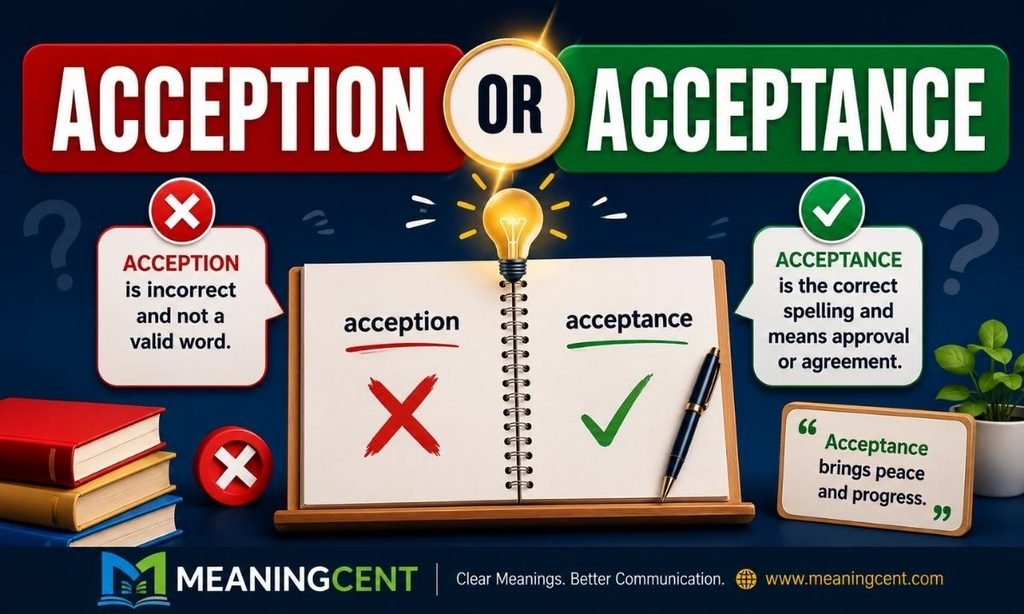
If you mean “agreeing to” or “receiving” something, acceptance is the word you want, not acception.
Acception refers narrowly to a word’s sense or an archaic form of accepting, so it almost never substitutes for acceptance in modern writing.
no exceptions or acceptions
The correct phrase is always “no exceptions.” Acceptions isn’t a standard plural form you’ll find used this way in modern English.
Writers reaching for “no acceptions” almost always mean the exclusion sense, which points straight back to exception.
can you make an acception
No — the standard phrase is “make an exception.” Acception doesn’t function this way grammatically in everyday English.
If you’re describing a rule being waived for someone, exception is the word that fits the sentence correctly.
Read Also This Of vs Off: What’s the Difference? With Examples
acception in spanish
Spanish has a related word, “acepción,” which commonly means “the meaning or sense of a term” — and it’s used far more often in Spanish than acception is in English.
This cross-language link likely adds to the confusion, since English speakers exposed to Spanish sometimes assume “acception” should be just as common here.
Frequently Asked Questions
Is acception a real word?
Yes, but it’s rare enough that most everyday writing never calls for it, appearing mainly in linguistic or academic contexts.
What’s the difference between acception and acceptance?
Acceptance means agreeing to or receiving something, while acception refers to a specific meaning of a word or an older sense of accepting.
Can acception replace exception in a sentence?
No. They carry entirely different meanings, and exception is the word needed whenever you’re describing something excluded from a rule.
Why does spellcheck flag acception?
Because it’s uncommon enough that most tools assume you meant either exception or acceptance instead.
Is exception spelled the same in American and British English?
Yes, exception keeps the identical spelling and meaning in both varieties, with no regional variation to worry about.
Is acception considered outdated?
In modern everyday writing, yes — it now reads as archaic or highly specialized rather than standard vocabulary.
Which word should I use for SEO or blog writing?
Stick with exception unless your content is specifically discussing word meanings or linguistic interpretation.
So between acception vs exception, which is correct?
Exception is correct for nearly all modern writing. Acception only fits when you’re specifically discussing a word’s sense or meaning.
Final Thoughts
When you weigh acception vs exception side by side, the choice almost always favors exception — it’s common, clear, and understood everywhere in daily writing. Acception stays reserved for rare, specialized writing about a word’s particular sense.
Keep the “ex- means exit the rule” trick handy, and you’ll rarely second-guess this pair again. Choosing the right word here signals careful, professional writing more than most people realize.

1 thought on “Acception vs Exception: Meaning & Correct Usage”