

TBC meaning in text comes down to one simple idea: something is planned, but one detail still needs a final yes. It shows up in chats, emails, work schedules, and social posts almost every day.
In short, TBC stands for “To Be Confirmed.” This guide breaks down TBC meaning across every context you’ll actually see it in, so you never have to guess again.
What Does TBC Mean in Text?
TBC means “To Be Confirmed” in nearly every texting situation. Understanding TBC meaning starts with treating it as a placeholder, not a final answer.
Think of it as a sticky note. Someone knows an event is happening, but one piece, the venue, the time, the guest list, still needs a final confirmation.
Example Messages
Here’s how TBC actually looks in real conversations. Example: “We’re meeting Friday, time TBC.” Example: “Venue is TBC, I’ll update the group tomorrow.” Example: “Your interview slot is TBC until HR confirms.”
Notice the pattern. TBC always attaches to the one detail that’s still up in the air, not the whole plan.
Quick Meanings
TBC meaning has two possible readings, and context decides which one applies.
- TBC = To Be Confirmed, the far more common meaning, used for pending details.
- TBC = To Be Continued, used mostly for stories, shows, or posts that will pick up later.
If someone’s talking about a schedule or plan, assume “To Be Confirmed.” If they’re talking about a story or video series, “To Be Continued” fits better.
Background and Origin of TBC
TBC didn’t start on phones. It started on paper, in newspapers, event flyers, and printed schedules, decades before texting existed.
Organizers needed a quick way to say “this part isn’t locked in yet” without leaving a blank space. TBC filled that gap cleanly as a shorthand term.
Once texting and email took over daily communication, the same shorthand carried across naturally. People were already used to seeing it on posters and timetables, so it felt familiar in a chat window too.
Today, TBC meaning stays consistent whether you’re reading a printed program or a group chat, which is rare for an abbreviation this old.
How TBC Is Used in Different Contexts
TBC meaning doesn’t change much across settings, but the tone around it shifts depending on where you see it.
In Text Messages
Friends use TBC when they’re still finalizing casual plans. Example: “Movie night is on, time TBC, I’ll text you later.” It keeps the conversation moving without locking anyone into a wrong detail.
On Social Media
Brands and creators lean on TBC to build excitement. Example: “New merch drop coming, date TBC, stay tuned!” It works almost like a teaser for what’s next.
At Work
Professional messages use TBC to avoid promising something that might shift. Example: “Client call is scheduled, room TBC, will confirm by noon.” It protects the sender from sharing a detail that could still change.
During Events
Event planners rely on TBC constantly, since speakers, venues, and timings often shift right up until launch. Example: “Keynote speaker: TBC. Announcement expected next week.” It sets expectations honestly instead of guessing.
TBC Meaning Across Different Platforms
TBC meaning reads the same everywhere, but each app has its own flavor of using it.
Group chats use TBC heavily when coordinating plans among several people. Example: “Group dinner Saturday, restaurant TBC, vote in the poll.” It keeps everyone aligned while details get sorted.
Captions and stories use TBC to hint at something coming without giving it away. Example: “Collab announcement, date TBC.” It’s part marketing, part suspense.
TikTok
Creators drop TBC when teasing a follow-up video or series. Example: “Part 3 of this story, TBC.” Viewers know more content is on the way, just not exactly when.
Snapchat
Friends use TBC casually, often with a joke attached. Example: “Beach trip still TBC, weather’s being weird.” The tone here is lighter than on work platforms.
Also Read This DGAF Meaning: Full Form, Uses & Examples Explained
Other Meanings of TBC in Different Fields
TBC meaning shifts slightly by industry, but the core idea, something pending, stays the same.
Medical
Doctors mark test results or diagnoses as TBC when more data is needed before anything is final. Example: “Biopsy result: TBC, pending lab review.” It signals caution rather than doubt about the process itself.
Business
Companies use TBC for budgets, contracts, and appointments that haven’t cleared final approval. Example: “Q3 marketing budget: TBC, awaiting board approval.” It’s a professional way of saying “not yet, but soon.”
Aviation
Airlines and airports use TBC for gate numbers, boarding times, or schedule changes still in motion. Example: “Departure gate: TBC, check screens 30 minutes prior.” Passengers see this constantly on live boards.
Education
Schools and universities use TBC for exam dates, room assignments, or event details still being finalized. Example: “Final exam: TBC, updated timetable coming Monday.” Students learn to check back rather than assume a fixed date.
Technical Documents
Engineers and product teams mark unfinished specifications as TBC while requirements are still being worked out. Example: “Voltage rating: TBC, pending supplier confirmation.” It keeps documentation honest about what’s locked and what isn’t.
Construction / Building Industry
In construction, TBC often applies to material choices, contractor selection, or completion dates that depend on approvals or inspections. Example: “Flooring material: TBC, pending client site visit.” Project timelines frequently carry several TBC items until permits and approvals come through.
Common Misconceptions About TBC
Most confusion around TBC meaning comes from people assuming one fixed reading regardless of context.
- Assuming TBC always means “To Be Continued,” when “To Be Confirmed” is far more common.
- Thinking TBC only belongs in texting, when it’s just as common in official documents.
- Reading it as something negative, when it’s simply neutral and informational.
- Mixing it up with TBD or TBA, which carry slightly different shades of meaning.
Context almost always settles the confusion. A message about a meeting time is never talking about “To Be Continued.”
Similar Terms and Alternatives
Several abbreviations share space with TBC, and mixing them up is easy if you don’t know the small differences.
| Abbreviation | Meaning | When It’s Used |
| TBC | To Be Confirmed | Waiting on final confirmation of an existing plan |
| TBD | To Be Decided | No decision has been made yet |
| TBA | To Be Announced | Details are known internally, just not shared yet |
| TBR | To Be Resolved | An issue or detail still needs sorting out |
| FYI | For Your Information | Sharing something useful, no action needed |
| ASAP | As Soon As Possible | Requesting quick action |
Knowing these small differences makes your own messages sound sharper and clearer.
TBC vs Similar Abbreviations
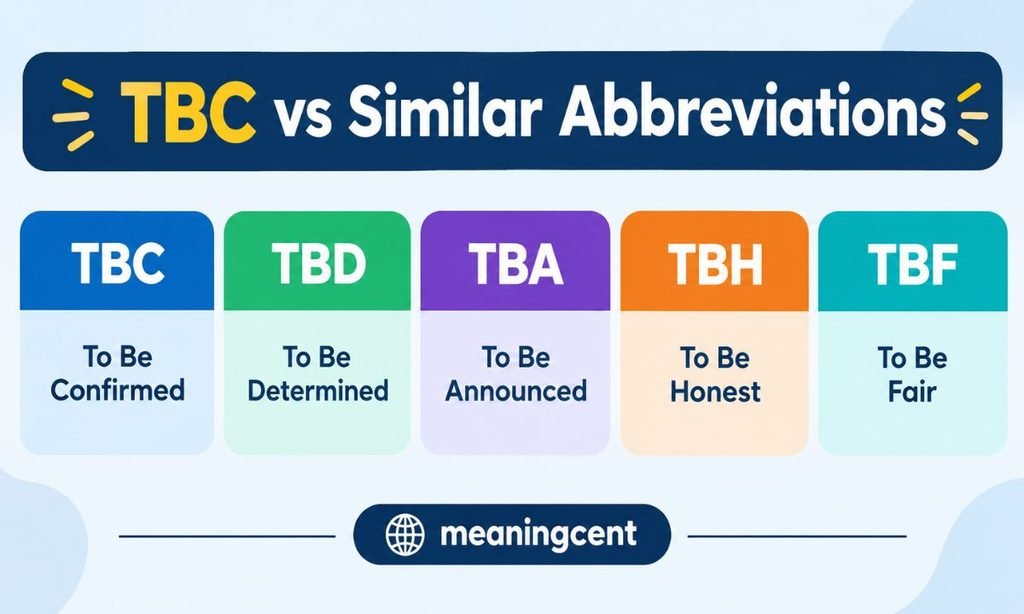
The real difference between TBC, TBD, and TBA comes down to how much is already decided.
TBC means a plan exists and just needs a final yes. Example: “Venue: TBC” usually means a venue is already picked, just not signed off.
TBD means no decision has been made at all yet. Example: “Winner: TBD” means nobody has been chosen yet.
TBA means the answer is already known but hasn’t been shared publicly. Example: “Guest speaker: TBA” means organizers already know who it is.
Swapping these terms isn’t wrong grammatically, but it does send a slightly different signal about how far along a plan actually is.
Also Read This DGAF Meaning: Full Form, Uses & Examples Explained
How to Respond to TBC
The right reply to TBC depends on how much the pending detail affects your own plans.
If a detail matters to you, ask for a rough timeline. If it doesn’t, a simple acknowledgment works fine.
Chat Examples
Friend: “Party location is TBC.” You: “No worries, let me know once it’s set!”
Coworker: “Meeting time is TBC.” You: “Got it, I’ll keep that slot open for now.”
Organizer: “Speaker lineup is TBC.” You: “Excited to see who’s confirmed, keep us posted.”
TBC in Online Conversations and Dating Apps
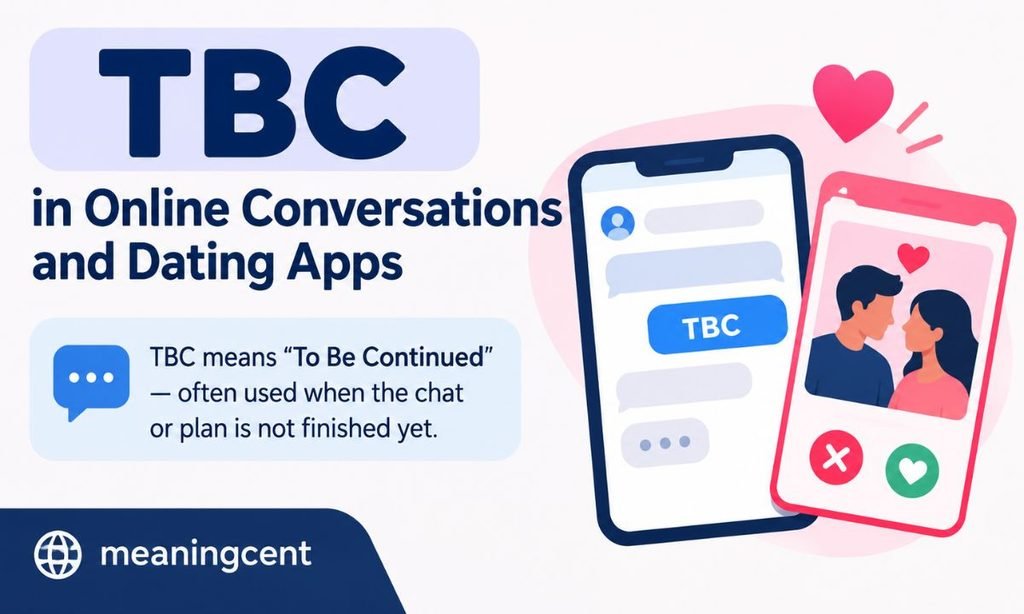
TBC shows up often in dating apps and casual online chats because plans there change constantly. Example: “Coffee this weekend, exact time TBC, I’ll text you Saturday morning.” It signals real interest without over-committing to a detail that might shift.
People tend to appreciate this phrasing because it’s honest instead of vague. Saying “TBC” reads better than going quiet or giving a fake confirmed time that later falls through.
Popularity and Trends Over Time
TBC has stayed relevant for decades because it solves a real communication problem that never goes away.
It started in print schedules, moved into emails, and now sits comfortably inside every major messaging app. Search interest in TBC meaning tends to spike around event seasons, conference planning, and travel booking periods.
Unlike slang that fades within a year or two, TBC keeps its place because the need for it, flagging pending details, never really disappears.
TBC Meaning in Urdu/Hindi (Quick Note)
TBC meaning stays the same in Urdu and Hindi conversations as it does in English. People often explain it as “confirm hona baaki hai,” which simply means confirmation is still pending.
Many South Asian users type TBC directly into Roman Urdu or Hindi-English messages rather than translating it, since the abbreviation is already widely understood in mixed-language chats.
Frequently Asked Questions
What does TBC mean in a text message?
TBC usually means “To Be Confirmed,” showing that a detail like a date or time isn’t final yet. It’s the most common reading in everyday texting.
Does TBC always mean “To Be Continued”?
No. That meaning applies mostly to stories, shows, or serialized posts. In scheduling contexts, TBC almost always means “To Be Confirmed.”
What’s the real difference between TBC and TBD?
TBC means a plan already exists and just needs a final confirmation. TBD means no decision has been made at all yet.
Is TBC okay to use in professional emails?
Yes. TBC is standard in business communication whenever a date, budget, or detail is genuinely still pending approval.
Why do event organizers use TBC so often?
Events involve many moving parts, like speakers, venues, and timings, that can shift right up until launch. TBC lets organizers share progress honestly without locking in the wrong details.
How should I reply when someone sends me TBC?
A short, easy reply works best, like “Sounds good, let me know once it’s confirmed.” Only push for a firm answer if the detail directly affects your own plans.
Is TBC meaning the same in Urdu or Hindi chats?
Yes. TBC is commonly borrowed as-is into Roman Urdu and Hindi-English messages, carrying the same “confirmation pending” meaning as in English.
Conclusion
TBC meaning in text almost always comes down to one simple idea: something is planned, but one detail is still waiting on final confirmation. Once you spot the pattern across chats, work emails, and social posts, it stops being confusing.
Whether it’s a friend firming up weekend plans or a company finalizing a budget, TBC is just a short, honest way of saying “almost there, not quite yet.”

1 thought on “TBC Meaning in Text: Full Form, Uses & Examples Explained”