

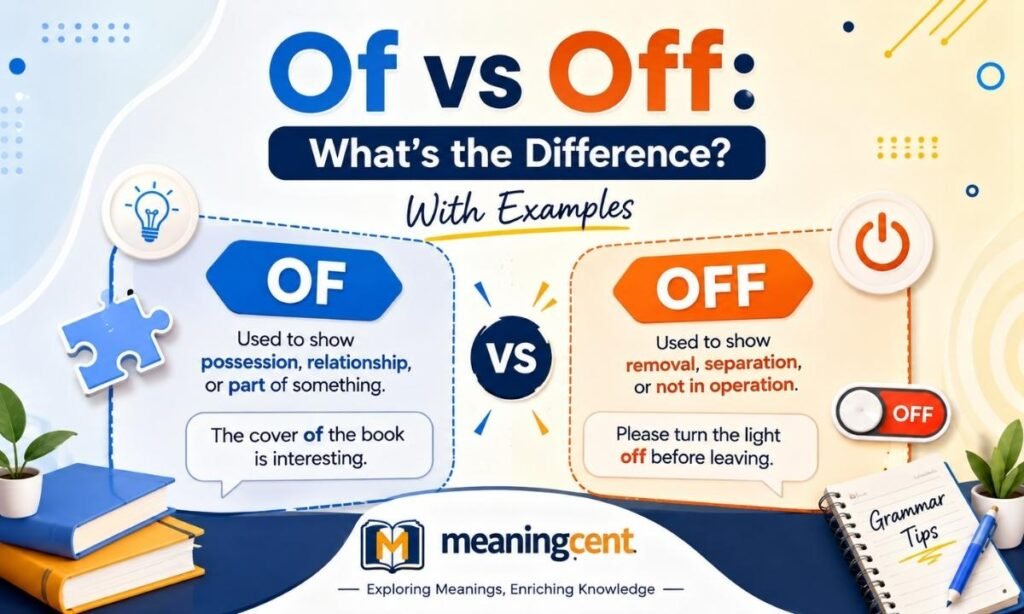
Mixing up of vs off is one of the most common slips in everyday English, and it happens to native speakers too, not just learners. The two words look almost identical on paper, yet they do completely different jobs in a sentence.
Once you see the pattern, though, you won’t second-guess yourself again. This guide breaks down of vs off with a comparison table, real examples, pronunciation tips, and a quick quiz so you can test what you’ve learned.
Quick Difference Between Of and Off
“Of” links two things together, while “off” pulls something away from a place, position, or state. That one-letter change flips the entire meaning of a sentence.
Say “a slice of bread,” and you’re describing a part of a whole. Say “the crust fell off the bread,” and now something has physically separated from it. The words sound close, but their jobs couldn’t be more different.
Here’s the pattern in short form:
- “Of” shows a relationship — ownership, quantity, or where something comes from.
- “Off” shows a break — movement away, removal, or something switching from active to inactive.
Keep that contrast in mind and most sentences sort themselves out on their own — the whole of vs off question really does come down to this one test.
Comparison Table: Of vs Off
A side-by-side view makes the of vs off grammar rules easier to absorb than reading paragraph after paragraph.
| Feature | Of | Off |
| Word type | Preposition | Preposition, adverb, or adjective |
| Core job | Connects or relates two things | Separates, removes, or deactivates |
| Typical use | Possession, quantity, origin | Movement away, switching off, disconnection |
| Sample sentence | a bar of soap | wipe the mud off your boots |
| Common slip-up | “climb of the roof” (wrong) | “the lights are of” (wrong) |
| Sound | Soft, almost “uv” | Sharper, ends with a hard “f” sound |
| Quick test | Can you swap it for “belonging to”? | Can you swap it for “away from”? |
Run any confusing sentence through that last row, and the correct word usually becomes obvious.
What Does “Of” Mean?
“Of” is a preposition that ties one thing to another — showing who owns what, what something is made from, or how much of it there is. It rarely stands on its own; it almost always links two nouns.
You’ll spot it constantly in ownership phrases:
- the edge of the table
- the name of the street
- a friend of mine
It also handles quantity and material:
- a slice of pizza
- a bag of rice
- a ring made of silver
Beyond that, “of” shows up in fixed expressions that don’t translate literally, like “because of,” “full of,” or “tired of.” These don’t follow a strict logic — they’re just patterns worth memorizing through repetition, and they’re a big part of why of vs off trips people up in casual speech.
What Does “Off” Mean?
“Off” signals that something has left a surface, stopped running, or moved away from where it used to be. Unlike “of,” it can stand alone as an adverb, not just as a connector.
You’ll see it wherever something physically detaches:
- the sticker peeled off the box
- she stepped off the curb
- the wheel came off
It also covers machines and states switching from active to inactive:
- shut off the engine
- the alarm went off
- her phone was off all day
And it’s baked into dozens of phrasal verbs — drop off, tell off, kick off — where the meaning shifts depending on the verb it’s paired with. Native speakers pick these up naturally, but they’re worth studying as fixed units rather than word-by-word, since this is where of vs off confusion shows up most in real conversation.
Why Do People Confuse Of and Off?
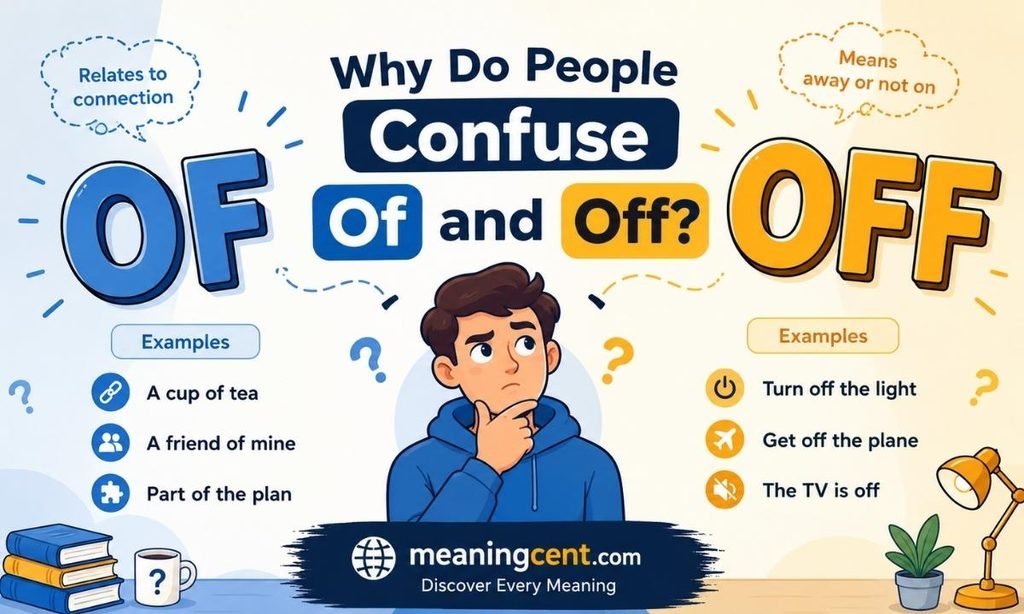
Rapid speech is the main culprit — “of” gets swallowed into a quick “uv” sound, which lands close enough to “off” that the ear can’t always tell them apart. That habit then leaks into writing.
Spelling doesn’t help either. Drop or add a single letter and one word becomes the other, so a rushed typist can slip without noticing:
- ❌ she got of the bus
- ✅ she got off the bus
Learners whose first language doesn’t have a similar preposition system feel this even more. Phrases like “kind of” or “off the record” don’t translate directly, so the words end up memorized as sounds rather than understood as functions — which is exactly where of vs off mix-ups start.
When to Use “Of”
Reach for “of” whenever the sentence is describing a relationship — ownership, quantity, material, or a part belonging to a bigger whole.
Ownership and origin:
- the roof of the house
- a native of Karachi
Quantity or amount:
- a cup of tea
- dozens of emails
Part of a larger group:
- one of the finalists
- most of the team
If you can rephrase the sentence with “belonging to” or “made from” and it still makes sense, “of” is almost certainly the right call in the of vs off debate.
When to Use “Off”
Reach for “off” whenever the sentence describes something leaving, stopping, or breaking contact with a surface or state.
Physical separation:
- the branch snapped off the tree
- he fell off his bike
Switching something down or out:
- power off the router
- the TV clicked off
Time away or cancellation:
- she took Friday off
- the trip is off
A quick trick: if “away from” or “not on” fits naturally in place of the word, you need “off,” not “of” — a handy shortcut whenever the of vs off choice feels unclear.
Common Mistakes with Of and Off
Most errors here come down to writing what you hear rather than what the sentence actually needs.
| Wrong | Right |
| take of your jacket | take off your jacket |
| she jumped of the roof | she jumped off the roof |
| a slice off bread | a slice of bread |
| switch the fan of | switch the fan off |
| he’s of the belief that… | he’s of the belief that… (correct — idiom keeps “of”) |
A fast way to catch these before hitting publish: read the sentence aloud slowly. If it describes connection, “of” belongs there. If it describes distance or stopping, “off” does — that’s the entire of vs off mistake pattern in one sentence.
Is “Off Of” Grammatically Correct?
Yes, “off of” is grammatically accepted in casual speech, but most style guides consider it redundant in formal writing. Trimming the “of” usually tightens the sentence without losing any meaning.
Casual: He climbed off of the roof. Cleaner: He climbed off the roof.
You’ll hear “off of” constantly in conversation, interviews, and song lyrics — it’s a natural feature of spoken American English. For essays, reports, or professional emails, though, dropping the extra word reads sharper and more polished.
Of vs Off in Pronunciation
“Of” is pronounced with a soft “v” sound — closer to “uhv” than to how it’s spelled. “Off,” on the other hand, ends with a firm, unmistakable “f.”
Say these out loud back to back:
- a cup of coffee → sounds like “cup-uhv coffee”
- turn off the lamp → the “off” stays crisp and clipped
That soft-versus-sharp contrast is actually the easiest way to tell them apart in fast conversation. If you’re ever unsure while speaking, slowing down and exaggerating the final sound will usually reveal which word you actually mean.
Read Also This ISK Meaning in Text
Memory Tricks to Remember Of vs Off
A handful of small mental hooks make this distinction stick far better than repeating grammar rules.
- Count the F’s. “Off” has two F’s because it pushes something twice as far away. “Of” has one, because it’s just holding two things together.
- Picture the action. “Of” links, like a chain connecting two links. “Off” launches, like something flying away from a surface.
- Say it in a sentence pair. “A piece of cake” (connection) versus “fell off the plate” (separation) — repeating pairs like this trains your ear faster than isolated definitions.
Reading example sentences aloud, rather than just memorizing rules silently, tends to cement the difference much faster.
Etymology: Where Do “Of” and “Off” Come From?
Both words actually trace back to the same Old English root, which is part of why they still look and sound so close today. According to Etymonline, “of” comes from Old English of, itself rooted in Proto-Germanic af, originally carrying the sense of “away.”
“Off” split off later, around the 13th century, as an emphatic variant of that same root, eventually hardening into its own distinct meaning of separation. Over centuries, English speakers pulled the two apart grammatically — “of” settled into showing connection, while “off” claimed the territory of distance and disconnection.
Knowing this shared history won’t change how you use either word today, but it explains exactly why they’ve confused writers for hundreds of years rather than being a modern texting-era mistake.
Synonyms of Off
When “off” feels repetitive in a sentence, a few substitutes can carry the same meaning depending on context.
- Away — she walked away from the counter
- Disconnected — the cable came disconnected
- Inactive — the account has gone inactive
- Cancelled — the event was cancelled last minute
- Detached — the handle is detached from the door
Note that “of” doesn’t really have direct synonyms in the same way, since it functions more like grammatical glue than a descriptive word — that’s actually another clue for telling the two apart.
Of vs Off vs For
“For” adds a third layer of confusion because it also connects nouns, but it points toward purpose or a recipient rather than possession or separation.
- a gift of love (what it consists of) vs. a gift for her (who receives it)
- a piece of advice (part of a whole) vs. advice for beginners (intended audience)
If the sentence is answering “who or what is this intended for,” you need “for.” If it’s answering “what does this belong to or contain,” you need “of.” “Off” doesn’t compete with either, since it’s the odd one out describing separation, not connection.
Real-Life Examples of Of and Off
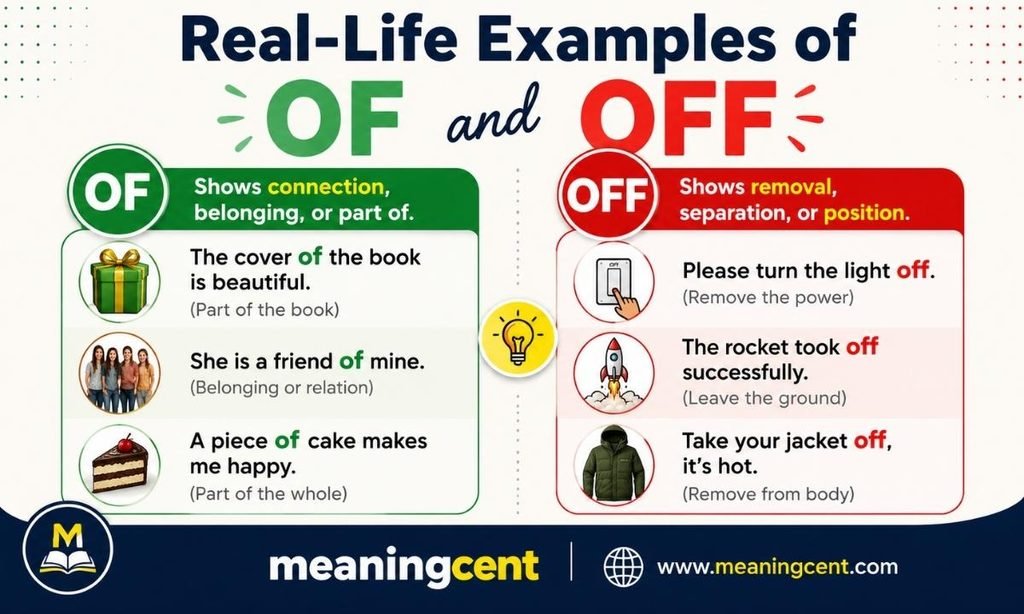
Seeing both words inside everyday situations makes the pattern click faster than any rule ever could.
Daily Conversation
- I hopped off the bus a stop early.
- She poured a glass of orange juice.
School and Academic Writing
- The thesis of the essay needed more support.
- Please switch off your phones during the exam.
Workplace Communication
- The director of operations sent the update.
- He requested Monday off for a family event.
Social Media and Casual English
- That playlist is kind of perfect for studying.
- Don’t forget to log off before you close the tab.
Notice how “of” keeps appearing wherever something connects to something else, while “off” shows up the moment an action or object pulls away.
Of and Off Worksheet: Practice Ideas
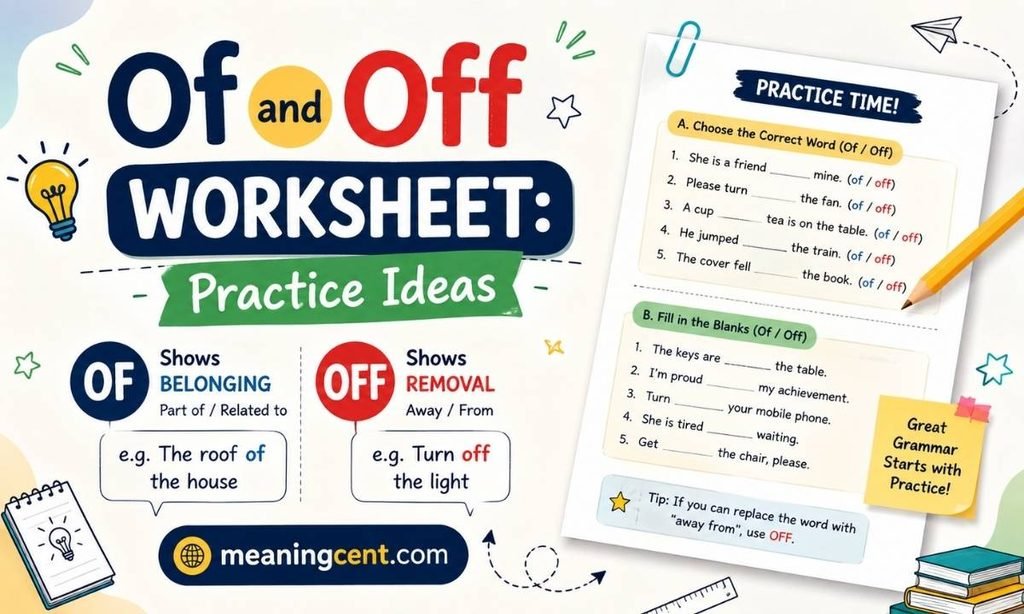
Building your own short drills is one of the fastest ways to lock this in, especially if you’re teaching the difference to students or ESL learners.
- Write 10 sentences using “of” for possession, then swap the noun each time (book of poems, box of tools, list of names).
- Write 10 sentences using “off” for separation or shutdown (turn off, fall off, take off).
- Create a fill-in-the-blank sheet mixing both words randomly, then check answers against the “belonging to” versus “away from” test.
- Read a short paragraph aloud and circle every instance of “of” or “off” to practice spotting them by ear.
These exercises work well as a five-minute daily warm-up rather than a one-time worksheet you complete and forget.
Read Also This ISK Meaning in Text
Mini Quiz: Can You Choose the Correct Word?
Try filling in each blank before checking the answers below.
Fill in the blanks
- She switched ___ the heater before leaving.
- He drank a bottle ___ water during the run.
- The kite drifted ___ course in the wind.
- This is one ___ the busiest weeks all year.
- Please take ___ your shoes at the door.
Answers
- off
- of
- off
- of
- off
If you got four or five correct, you’ve got a solid handle on when each word belongs.
Frequently Asked Questions
What is the difference between leave and off?
“Leave” usually refers to authorized time away from work, like maternity leave or sick leave, while “off” simply describes any day someone isn’t working, formal or not. You can say “I’m on leave” for an official absence, but “I’m off today” works for something as casual as a personal day.
Which is correct: “1 off” or “1 of”?
“1 off” is correct when you mean a single, unique item — commonly used in manufacturing or design to mean “made only once.” “1 of” is correct when you’re referencing one item from a set, like “1 of 10 winners.” They aren’t interchangeable, since each phrase answers a different question.
What is the difference between out and off?
“Out” typically describes leaving an enclosed space or running out of supply, such as “step out of the room” or “we’re out of milk.” “Off” instead describes separation from a surface or deactivation, like “get off the chair” or “turn off the fan.” The two overlap in casual speech but aren’t grammatically the same.
Is it “day of” or “day off”?
“Day off” refers to a day away from work or school, as in “I’m taking a day off.” “Day of” is only correct when followed by a noun, like “the day of the wedding,” where it’s describing the specific date something happens. Dropping the following noun after “day of” leaves the sentence incomplete.
What does “use off” mean in a sentence?
There’s no standard phrase called “use off” in English — this is usually a mix-up with “use of,” which means the act or manner of using something, as in “the use of a dictionary helps with spelling.” If you meant a phrasal verb involving “off,” phrases like “wear off” or “pay off” carry entirely different meanings tied to fading or settling a debt.
Can “off of” ever be correct in writing?
Yes, though it’s better suited to informal or conversational writing rather than formal documents. “She grabbed the cup off of the table” is understandable and common in speech, but trimming it to “off the table” reads cleaner in an email, report, or essay.
How do I quickly remember when to use of vs off?
Test the sentence with a substitute word: if “belonging to” fits, use “of”; if “away from” fits, use “off.” This single check resolves the vast majority of mix-ups faster than memorizing formal grammar rules.
Final Thoughts
The gap between of vs off comes down to one simple test: does the sentence connect two things, or does it separate them? “Of” links ownership, quantity, and origin, while “off” signals movement away, removal, or something switching off entirely.
Once that contrast feels automatic, phrases like “off of,” “day off,” or “1 off” stop being confusing exceptions and start reading as ordinary, predictable English.

1 thought on “Of vs Off: What’s the Difference? With Examples”