

FFS ka text ya comment mein use dekh kar confuse ho gaye? Aap akele nahi hain — ye slang har jagah, chats se le kar TikTok comments tak, dikhta hai lekin uska tone situation ke hisaab se badalta rehta hai.
Is guide mein hum FFS ka asli meaning, real chat examples, aur ye batayenge ke kab use karna theek hai aur kab bilkul avoid karna chahiye — taake aap confidently samajh saken ke agli baar koi FFS type kare to uska matlab kya hai.
What Does FFS Mean in Slang?
FFS stands for “for f**k’s sake.” It’s an internet slang abbreviation used to express frustration, annoyance, or disbelief in a text, chat, or comment.
People use FFS as a fast emotional reaction. Instead of writing a full sentence about how annoyed they are, they type three letters and move on.
It’s not meant to explain anything. It’s meant to react. Think of it as a written version of an exhausted sigh.
You’ll usually see it in:
- Group chats
- Gaming lobbies
- Social media comments
- Casual texts between friends
The meaning stays the same across platforms, but the tone shifts depending on who’s saying it and why.
Does FFS Have Other Meanings? (Not Just Slang)
Yes — FFS isn’t always slang. In some technical and business contexts, it stands for something completely different.
Flash File System
A term used in computing and tech support, referring to how data is stored on flash memory.
Fee For Service
A billing term used by landscapers, home inspectors, and some healthcare or freelance services.
If someone uses FFS in a tech support ticket or an invoice, they almost certainly don’t mean the slang version. Context tells you which meaning applies — a casual chat points to slang, while a technical or business document points to one of these other definitions.
Where Did FFS Come From? (Real Origin & History)
FFS is a shortened, internet-era version of the older phrase “for f**k’s sake,” which itself grew out of even older exclamations like “for God’s sake” and “for Christ’s sake.”
These older phrases have been used for generations to express exasperation. The profane version simply added more emotional weight.
The abbreviated form “FFS” gained real traction in early internet chatrooms and gaming communities in the early 2000s, where fast typing mattered more than full sentences. One of the earliest recorded definitions of “FFS” on the slang site Urban Dictionary dates back to 2002.
From there, it spread into:
- Online forums
- Instant messaging
- Social media
- Everyday texting
By the mid-2010s, FFS had become fully mainstream in digital communication — recognized well beyond gaming circles.
MORE RELATED POSTS CLICK ME
Tone & Context Variations
FFS doesn’t carry one fixed emotion — its tone changes completely based on context.
Common Scenarios and Their Tone
| Situation | Likely Tone |
| Friend is late again | Mild annoyance |
| Teammate messes up in a game | Irritation |
| Reacting to a funny meme | Playful exaggeration |
| App or website crashes | Genuine frustration |
| Serious argument | Real anger |
Punctuation and Capitalization Cues
Punctuation and capitalization matter too. “FFS” in all caps usually signals stronger emotion than a lowercase “ffs.” Adding “lol” or an emoji right after softens it into a joke.
Reading the relationship between the people texting is often more useful than reading the words themselves.
Where You’ll See FFS (Social Media & Platforms)
FFS shows up across almost every major chat and social platform, though the way it’s used shifts slightly by community.
Used in comments and captions about daily frustrations or funny fails.
TikTok
Common in comment sections reacting to relatable or annoying content.
Frequently appears in group chats during stressful group planning.
Discord and Gaming Chats
Used constantly when teammates make mistakes or a match goes badly.
Twitter/X
Common in reactions to news, viral posts, or heated replies.
The core meaning doesn’t change platform to platform. What changes is the intensity — gaming chats tend to use it more aggressively, while Instagram captions often use it for light humor.
Punctuation & Style Variations (ffs vs FFS vs F.F.S.)
How FFS is written often says more than the letters themselves.
ffs (lowercase)
Casual, low-intensity, often just a mild “ugh” reaction.
FFS (uppercase)
Stronger emotion, signals real frustration or emphasis.
FFS!!!
High intensity, usually genuine anger or overwhelm.
F.F.S.
Rarely used in casual chat; when it appears, it’s often for dramatic or ironic effect.
Spacing can add drama too — writing it as “F F S” is sometimes used sarcastically to stretch out the reaction for comedic effect.
If you’re unsure how a message was meant, capitalization and punctuation are your best clues before the words that follow it.
Real Chat Examples (Natural & Relatable)
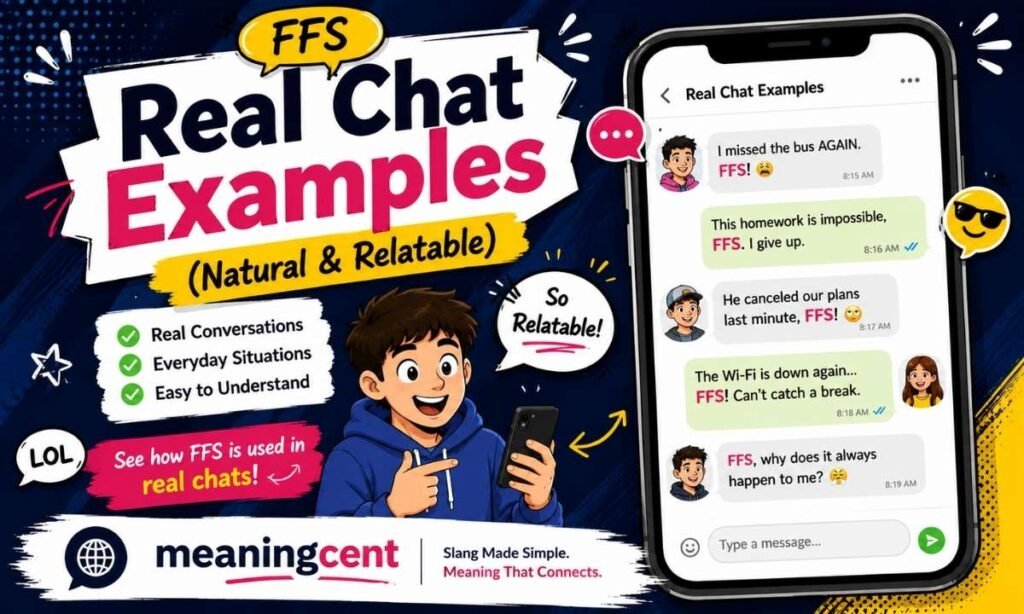
Seeing FFS in real conversation makes the tone shifts easier to understand.
Mild frustration:
A: The delivery got delayed again.
B: ffs, third time this month.
Playful teasing:
A: I left my charger at your place. Again.
B: FFS you always do this 😂
Genuine annoyance:
A: They moved the meeting to 8am.
B: FFS, I just went to sleep.
Self-directed:
“FFS, why do I always forget my umbrella.”
Gaming frustration:
“FFS, lag killed me right before the win.”
Notice how the same three letters cover humor, mild irritation, and real anger — the surrounding words and emojis do most of the emotional work.
READ MORE RELATED POTS CLICK ME
Is FFS Rude or Offensive?
Sometimes — it depends entirely on the setting and relationship.
FFS is technically a censored version of a profane phrase, so some people do consider it offensive, especially in formal or unfamiliar settings.
It tends to feel rude when:
- Used with strangers or new acquaintances
- Directed at someone personally (“FFS, you’re so slow”)
- Used in professional or academic spaces
- Read by someone who dislikes profanity, even censored
It usually feels harmless when:
- Used between close friends
- Self-directed (“FFS, I did it again”)
- Used in casual gaming or meme contexts
The words never change — the audience does.
Can You Overuse FFS? (Social Risk of Repetition)
Yes, and overusing it can backfire socially.
Using FFS occasionally reads as a natural reaction to something annoying. Using it constantly — especially aimed at other people — can start to feel harsh or dismissive.
A few risks of overuse:
- Friends may start reading it as genuine irritation, even when you mean it lightly
- Repeated use toward one person can come across as a put-down
- In group chats, overuse can shift the whole tone toward negativity
Save it for moments that genuinely call for it. Used sparingly, FFS lands as a quick, relatable reaction. Used constantly, it loses its impact and can start to feel like a habit of complaining.
When Should You Avoid Using FFS?
Avoid FFS in any setting where profanity, even censored, would be inappropriate.
Clear no-go zones:
- Work emails and professional chats
- Academic writing or school assignments
- Job interviews and first conversations with new people
- Customer service or client communication
- Conversations with people you don’t know will be comfortable with it
It’s fine to use in most casual, personal spaces — but when in doubt, especially with someone new or in a formal setting, it’s safer to skip it entirely.
How to Reply When Someone Says FFS
The right reply depends on whether they’re venting, joking, or genuinely upset.
- If they seem stressed: “That sounds really frustrating, what happened?”
- If they seem playful: “Lol, classic. What now?”
- If it’s aimed at you: “Sorry about that, let me fix it.”
- If you’re unsure of the tone: A neutral “Everything okay?” works safely in almost any situation.
Most of the time, someone typing FFS isn’t looking for a debate about the word itself — they just want a quick, human response to what’s actually bothering them.
FFS vs WTF, SMH, OMG, FML (Comparison)
These slang terms all express strong reactions, but each carries a different emotional flavor.
| Term | Full Meaning | Core Emotion |
| FFS | For f**k’s sake | Frustration, impatience |
| WTF | What the f**k | Shock, confusion |
| SMH | Shaking my head | Disappointment, disbelief |
| OMG | Oh my god | Surprise (often neutral) |
| FML | F**k my life | Self-pity, personal misfortune |
FFS and WTF are close in intensity, but WTF leans toward confusion while FFS leans toward impatience. SMH and OMG are noticeably milder and more socially acceptable in mixed company.
Similar Old-School Phrases (For Crying Out Loud, For God’s Sake)
FFS has older, non-profane relatives that expressed the exact same frustration long before texting existed.
For God’s Sake
An older exclamation of exasperation, still used by older generations.
For Christ’s Sake
A stronger, more direct precursor to the modern profane version.
For Crying Out Loud
A fully clean alternative with the same emotional function.
Are You Kidding Me?
Less of a direct match, but used in the same frustrated moments.
FFS didn’t invent this kind of reaction — it just compressed a very old habit of speech into three letters that fit a text message.
How FFS Feels in Real Conversations
In everyday use, FFS works more like an emotional release valve than an insult.
Most people aren’t trying to offend anyone when they type it. They’re venting quickly about something annoying — a late bus, a crashed app, a forgotten task — and moving on.
The tone almost always depends on the relationship between the people talking, not the word itself. Between close friends, it often reads as funny or relatable. Between strangers or in professional spaces, the same word can feel harsh.
Understanding that difference is really the whole point of knowing what FFS means.
FAQs
What does FFS mean in text?
It means “for f**k’s sake” — a slang expression of frustration, annoyance, or disbelief.
Is FFS rude?
Sometimes. It depends on the relationship, platform, and tone — not the word alone.
Does FFS always mean anger?
No. It can also be playful, sarcastic, or a mild joke among friends.
Is FFS the same as WTF?
Close, but not identical. FFS leans toward frustration and impatience, while WTF leans toward shock and confusion.
Can adults use FFS?
Yes, but it remains informal slang and isn’t suitable for professional settings.
Does FFS have any non-slang meanings?
Yes — it can also stand for “Flash File System” in tech contexts or “Fee For Service” in some billing and service industries.
Where did FFS come from?
It’s a shortened, profane-tinged evolution of older phrases like “for God’s sake,” gaining popularity through early 2000s internet chat and gaming culture.
How should I respond if someone sends me FFS?
Read the context first. If they seem stressed, respond with empathy. If it’s playful, humor works fine.
Conclusion
At its core, FFS meaning in slang comes down to one thing: context. The same three letters can be a joke between friends, a quick vent about a bad day, or something better left unsaid in a work chat.
Now that you know where it came from, how tone changes its meaning, and when to skip it altogether, you’re set to read it — and use it — the right way.
Seen an FFS moment worth sharing? Drop it in the comments below.