

JSP Meaning JSP usually means “just saying” in texts and DMs. It’s a quick way to share an opinion without sounding pushy or starting an argument.
On some apps, especially Snapchat, it can also mean “just playing,” signaling that the last message was a joke. Like most texting abbreviations, the app and the flow of the conversation usually make the intended meaning obvious within a message or two.
Short Meaning of JSP
The short meaning of JSP is “just saying,” used to soften an opinion or comment. It tells the other person you’re not trying to pick a fight, just voicing a thought.
Example: “Your playlist is kind of basic, jsp 😂”
Simple Explanation
It works like a verbal shrug added to the end of a sentence, taking the edge off whatever came before it — a light criticism, a random comment, or an unsolicited opinion.
Think of it as the texting equivalent of saying “no offense” or “take it or leave it.” It doesn’t change the content of the message, just the tone.
Example: “You always order the same thing, jsp” reads far softer than the same sentence without it attached.
Quick Chat Examples
Here’s how JSP typically shows up in real conversations across different platforms and moods.
- “That test was way harder than last time, jsp”
- “You’d look better in the blue one, jsp”
- “Jsp but you’re always late lol”
Example: Friend 1: “I redid my room.” Friend 2: “It’s giving very 2019, jsp.”
Full Form, Stands For & Short Meaning of JSP
JSP most commonly stands for “just saying” in English-language texting. Depending on the app and the region, the same letters can also stand for “just playing,” “just stay put,” or the French phrase “je sais pas” (I don’t know).
These letters don’t carry meaning on their own — they only make sense once matched to the full phrase a group or platform has settled on. That’s why the same three letters can read differently on Snapchat than in a WhatsApp group chat.
Example: A gamer typing “jsp, respawn in 10” is likely using “just stay put,” not “just saying.”
Breakdown of the Words
Each letter maps directly onto a word in the source phrase, which is what makes the acronym easy to guess once you know one version. J stands for “just,” S stands for “saying” or “stay,” and P stands for “playing,” “put,” or is silent in the French version’s spelling logic.
This one-letter-per-word structure is common across chat abbreviations and internet slang, similar to acronyms like TBH (to be honest) or IMO (in my opinion).
Example: Breaking down “jsp = just stay put” makes it obvious why gamers use it during multiplayer matches.
Why People Use JSP
People use it mainly to sound less confrontational when sharing an opinion. It’s a small verbal cushion that keeps casual chats feeling light.
It also saves time and characters, which matters in fast-moving group chats or comment sections. Typing three letters is quicker than typing out “I’m just saying this, don’t take it personally.”
Example: “Ngl that outfit ain’t it, jsp” lands softer than the same line without the tag.
Short Meaning Recap
In most everyday texting, it means “just saying” — a soft, low-stakes way to state an opinion. On Snapchat specifically, it more often means “just playing,” so the platform matters.
Example: The same three letters can mean two different things depending on whether you’re texting or Snapping.
Also Read This FYM Meaning: What FYM Means in Text, Chat & Snapchat
Origin, History & First Known Use of JSP
This acronym grew out of the broader trend of shortening common phrases for faster typing, a pattern that dates back to early instant messaging and SMS abbreviations in the late 1990s and 2000s. There’s no single documented “first use,” since digital communication terms like this tend to spread organically through group chats before anyone tracks them formally.
It follows the same logic as older abbreviations like BRB (be right back) or NVM (never mind), which were built for speed on flip phones with limited character counts. This one simply carried that same shorthand habit into modern texting and social apps.
Example: Just as “lol” outlived early 2000s chatrooms, jsp outlived flip-phone texting and moved into iMessage and Snapchat.
Where It Became Popular
It became especially common on platforms built around quick, casual exchanges — texting apps, Snapchat, and comment sections on Instagram and TikTok. Teen and young adult chat culture drove much of its spread, since these groups text in high volume and favor brevity.
Group chats are a particularly strong breeding ground for acronyms like this, since repeated use within a friend group tends to cement a shorthand’s meaning quickly.
Example: A term that starts in one school’s group chat can spread to an entire platform’s slang within a semester.
How People Use JSP in Daily Conversations
People mostly use it to add a lighthearted or non-committal tone to an opinion, observation, or minor complaint. It rarely carries weight on its own — it’s a modifier, not a standalone statement.
It shows up most often at the end of a sentence, functioning almost like a tone indicator rather than new information.
Example: “This coffee shop is overrated, jsp” reads as a passing opinion, not a strong stance.
Common Uses
It typically appears in a few recurring situations: softening criticism, adding a joke, or casually sharing an unsolicited opinion. It’s rarely used to open a conversation and almost always tacked onto the end of one.
- Softening feedback: “Your handwriting is rough, jsp”
- Adding humor: “You’d lose that race, jsp”
- Sharing a passing thought: “This show is going downhill, jsp”
Example: A coworker texting “That meeting could’ve been an email, jsp” is using it to vent lightly, not start a debate.
Real-Life Examples
In practice, it shows up across texts, comments, and captions in fairly predictable patterns. Seeing it in context makes the meaning click faster than any definition alone.
- Text: “You’ve watched that show like five times, jsp”
- Comment: “This recipe needs more salt, jsp”
- Caption reply: “Bold choice, jsp 👀”
Example: A group chat debating a restaurant might end with, “Honestly kind of overpriced, jsp,” closing the topic without escalating it.
JSP Meaning Across WhatsApp, Instagram, TikTok & Snapchat
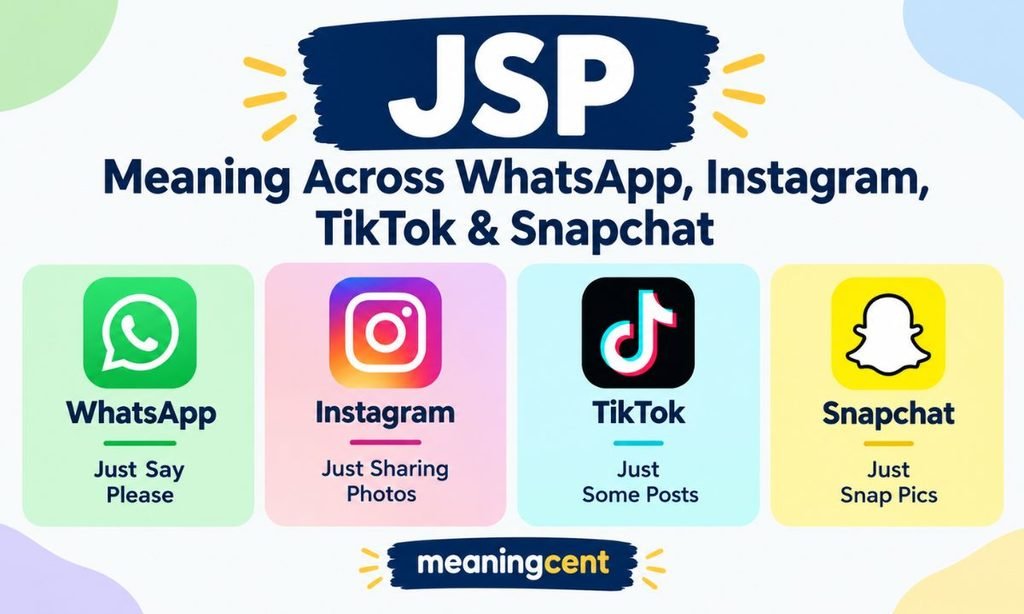
It generally means “just saying” on WhatsApp, Instagram, and TikTok, but on Snapchat it more often means “just playing.” The social media platform you’re chatting on is the biggest clue to which meaning applies.
Younger, meme-heavy platforms tend to favor the playful “just playing” reading, while general messaging apps lean toward the “just saying” opinion-softener. This kind of platform-based shift is common across internet slang, not just this one acronym.
Example: The same “jsp” in a Snapchat streak might mean a joke, while in a WhatsApp family group it likely means an honest opinion.
On WhatsApp, it’s almost always used as “just saying,” typically to add a personal opinion in family or friend groups. Because WhatsApp skews toward a wider age range, the meaning tends to stay closer to the classic definition.
Example: “We should’ve left earlier, jsp” in a family group chat is a mild, opinion-only comment.
On Instagram, it shows up frequently in comments and DMs, again usually meaning “just saying.” It’s often used to drop a lighthearted critique or reaction under a post without sounding harsh.
Example: Commenting “The lighting in this pic is rough, jsp” under a friend’s photo is meant as a tease, not an attack.
TikTok
On TikTok, it appears in comment sections as a way to add a quick take on a video without writing a full sentence. It usually still means “just saying,” often paired with humor or sarcasm.
Example: “Bro really thought that dance was it, jsp” is a common style of TikTok comment.
Snapchat
On Snapchat, it most often means “just playing,” used to clarify that a previous Snap or message was a joke. This is the platform where the meaning most clearly diverges from the standard texting definition.
Example: Sending an exaggerated insult in a Snap and following it with “jsp” tells the friend not to take it seriously.
Different Meanings of JSP in Other Fields
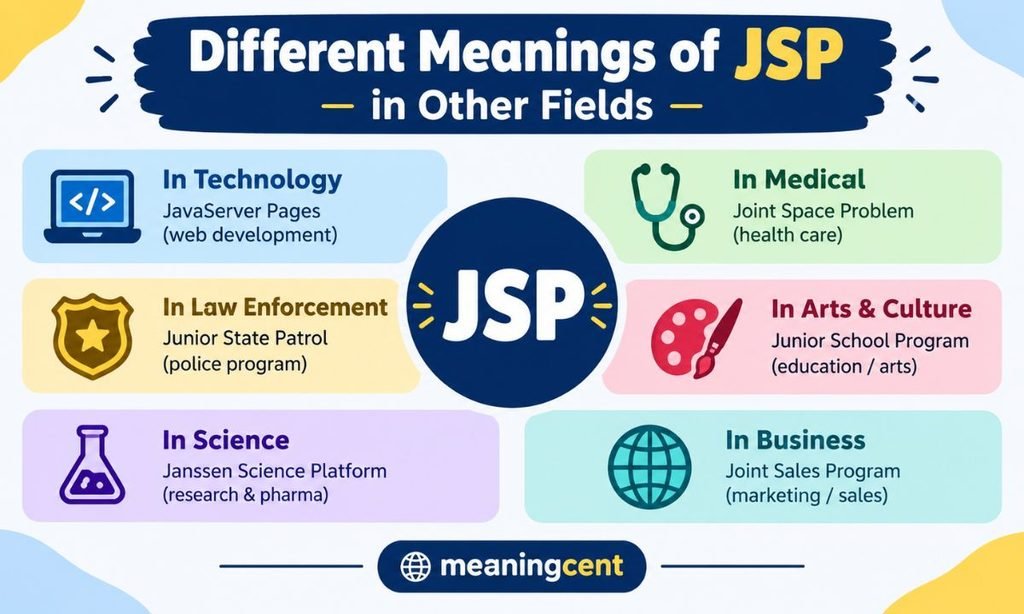
Outside of texting, the acronym has entirely different, well-established meanings in technology, business, and technical fields. These uses predate the slang version and remain the dominant meaning in their respective industries.
The surrounding conversation is what separates these meanings — nobody discussing web development or ammunition specs is using internet slang, and vice versa.
Example: A Java developer saying “we’re deprecating our JSP files” has nothing to do with texting etiquette.
In Technology
In technology, it stands for JavaServer Pages, a Java-based technology used to build dynamic, server-rendered web pages by embedding Java code inside HTML. It has been part of the Java web development ecosystem since the late 1990s and is still referenced in legacy enterprise systems today.
Example: “This site still runs on JSP” tells a developer the backend uses older Java web technology rather than a modern framework.
Education & In Business
In education and career settings, JSP commonly stands for a Job Search Plan — a structured document outlining a student’s or job seeker’s target roles, application timeline, and networking steps. Career centers and vocational programs often ask candidates to prepare one before offering coaching or placement support.
In corporate settings, the same letters can stand for a Joint Strategic Plan, a shared roadmap two departments or partner organizations use to align long-term goals. Because neither meaning is universally standardized, professional writing usually spells the term out in full the first time it’s used.
Example: A career advisor might say, “Send over your JSP before Thursday’s session,” meaning the job search plan, not the texting slang.
In Medical or Technical Contexts
In firearms and ballistics, JSP stands for “jacketed soft point,” a bullet design with an exposed lead tip inside a partial metal jacket, built to expand on impact for hunting use. This is a well-documented ammunition category with no connection to texting or software.
The term also occasionally surfaces in manufacturing and industrial documentation as a project or part-numbering code, though this usage varies by company and isn’t standardized industry-wide. In every one of these fields, the acronym is unrelated to the “just saying” meaning used in chat.
Example: “Loaded with 180-grain JSP rounds” is a sentence from a hunting or ammunition catalog, not a group chat.
Common Confusions, Mistakes & Wrong Interpretations
The biggest mistake people make is assuming it only ever means “just saying,” regardless of platform or context. That assumption breaks down fastest on Snapchat, where “just playing” is the more common reading.
Confusion also happens across languages, since French speakers frequently use “jsp” for “je sais pas” (I don’t know), which has nothing to do with either English meaning.
Example: A French friend texting “jsp, demande à Sam” means “I don’t know, ask Sam” — not “just saying, ask Sam.”
Also Read This FYM Meaning: What FYM Means in Text, Chat & Snapchat
Common Mistakes
People often misread it as sarcastic or passive-aggressive when it’s actually meant to be neutral or light. Others confuse it with similar-looking acronyms like JS (just saying) or JK (just kidding), which overlap in meaning but aren’t identical.
- Assuming it’s always “just saying” on every app
- Missing the French “je sais pas” meaning in international chats
- Confusing it with JS or JK
Example: Reading “jsp” as an insult when a friend meant it as a harmless, offhand comment is a common miscommunication.
Correct Understanding
The correct approach is to read it based on the platform, the conversation’s tone, and who’s texting. On Snapchat, lean toward “just playing”; in general texting, “just saying” is the safer default.
Example: If a Snapchat friend sends a bold claim followed by “jsp,” it’s almost certainly a joke, not a genuine confession.
Similar Terms, Alternatives & Related Slang
It sits alongside a small family of similar text abbreviations used to soften or clarify tone in a message. Knowing these related terms makes it easier to read a chat’s overall tone and intent.
- JS – “just saying,” nearly identical in meaning to the standard version
- JK – “just kidding,” used after a joke or exaggeration
- TBH – “to be honest,” used to introduce a candid opinion
- NGL – “not gonna lie,” similar to TBH in framing an honest take
- IMO / IMHO – “in my opinion” / “in my humble opinion”
Example: “That was a bad idea, ngl” and “That was a bad idea, jsp” carry nearly the same tone, just with different acronyms.
Examples of JSP in Real Chat Situations
Seeing it across different everyday situations helps make the pattern clear: it almost always follows an opinion, joke, or observation. Below are a few realistic scenarios showing how it lands in context.
- Group chat: “We should’ve booked earlier, jsp”
- Sibling text: “You always forget your charger, jsp”
- Comment section: “This trend needs to end, jsp”
Example: A friend texting “You’d have won if you tried harder, jsp 😂” is teasing, not criticizing.
How to Reply When Someone Says JSP
The easiest way to reply is to acknowledge the opinion casually, without treating it as a serious accusation. Matching the light tone keeps the conversation moving smoothly.
A simple “lol true” or a playful pushback both work well, depending on whether you agree.
Example: If a friend texts “You always order fries, jsp,” a natural reply is “and I’d do it again lol.”
Good Reply Options
Good replies keep the same casual energy the original message used, rather than escalating or over-explaining. Short, light responses tend to work best.
- “Lol fair enough”
- “Rude but true 😂”
- “Okay but you’re not wrong”
Example: Replying “okay valid” to that kind of comment keeps the exchange easy and low-stakes.
Is JSP Still Popular? Trends & Online Usage
It’s still actively used in texting and comment sections, though it sits alongside newer, more visual ways of softening tone, like emojis and reaction GIFs. It hasn’t disappeared, but it now shares space with alternatives like “ngl” and “no cap.”
Texting slang tends to cycle rather than vanish outright, and this term’s simplicity has helped it stay in circulation longer than more niche acronyms.
Example: Scrolling through recent Instagram comments on trending posts still turns up “jsp” used the same way it was several years ago.
Frequently Asked Questions
What does JSP mean in a text message?
JSP most commonly means “just saying” in a text message. It’s used to add or soften an opinion without sounding forceful.
What does JSP mean on Snapchat specifically?
On Snapchat, JSP usually means “just playing,” signaling that a previous message was a joke. This differs from its more common “just saying” meaning on other apps.
Is JSP the same as JS or JK?
JSP overlaps with JS (“just saying”) but is different from JK (“just kidding”), which specifically follows a joke rather than an opinion. Context usually makes the distinction clear.
Does JSP have a different meaning in French?
Yes, in French internet slang, “jsp” is shorthand for “je sais pas,” meaning “I don’t know.” This meaning is unrelated to the English texting definitions.
What does JSP mean outside of texting?
Outside texting, JSP most notably stands for JavaServer Pages, a Java web development technology. It can also refer to formal planning documents like a Job Search Plan, depending on the field.
Is it rude to use JSP in a conversation?
No, it’s generally not rude — it’s designed to soften a statement rather than sharpen it. Tone and wording around it still matter more than the acronym itself.
Is JSP still used in 2026?
Yes, it’s still commonly used in texts and comments, though it now shares space with newer slang like “ngl” and “no cap.” Its simplicity has helped it remain in everyday use.
Summary
It’s a simple, low-stakes acronym that mostly means “just saying,” with “just playing” taking over as the go-to meaning on Snapchat. The right reading almost always comes down to the platform and the tone of the conversation around it.
Knowing the difference between its casual chat meaning and its technical meanings, like JavaServer Pages, helps avoid mixing up two completely unrelated worlds. Once you spot the pattern, reading it in any chat becomes second nature.

1 thought on “JSP Meaning in Text & Chat: Definition, Uses & Examples ”