

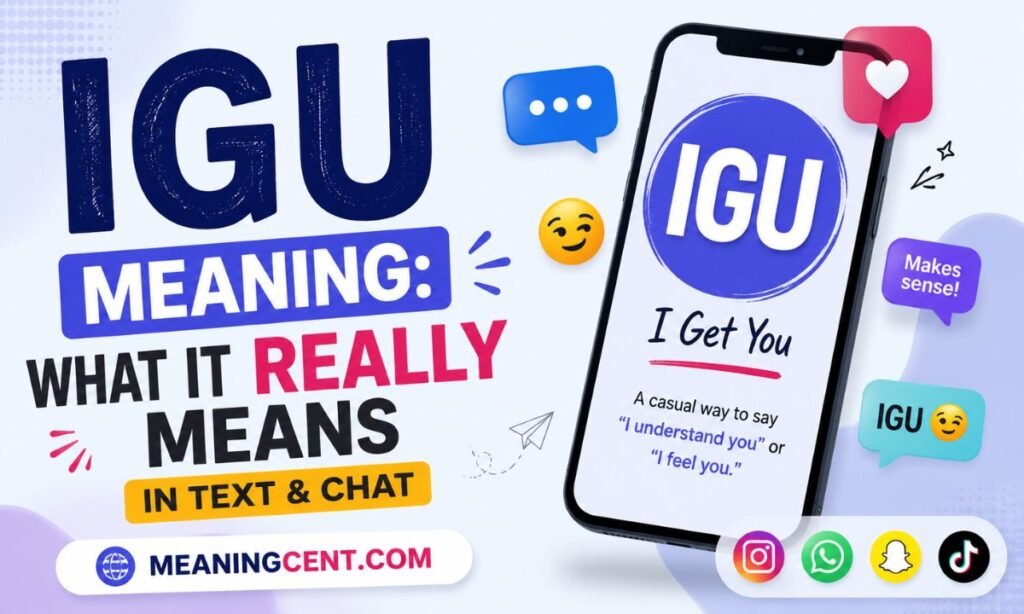
You got a text back that just said “IGU” and now you’re stuck staring at it. IGU meaning depends heavily on where you saw it, but in almost every chat it stands for “I Give Up” a quick way to admit defeat, frustration, or exhaustion without typing a full sentence.
That said, the letters aren’t locked to just one meaning. Some people use IGU to mean “I Got You,” and there’s even a totally unrelated technical use of the term. This guide breaks down every version so you never have to guess again.
Meaning & Explanation
What Does IGU Mean in Text?
In texting, IGU almost always means “I Give Up.” People send it when they’ve hit a wall a hard question, a broken app, an argument going nowhere.
It’s rarely a dramatic surrender. Most of the time it’s closer to a shrug than an actual white flag.
Common situations where IGU shows up:
- Struggling with homework or a tricky problem
- Losing a game or a debate
- Getting overwhelmed by too many choices
- Joking about something being “too hard” to deal with
A typical exchange looks like this: “Have you cracked that riddle yet?” “Nope, IGU.” The reply isn’t literal despair it’s just an easy way to close the topic.
Is IGU an Acronym, Abbreviation, or Slang Word?
IGU checks all three boxes at once. It’s an acronym because each letter stands for a separate word, an abbreviation because it shortens a longer phrase, and slang because it only really makes sense inside casual digital conversation.
Breaking down the letters:
- I – I
- G – Give
- U – Up
You won’t find IGU in a standard dictionary, which is part of why it confuses people the first time they see it.
Why Do People Use IGU?
Typing three letters is faster than typing a sentence, and that’s really the whole story. “I give up trying to figure this out” turns into “IGU” in about two seconds.
There’s also a tone benefit. IGU softens what could otherwise sound like a heavy admission, letting the sender express frustration without making the moment feel serious.
For busy group chats, that speed and lightness matter more than grammar ever will.
Other Meanings of IGU
While “I Give Up” dominates everyday texting, IGU isn’t a one-meaning term. A smaller but real group of users write it to mean “I Got You,” offering reassurance instead of surrender.
A much rarer reading “I Get You” pops up occasionally when someone wants to signal empathy rather than defeat or support. Outside of slang entirely, IGU is also a real technical abbreviation in the construction and window industry (more on that further down).
Context is everything here. The sentence around IGU, and sometimes the emoji next to it, usually makes the intended meaning obvious within a second or two.
IGU Meaning on Different Platforms
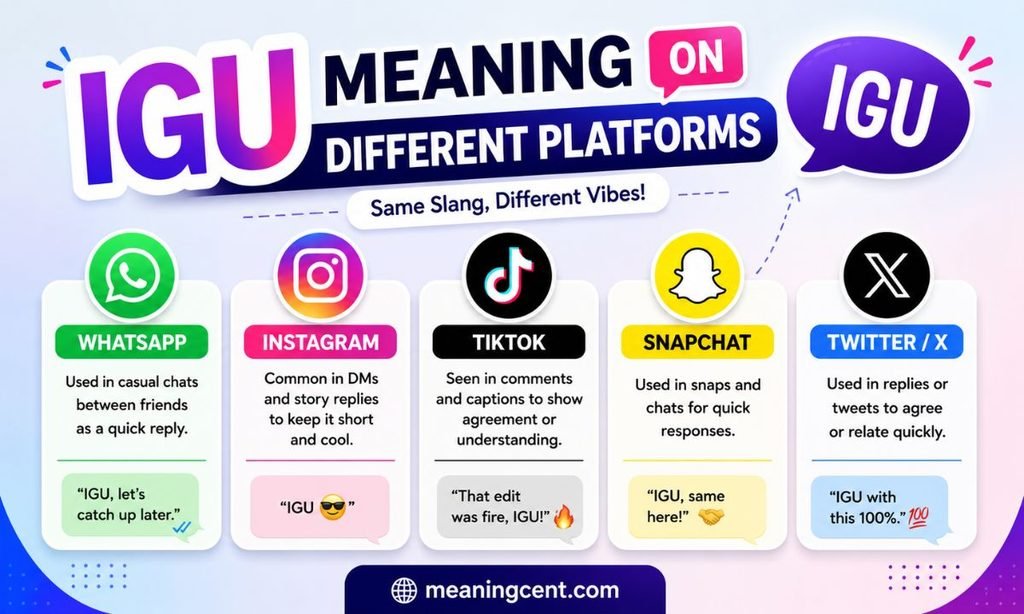
IGU Meaning on TikTok
On TikTok, IGU shows up constantly in comment sections, usually reacting to something impossible, chaotic, or hilariously confusing.
“I tried this trend five times and IGU” is a typical comment under a dance or challenge video. It’s less about quitting and more about admitting a video got the better of you.
IGU Meaning on Instagram
Instagram users lean on IGU in Reels comments, story replies, and DMs when a caption, plot twist, or inside joke goes over their head.
“IGU trying to understand what this caption even means” is the kind of line you’ll see under a confusing post. It signals playful confusion more than genuine frustration.
IGU Meaning on Snapchat
Snapchat’s fast, back-and-forth style makes IGU feel right at home. A quick snap conversation might go: “Did you finish that puzzle?” “IGU after the first ten minutes.”
Because Snapchat threads move quickly, short reactions like this keep the conversation from stalling.
IGU Meaning on WhatsApp
WhatsApp group chats especially family or friend groups use IGU when nobody can agree on something. “IGU, you all pick where we’re eating” is a common example.
It works well here because WhatsApp threads often involve group decisions where someone eventually just checks out of the debate.
IGU Meaning on X (Twitter)
On X, IGU tends to show up in reaction posts, usually paired with disbelief about news, a show, or an ongoing online argument.
“IGU, the timeline has officially broken me today” captures the exhausted-but-amused tone that’s common on the platform.
Also Read This CTFU Meaning: What It Really Stands For (2026 Guide)
Tone & Context Variations
Funny Tone
A: Did you finally beat that level? B: IGU after boss three showed up again. A: Rough. B: Painfully.
Sarcastic Tone
A: The app crashed again, shocking. B: Truly world-class engineering. A: IGU with this thing.
Playful Tone
A: Bet you can’t guess my favorite show. B: I’ve guessed like fifteen times already. A: And? B: IGU, just tell me.
Serious Tone
A: Any closer to deciding on the job offer? B: Honestly, some days I feel like IGU. A: That’s a big decision to sit with. B: Yeah, it’s a lot right now.
Real Chat Examples
Example 1
A: Did you solve the crossword yet? B: IGU on clue seven. A: That one’s brutal.
Example 2
A: Why do you look exhausted? B: This assignment made no sense. A: IGU vibes? B: Completely.
Example 3
A: Laptop working now? B: Nope, still broken. A: What’s next? B: IGU, calling a repair guy.
Example 4
A: Picked a restaurant yet? B: I’ve scrolled through forty menus. A: And? B: IGU, you choose.
Example 5
A: Did that movie ending make sense to you? B: IGU trying to explain it. A: That confusing? B: Genuinely.
Example 6
A: Did you get the assignment instructions? B: Read them three times, still lost. A: Seriously? B: IGU.
Example 7
A: Finished packing for the trip? B: Can’t decide what to bring. A: Still? B: IGU at this point.
Example 8
A: Beat your brother in chess yet? B: Not even close. A: That bad? B: IGU halfway through.
Example 9
A: Why are twenty tabs open on your screen? B: Was trying to research something. A: Find it? B: IGU before I even got there.
Example 10
A: Planned the vacation itinerary? B: Too many good options. A: That’s a good problem to have. B: IGU anyway, you pick.
Example 11
A: Did the puzzle finally come together? B: Honestly the puzzle beat me. A: So that’s a no? B: IGU, completely.
Grammar & Language Role
Part of Speech
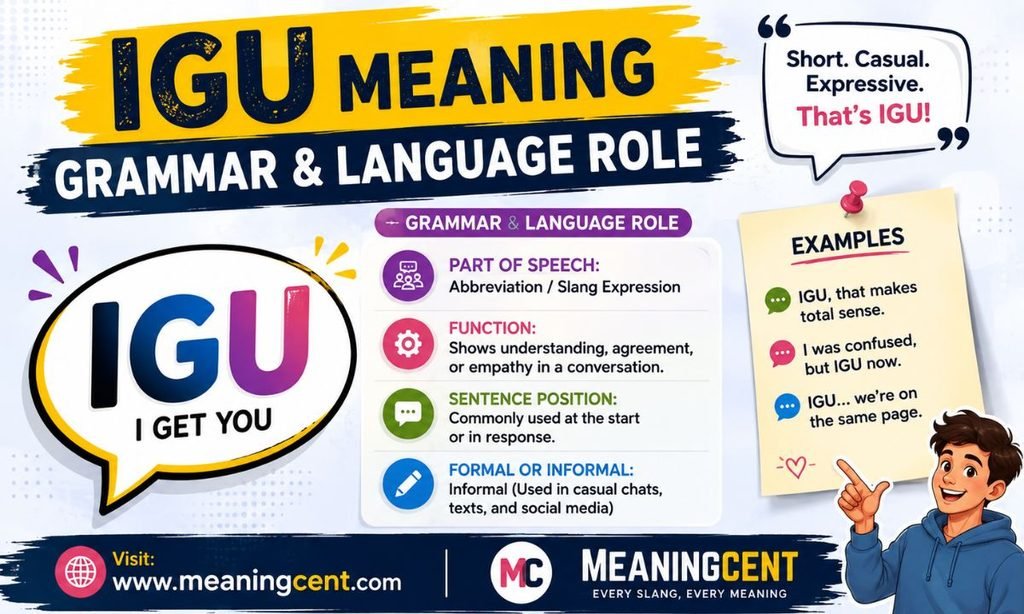
IGU behaves like a short interjection or reaction phrase rather than a traditional part of speech. It functions as a standalone statement that carries emotional meaning on its own.
Sentence Position
IGU is flexible about placement. It works alone, at the start of a message, or tacked onto the end of a sentence.
- IGU.
- IGU, this is impossible.
- I’ve tried three times already, IGU.
Can IGU Replace a Full Sentence?
Yes, and that’s actually its main appeal. A simple exchange like “Did you finish it?” “IGU.” works perfectly on its own, with no extra words needed to get the point across.
Formal vs Informal Register
| Context | Appropriate? |
| Texting with friends | Yes |
| Snapchat or TikTok comments | Yes |
| Group chats | Yes |
| Work emails | No |
| Academic writing | No |
IGU sits firmly in casual, informal territory and doesn’t belong anywhere near formal writing.
How to Reply When Someone Says IGU
Funny Reply
“Guess the challenge wins this round.” or “Well, you tried.”
Serious Reply
“Want to take a break and come back to it?” or “I can help if you want.”
Flirty Reply
“Lucky for you I’m here to save the day.” or “Need a personal problem-solver?”
Neutral Reply
“Fair enough.” or “Happens to everyone.”
Comparison Table
| Term | Meaning | Usage Context | Tone | Popularity |
| IGU | I Give Up | Frustration, defeat | Casual | High |
| IDK | I Don’t Know | Uncertainty | Neutral | Very High |
| IKR | I Know, Right? | Agreement | Friendly | Very High |
| SMH | Shaking My Head | Disapproval | Frustrated | High |
| FML | Frustration expression | Strong frustration | Dramatic | High |
| GG | Good Game / I’m Done | Acceptance, closure | Casual | High |
Who Uses This Term?
Age Group Breakdown
IGU is used most by teenagers, Gen Z, and younger millennials groups that grew up texting in shorthand rather than full sentences.
Gen Z vs Millennials
Gen Z tends to use IGU casually and humorously, often multiple times a day across different apps. Millennials reach for it less often, and when they do, it usually reflects genuine frustration rather than a joke.
Regional Usage
IGU isn’t tied to any single country. It’s common across the US, UK, Canada, and Australia, and it spreads through global English-speaking online spaces without much regional variation.
Platforms
| Platform | Usage Frequency |
| Snapchat | Very High |
| TikTok | High |
| High | |
| Moderate | |
| X (Twitter) | Moderate |
Origin & Internet Culture
Where Did IGU Come From?
IGU grew out of the same texting-shorthand wave that gave us LOL, BRB, and IDK. As messaging apps pushed people toward faster, shorter replies, longer admissions like “I give up” naturally got compressed into a three-letter reaction.
Role in Internet Culture
“I give up” is an easy feeling to turn into a meme, which is part of why IGU stuck around. It fits neatly under posts about impossible challenges, glitchy tech, or confusing plot twists.
TikTok and Meme Influence
TikTok’s reaction-comment culture kept IGU alive well after other early texting abbreviations faded. Puzzle videos, “try not to laugh” challenges, and confusing life-hack clips are prime territory for it.
Evolution of Usage
Early on, IGU leaned toward real frustration. Over time it shifted toward exaggeration most people typing it today aren’t actually giving up on anything, they’re just emphasizing how ridiculous a situation feels.
Also Read This CTFU Meaning: What It Really Stands For (2026 Guide)
Safety & Appropriateness
Is IGU Rude?
No. IGU reads as neutral to mildly frustrated, not disrespectful, in almost every context it appears in.
Is IGU Profanity?
No. There’s nothing explicit or offensive hiding inside the abbreviation.
Is IGU Appropriate for School?
It’s fine in casual conversations between students, though teachers generally expect full wording in assignments and formal writing.
Is IGU Appropriate for Work?
It works in relaxed chats between coworkers who already text casually, but it has no place in emails, reports, or client-facing messages.
Cultural Sensitivity Notes
IGU carries no known cultural sensitivity issues. It reads as ordinary internet shorthand across English-speaking communities.
Real-World Observation
IGU sticks around because it names a feeling almost everyone recognizes that moment where continuing to try just isn’t worth the energy anymore. A hard puzzle, a glitchy app, an argument that’s going nowhere: three letters cover all of it instantly.
Its real strength is flexibility. The same abbreviation can carry sarcasm, humor, or genuine exhaustion depending entirely on the sentence around it, which is exactly why it hasn’t gone out of style the way older texting shorthand has.
IGU vs I Got You vs I Get You Which One Does It Really Mean?
Most of the time, IGU means “I Give Up,” but the “I Got You” reading is real enough to cause genuine mix-ups in certain chats. Here’s how to tell the two apart quickly.
| Meaning | How Common | Signal to Look For |
| I Give Up | Very common | Follows a struggle, question, or failed attempt |
| I Got You | Less common, still used | Follows a request for help or reassurance |
| I Get You | Rare | Follows someone sharing a feeling or opinion |
If someone asks for help and gets “IGU” back, they’re probably being reassured, not abandoned. If IGU follows a failed attempt at something, defeat is almost always the intended read. When the context genuinely could go either way, it’s worth just asking what they meant.
IGU Full Form (Insulated Glass Unit) Non-Slang Meaning

Outside of texting, IGU has a completely unrelated technical meaning: Insulated Glass Unit. This term shows up in construction, architecture, and window manufacturing, not in casual chat.
An insulated glass unit is a type of window built from two or more glass panes with a sealed air or gas gap between them, designed to improve insulation and energy efficiency. Contractors, architects, and window suppliers use “IGU” constantly in specs, quotes, and product listings.
If you spot IGU on a construction document, home renovation quote, or window catalog, it has nothing to do with texting slang it’s simply industry shorthand for that type of window.
IGU Meaning by Sender and Context
IGU Meaning Text From a Guy
When a guy texts IGU, it’s usually casual and low on emotional weight often tied to a game, a joke, or a debate he’s willing to lose. “Bro this makes zero sense, IGU” is a typical example.
IGU Meaning From a Girl
When a girl sends IGU, the surrounding context still decides the tone, but it can carry slightly more emotional nuance, especially in personal or relationship conversations. “I’ve tried explaining myself twice now, IGU” leans more toward genuine tiredness than a joke.
IGU Meaning in Gaming
Gamers use IGU constantly during tough matches, impossible bosses, or lopsided rounds. “This level’s rigged, IGU” is standard chat-lobby language, and it’s almost always lighthearted rather than an actual quit.
Window IGU Meaning
In the window and construction world, “window IGU” refers directly to the Insulated Glass Unit explained above the sealed, multi-pane glass assembly used in energy-efficient windows. It’s a completely separate meaning from the texting abbreviation, and the two never really overlap outside of coincidence.
Frequently Asked Questions
What does IGU mean in text?
IGU most commonly means “I Give Up,” used when someone feels frustrated, defeated, or done trying at something.
Is IGU rude?
No, IGU generally reads as neutral or mildly frustrated rather than disrespectful.
Does IGU ever mean “I Got You”?
Yes, some people use IGU to mean “I Got You,” though it’s less common than the “I Give Up” reading. Context usually makes the intended meaning clear.
What does IGU mean on Snapchat?
On Snapchat, IGU almost always means “I Give Up,” fitting the platform’s fast, casual conversation style.
Is IGU appropriate for work or school?
It’s fine in casual chats with coworkers or classmates, but it should be avoided in emails, assignments, and any formal writing.
What does IGU mean outside of texting?
Outside of slang, IGU stands for Insulated Glass Unit, a technical term used in construction and window manufacturing.
How should I reply when someone sends IGU?
Match their tone offer help if they sound genuinely frustrated, joke back if it’s playful, or simply acknowledge it with something like “fair enough.”
Final Thoughts
IGU meaning comes down to context more than anything else. Most of the time it stands for “I Give Up,” but “I Got You” and even the technical “Insulated Glass Unit” are real enough to cause the occasional double-take.
Once you know what to look for the sentence before it, the platform it showed up on, the tone of the conversation reading IGU correctly takes about two seconds instead of a guessing game.