
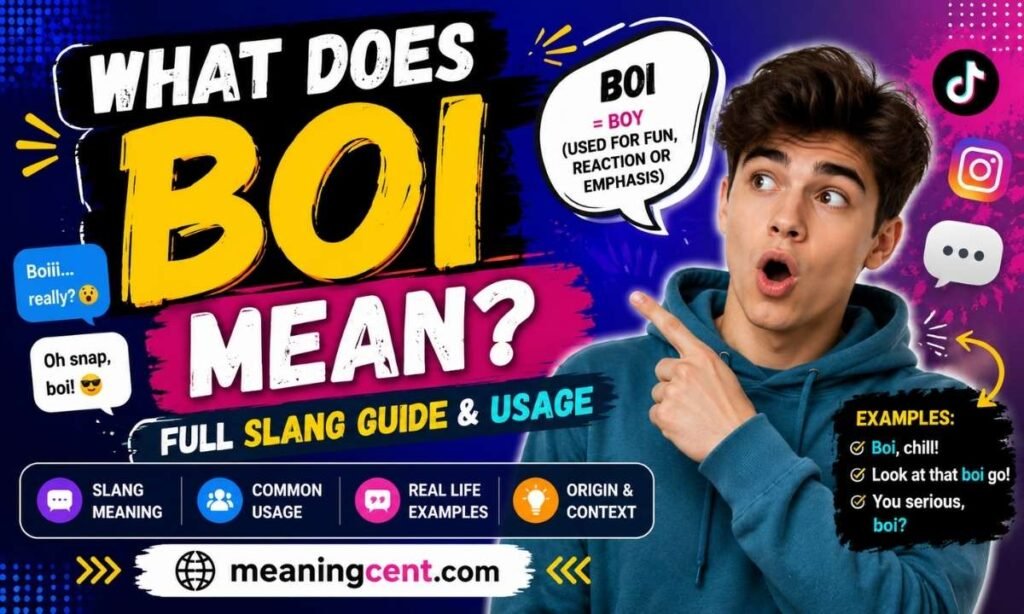
You’ve probably typed “boi” or seen someone drop it in a chat and wondered what does boi mean exactly. It looks like a typo for “boy,” but it’s not a mistake at all — it’s an internet slang term with its own personality, tone, and history.
This guide breaks down every angle of boi mean — where it started, how people actually use it in real chats, what it signals emotionally, and how it changes across regions and platforms. By the end, you’ll know exactly when to use it and when to leave it alone.
What Does Boi Mean – Quick Meaning
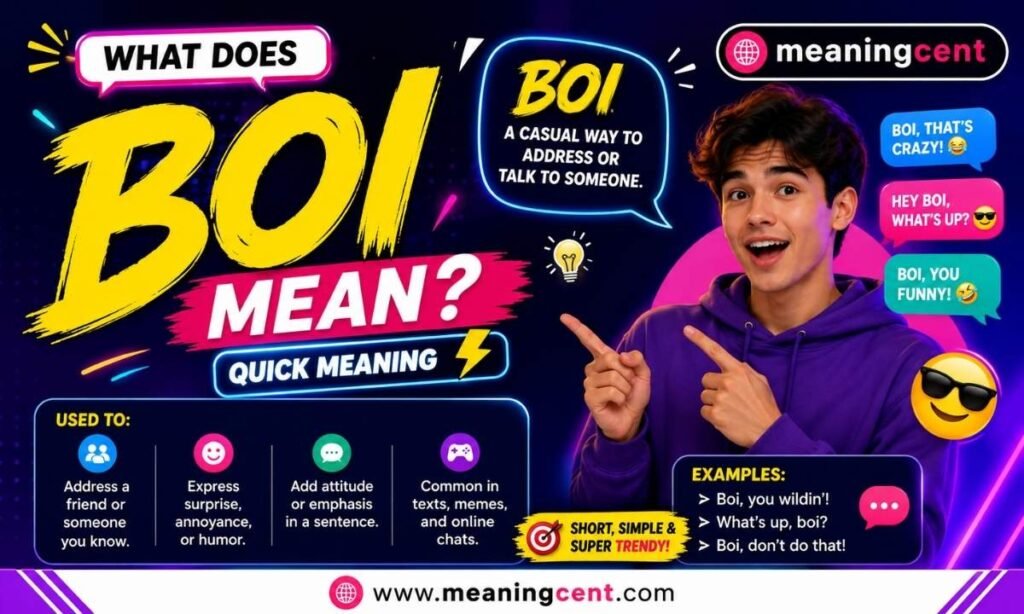
Boi is an informal, playful respelling of “boy” used online and in texting to add humor, warmth, or exaggeration to a message. As a Gen Z slang word, the meaning shifts with tone — it can be teasing, affectionate, or proud, but it rarely means exactly what “boy” means on its own.
Quick breakdown:
- It’s spelled differently on purpose, not by accident
- The emotion behind it matters more than the literal word
- It shows up most in memes, group chats, and social captions
A few real-style examples:
- “Bro really thinks he’s the main character, this boi.”
- “That’s my boi, showed up for me when nobody else did.”
- “Boi stop acting brand new.”
Boi vs BOI (Acronym) — Quick Disambiguation
Not every “BOI” you see online is slang. In finance and government contexts, BOI stands for Beneficial Ownership Information, a reporting requirement tracked by agencies like the U.S. Treasury’s FinCEN. That’s an entirely different topic from the casual slang word covered here, so if you landed here searching for compliance paperwork, you’re in the wrong place — but if you’re trying to figure out why your friend keeps texting “boi,” keep reading.
Origin & Background
Boi didn’t start as a meme-culture invention — it has roots that go back decades before memes existed. Understanding where this casual slang came from explains why it carries so much more feeling than a simple spelling swap.
Where it came from
The spelling traces back to African American Vernacular English, where alternate spellings of common words carried cultural identity and rhythm. Rapper Big Boi’s rise in the early 1990s helped push the word into wider pop culture, and skate communities picked it up soon after as a badge of belonging rather than a literal label.
How it evolved
Once social platforms like Tumblr and early Twitter took off, boi stopped being tied to one community and became a flexible, tone-based word anyone could use. Today it stretches across humor, affection, identity, and internet irony all at once — something the plain word “boy” never really did.
Real-Life Conversations (How People Actually Use “Boi”)
Reading definitions only gets you halfway. Seeing boi inside actual conversations shows how flexible the word really is depending on the app and the relationship.
WhatsApp Chat
Person A: Bro tried to parallel park for ten minutes straight lol
Person B: This boi has no business owning a car 😭
Instagram DMs
Person A: Just hit my savings goal for the month!
Person B: Look at this boi being responsible, proud of you 🙌
TikTok Comments
Person A: He filmed himself failing the recipe three times before it worked
Person B: Respect the grind, that boi doesn’t give up
Across all three, notice how the word never changes meaning much — it just adjusts the emotional temperature of the message.
Emotional & Psychological Meaning
People don’t reach for boi by accident. It’s chosen because it softens a sentence and pulls the listener closer emotionally.
Why people connect with it
- It sounds friendly instead of formal
- It shrinks the emotional gap between speaker and listener
- It lets someone tease without sounding harsh
What it reflects
Using boi often reflects comfort, inside-joke familiarity, or light-hearted pride in someone. It’s rarely neutral — there’s almost always a small emotional nudge attached, even in a one-word reply.
Usage in Different Contexts
The exact same slang term can land completely differently depending on where it’s used. Context does most of the heavy lifting when it comes to how boi should be read.
Social Media
On platforms built for quick reactions, boi shows up in memes, comment sections, and caption humor, often exaggerating a situation for comedic effect.
Friends & Relationships
Between close friends, boi tends to work as gentle teasing or genuine encouragement, depending entirely on the sentence around it.
Work or Professional Settings
Boi has almost no place in professional communication. Even in relaxed workplace chats, it can read as unprofessional unless the entire team culture is already extremely informal.
Casual vs. Serious Tone
In casual writing, “that boi never texts back” reads as harmless. In anything serious — reports, emails, formal requests — swapping in “boy” or dropping the word entirely is the safer call.
Common Misunderstandings
Because boi looks like a simple misspelling, people often assume things about it that aren’t quite accurate.
1. It always means “boy”
Not always. Sometimes it points at a behavior or attitude rather than an actual age or gender.
2. It’s insulting
Rarely. Most everyday use is playful rather than mean-spirited, though a harsh tone can still make any word land as an insult.
3. It’s universally acceptable
Not quite. It fits casual, online spaces well but doesn’t translate cleanly into every culture or setting, so reading the room still matters.
4. It’s gender-specific
It leans toward describing men or masculine behavior most often, but plenty of casual and community usage isn’t strictly limited to one gender.
Also Read This CMP Meaning
Comparison Table
| Term | Core Meaning | Typical Tone |
| Boi | Playful, tone-driven reference to a person | Casual, humorous |
| Boy | Literal young male | Neutral |
| Dude | General informal address | Friendly |
| Bro | Close, casual male friend | Warm, familiar |
| Man | Adult male, direct address | Serious to neutral |
The takeaway: as urban slang, boi is chosen for its vibe, not because it’s the technically correct word for the situation.
Variations & Types of “Boi”
- Smol boi — someone acting cute or a little shy
- Good boi — praise, often affectionate
- Sad boi — leaning into emotional vulnerability, half-joking
- Soft boi — sensitive, artistic personality type
- Angry boi — exaggerated, non-serious frustration
- Sleepy boi — someone tired, low-energy
- Hungry boi — playful way of saying someone wants food
- Chaotic boi — unpredictable, high-energy behavior
- Quiet boi — calm, introverted personality
Each version keeps the same base word but colors it with a specific mood or personality trait.
How to Respond When Someone Uses “Boi”
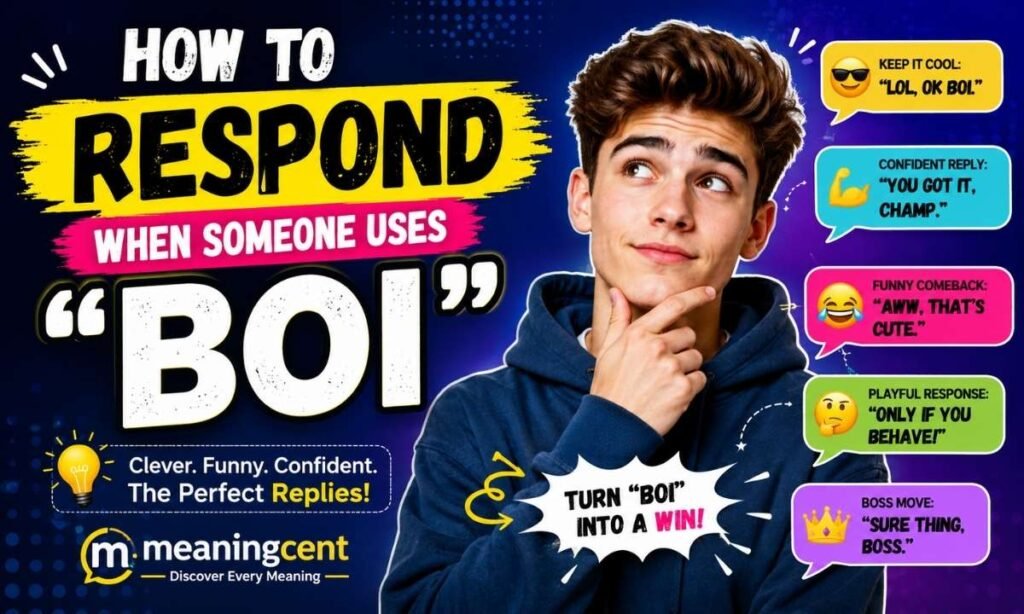
How you reply usually depends on your relationship with the person and the mood of the conversation.
Casual Replies
- “Yep, that’s me.”
- “Can’t argue with that.”
Funny Replies
- “Boi energy confirmed.”
- “This is my final form.”
Mature / Confident Replies
- “I’ll take that as a compliment.”
- “Facts, honestly.”
Private or Respectful Replies
- “Ha, fair point.”
- “Noted, appreciate the honesty.”
Matching the energy of whoever said it usually keeps the exchange smooth.
Regional & Cultural Usage
Boi doesn’t sit the same way in every part of the world. Regional habits shape how often — and how comfortably — people use it.
Western Culture
It’s common across the US and UK in memes, texting, and everyday online banter, largely thanks to years of meme culture normalizing the spelling.
Asian Culture
Usage here is mostly online, picked up through exposure to Western internet trends rather than being a native slang term.
Middle Eastern Culture
Boi shows up far more in social media captions and comments than in everyday spoken conversation across this region.
Global Internet Usage
Meme culture has made boi recognizable almost everywhere younger internet users gather, regardless of native language.
Also Read This CMP Meaning
What does boi mean in texting
In texting, boi mean mostly comes down to adding personality to an otherwise plain message. As a piece of everyday chat slang, it’s a quick way to sound playful, sarcastic, or affectionate without typing out a longer explanation, and it works well as both a greeting and a reaction.
What does boi mean in urdu
There’s no direct Urdu translation for boi — it’s typically borrowed straight from English internet slang and dropped into Roman Urdu chats as-is. Young users in Pakistan and India often mix it into casual texting the same way they’d use “yaar” or “bro,” giving it a similar friendly, informal weight.
Boi meaning in love
In romantic texting, boi often softens a message and adds a teasing, affectionate layer — something like “stop being cute, boi” reads as flirty rather than literal. It’s less about labeling someone and more about setting a warm, playful tone between two people.
What does boi mean in business
In professional or business writing, boi essentially has no place — it reads as too casual and can undercut credibility in emails, proposals, or client communication. The only real business-related overlap is the unrelated acronym BOI used in financial reporting, which has nothing to do with the slang term.
What does boi mean on tiktok
On TikTok, boi mean usually points to comment-section humor, reaction videos, and caption jokes where the word amplifies a moment rather than describing someone literally. A comment like “this boi really tried it” is meant to highlight something funny or bold that just happened in the clip.
Boi meaning in chat from a girl
When a girl uses boi in chat, it’s almost always playful or affectionate rather than literal, often signaling comfort or light teasing rather than anything negative. Tone and emojis around the word usually make the intent obvious — a laughing emoji reads very differently than a flat, serious sentence.
Frequently Asked Questions
What does boi mean in a text message?
It usually means someone is being addressed or described in a playful, informal way rather than literally being called a boy.
Is boi an offensive word?
It’s generally not offensive on its own — tone and relationship between the people talking decide whether it lands as playful or rude.
Can boi be used for girls or women?
Yes, in casual and community contexts it’s sometimes used regardless of gender, though it still leans toward masculine or boyish framing most often.
Where did the word boi originally come from?
It traces back to African American Vernacular English and gained wider visibility through 1990s hip-hop culture and later skate and internet communities.
Is boi the same as the acronym BOI used in business?
No. The slang word and the financial reporting acronym BOI are completely unrelated and just happen to share the same letters.
Should I use boi in professional emails?
No, it’s too informal for professional writing and is best kept to casual texting, social media, and conversations with close friends, like most informal language of its kind.
Why do people use boi instead of just saying boy?
Because boi carries tone and personality that the plain word “boy” doesn’t — it signals humor, closeness, or exaggeration in a single word.
Final Thoughts
At its core, boi mean comes down to tone over technical definition — it’s less about who someone is and more about how a message feels when you read it. Whether it shows up in a WhatsApp chat, a TikTok comment, or a flirty text, the word is doing emotional work, not just spelling work.
Once you notice the tone behind it, boi stops being confusing and starts being just another flexible piece of how people actually talk online today.