
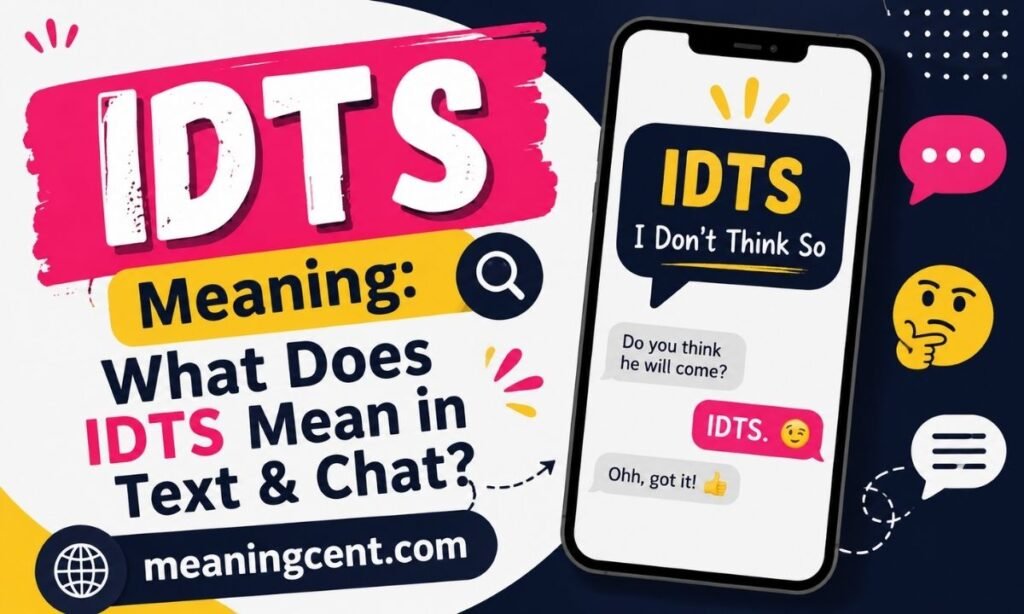
You spotted IDTS in a text and now you’re stuck guessing. It stands for “I don’t think so,” a quick way people express doubt or disagreement without sounding harsh.
This guide breaks down what it means on every major platform, how its tone shifts, and how to reply naturally. You’ll also find real chat examples, a comparison table, and answers rarely covered elsewhere — like its meaning in business or medical settings.
Quick Answer Box
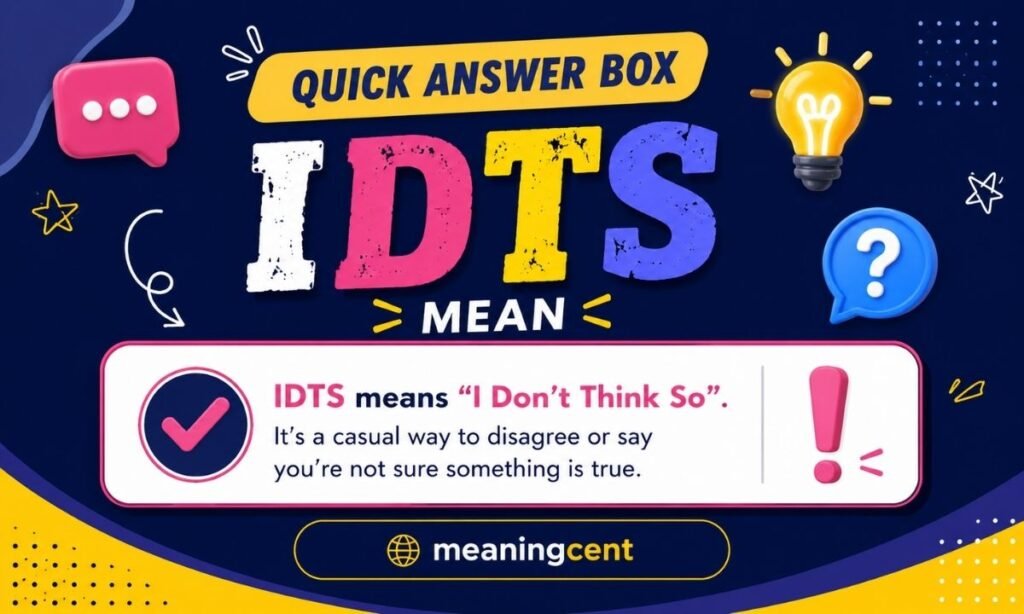
| Term | Full Form | Tone | Common Platforms | Safe for Work |
| IDTS | I Don’t Think So | Casual, doubtful, mildly disagreeing | Texting, Snapchat, Instagram, TikTok, WhatsApp | Yes |
What Does IDTS Mean?
IDTS stands for “I don’t think so.” People type it when they doubt something, disagree politely, or want to say “probably not” without a long explanation.
It’s one of those texting shortcuts that saves keystrokes while still carrying real meaning. Someone asks a question, you’re leaning toward “no,” and this abbreviation gets that across in four letters instead of a full sentence.
It’s a form of polite disagreement — skeptical, but not confrontational, and a small but useful piece of online communication shorthand. Here’s how it plays out:
Jordan: “You coming to the gym later?” You: “IDTS, I’m exhausted.”
That single reply tells Jordan exactly where you stand — probably not, but not a hard no either.
What Does IDTS Mean in Text?
In a text message, it almost always means “I don’t think so.” It works as a compact stand-in for a full sentence, which is exactly why it caught on.
Texting rewards brevity. Typing four letters instead of seventeen adds up over hundreds of messages a day, so shortcuts like this stick around.
A few natural examples:
- “IDTS the store’s open this late.”
- “IDTS she’s mad at you.”
- “IDTS we’ll make it on time.”
None of these read as rude. They just signal a leaning-no answer, delivered fast.
IDTS Meaning in Chat
Inside live chats and online chat platforms — think Discord, group threads, or messaging apps — the abbreviation keeps the same core meaning but moves even faster because chat culture favors real-time, short replies.
Priya: “Is the update live yet?” Sam: “IDTS. Nobody’s posted about it.”
Sam isn’t certain, but the lean is clearly toward “no.” That’s the whole function of this shorthand in a chat setting: give people a quick read on your opinion so the conversation can keep moving.
IDTS Meaning on Snapchat
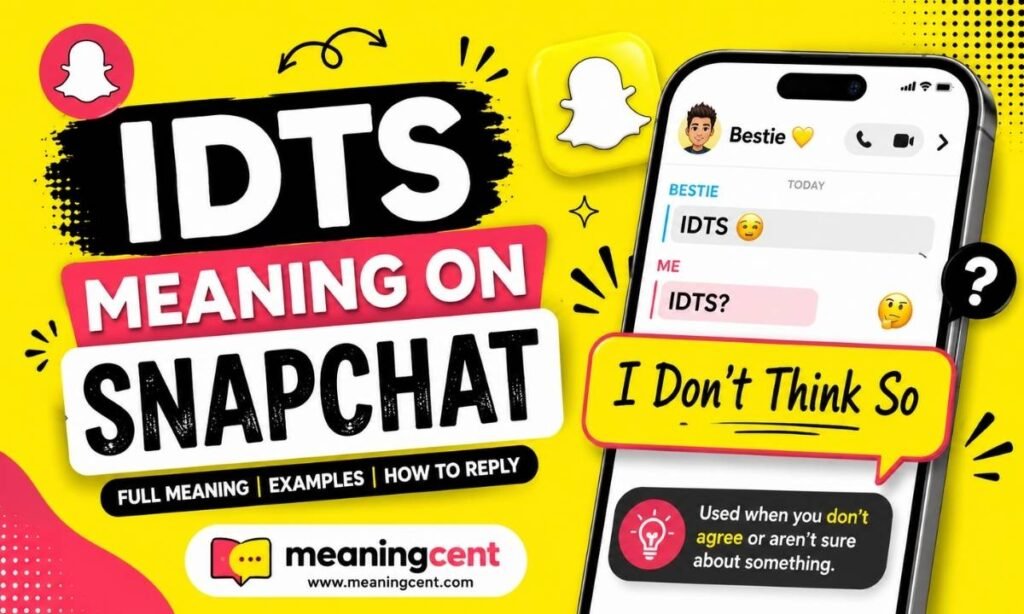
On Snapchat, this abbreviation shows up constantly in private snaps and chat replies, mostly because Snapchat conversations tend to be short bursts rather than long paragraphs.
It gets used to:
- Answer a friend’s question
- React to gossip
- Turn down a plan gently
- Share a quick opinion
Friend: “Should I text him first?” You: “IDTS… let him make the first move.”
The tone stays light and friend-to-friend, never formal.
IDTS Meaning on Instagram
Instagram users drop this reply into DMs, comment threads, and story replies pretty regularly, especially during debates about trending videos or celebrity news.
Example from a comment section: “IDTS that’s actually her account.”
It reads as a casual disagreement, nothing aggressive, and it fits right into the fast back-and-forth that Instagram comment sections tend to have.
IDTS Meaning on TikTok
TikTok comments move fast, and this shorthand fits that pace perfectly. Viewers use it to push back on a creator’s claim or opinion without writing a paragraph.
Creator’s caption: “This is objectively the best pizza place in the city.” Comment: “IDTS 💀 have you tried the one on 5th?”
Pairing it with an emoji is common on TikTok — it softens the disagreement and keeps things playful rather than confrontational.
IDTS Meaning on WhatsApp
WhatsApp conversations tend to mirror regular texting, so it carries the exact same meaning there: doubt or gentle disagreement.
Dad: “Will you make it home for dinner?” You: “IDTS, traffic’s rough tonight.”
Because WhatsApp is used across generations and countries, this is often where parents and older relatives first pick up the abbreviation from younger family members.
Is IDTS an Acronym?
Yes, it’s an acronym — each letter stands for the first letter of a word in the phrase “I Don’t Think So.”
That’s different from slang built on sound or spelling changes. It’s a straightforward initialism: I, Don’t, Think, So, compressed into one block of letters.
Is IDTS a Short Form?
Yes, and it works as both an acronym and a texting shortcut at the same time. It replaces the entire sentence “I don’t think so” without losing any of the meaning.
That dual identity — grammatically an acronym, functionally a shortcut — is part of why it spread so widely across messaging platforms.
Is IDTS a Phonetic Spelling?
No, it’s not phonetic. Phonetic spellings mimic how a word sounds when spoken, like “gonna” or “lemme.”
This abbreviation doesn’t imitate pronunciation at all — it’s built purely from initials, and nobody actually says “idts” out loud as a word. It stays a written shortcut.
Is IDTS a Typo Turned Slang?
No. Some internet slang started as accidental misspellings that stuck around, but this wasn’t one of them.
It was created on purpose as a way to type “I don’t think so” faster, and its meaning has stayed consistent since it first appeared in early texting culture.
How the Tone of IDTS Changes
The letters never change, but the mood behind them shifts depending on who’s typing, what came before, and whether an emoji tags along.
The same four characters can land as a joke between friends or as a flat, cold answer — context does all the heavy lifting here.
Funny Tone
Friends toss this abbreviation around as a light jab when someone makes a bold claim.
Maya: “I’m gonna run a marathon next month, no training needed.” Leah: “IDTS 😂 but go off.”
The laughing emoji makes it obvious this is teasing, not a real challenge to Maya’s plan.
Sarcastic Tone
Sometimes it calls out an obvious contradiction, and the sarcasm comes from the situation rather than the phrase itself.
Tyler: “I never procrastinate.” Noah: “IDTS… you just submitted that assignment at 11:58 PM.”
The humor lands because everyone already knows the claim isn’t true.
Romantic Tone
Couples use it in playful teasing that stays warm underneath the disagreement.
Ava: “You’ll get tired of my cooking eventually.” Ben: “IDTS 😄 never.”
It’s disagreement dressed up as affection — the opposite of a real rejection.
Read More Related Post NPC Mean
Angry Tone
Stripped of emojis or extra words, a bare “IDTS.” can come across cold, especially if it answers something emotionally loaded.
Person A: “Do you even trust me?” Person B: “IDTS.”
No softening words, no punctuation warmth — this version reads as blunt, maybe even dismissive.
Playful Tone
Add an emoji or two and the same phrase turns friendly again.
Chris: “I’ll beat you in this game, easy.” Jordan: “IDTS 😂🎮 bring it on.”
The playful version invites more conversation instead of shutting it down.
Mini Conversation Examples
Example 1
A: Are we finishing this presentation tonight? B: IDTS, we’ve barely started the slides. A: Guess we’re pulling a late one then.
Example 2
A: Is that verified account real? B: IDTS, no blue check anywhere. A: Good catch, I almost followed it.
Example 3
A: You think she noticed I left early? B: IDTS, she was on her phone the whole time. A: Phew, okay.
Example 4
A: Are they even open on holidays? B: IDTS, most places close early today. A: I’ll call ahead just in case.
Example 5
A: Will this song still be trending next week? B: IDTS, trends move so fast lately. A: True, we’ll see.
Grammar and Language Role of IDTS
This abbreviation doesn’t behave like a normal word — it functions as a stand-in for an entire sentence, and it slots into conversation the same way “no” or “not really” would.
Knowing where it fits grammatically makes it easier to use naturally instead of just copying what you’ve seen others type.
Part of Speech
It isn’t a noun, verb, or adjective in the usual sense. It’s better classified as a discourse marker or sentence-level abbreviation, since it carries the weight of a full statement on its own.
“IDTS.” and “I don’t think so.” do identical grammatical work in a conversation.
Sentence Position
This shorthand typically shows up in one of three spots:
- Opening a reply: “IDTS he’s coming tonight.”
- Standing alone as the whole response: “IDTS.”
- Leading into a reason: “IDTS, because the shop’s already closed.”
All three positions are common, and none of them feel out of place in casual texting.
Does IDTS Replace a Full Sentence?
Yes, that’s essentially its entire job. Instead of typing “I don’t think so,” the sender just types four letters, and the listener fills in the rest automatically.
This substitution is what makes the shorthand efficient — the meaning transfers without any loss, just less typing.
Tone Impact
Tone rides almost entirely on what surrounds it, not the letters themselves.
- Bare: “IDTS.” — can feel blunt
- Softened: “IDTS 😊” — feels friendly
- Extended: “IDTS, but let’s wait and see.” — feels thoughtful
Punctuation and emojis do more tonal work here than the abbreviation itself.
Formal vs. Informal Use
This term belongs firmly in informal writing and casual conversation — texts, DMs, group chats, comment sections. As a piece of text speak, it has no place in professional email, cover letters, or academic work.
For anything formal, spell it out: “I don’t think that’s accurate” reads far better in a work email than “IDTS” ever will.
15 Real Chat Examples Using IDTS
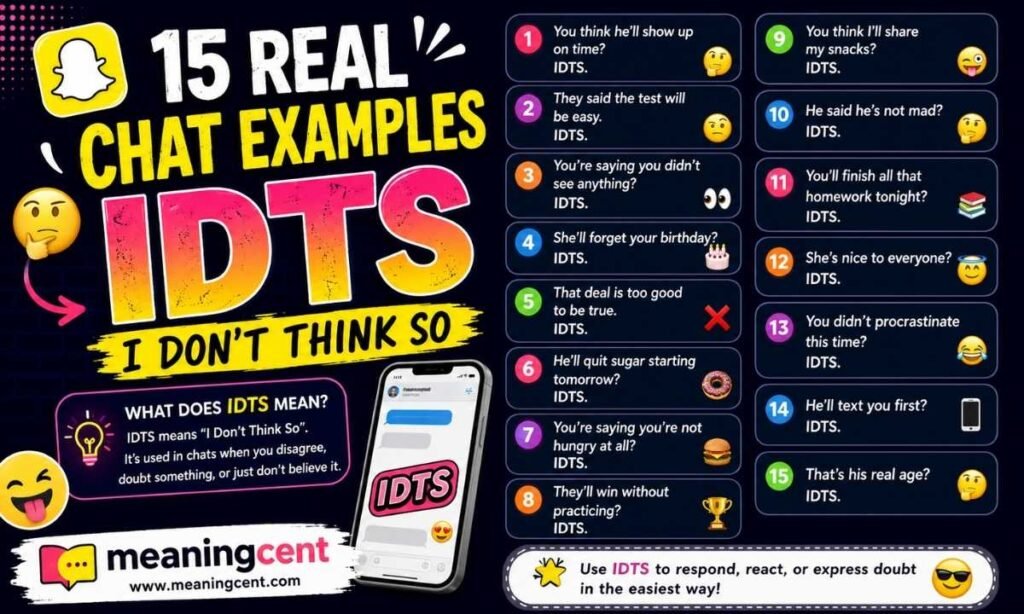
Real conversations show this abbreviation doing its job better than any definition can. Here are fifteen everyday exchanges.
Conversation 1
A: Think it’ll snow this weekend? B: IDTS, forecast says clear skies. A: Guess I’ll skip the shovel prep.
Conversation 2
A: Is that diner still serving breakfast this late? B: IDTS, they usually cut it off at 11. A: I’ll double-check before we drive over.
Conversation 3
A: You think he’ll text back tonight? B: IDTS, he mentioned he was busy. A: Fair, I’ll just wait it out.
Conversation 4
A: Are we running late for the meeting? B: IDTS, we’ve still got ten minutes. A: Good, that’s a relief.
Conversation 5
A: Did she read my message yet? B: IDTS, it still says “delivered.” A: I’ll hold off on sending another one.
Conversation 6
A: Is this the right formula for question five? B: IDTS, double-check the textbook example. A: Smart, I’ll compare it now.
Conversation 7
A: Are they being serious right now? B: IDTS 😂 A: Classic, they’re always joking around.
Conversation 8
A: Worth watching that new movie tonight? B: IDTS, the reviews weren’t great. A: Let’s find something else then.
Conversation 9
A: Is Jake still coming to the party? B: IDTS, he said he wasn’t feeling well earlier. A: That’s a bummer, hope he’s okay.
Conversation 10
A: Can we wrap this project up tonight? B: IDTS, not unless everyone chips in. A: I’ll message the group chat now.
Conversation 11
A: Do you think I’ve got a shot at winning? B: IDTS… but prove me wrong. A: Challenge accepted.
Conversation 12
A: Is that the original post or a repost? B: IDTS, the caption looks edited. A: Good eye, I wouldn’t have noticed.
Conversation 13
A: Think they caught us sneaking out early? B: IDTS 😂 A: Let’s hope we got away with it.
Conversation 14
A: Is that rumor about the merger true? B: IDTS, nobody official has confirmed anything. A: Good point, I’ll wait for a statement.
Conversation 15
A: Are you calling it quits on the project? B: IDTS, just stepping back for a bit. A: That’s fair, take your time.
Read More Related Post NPC Mean
How to Reply When Someone Says IDTS
Your reply depends heavily on the relationship and the topic — a friend teasing you deserves a very different response than a colleague raising doubt about a plan.
Funny Replies
- “We’ll see who’s right 😂”
- “Watch me prove you wrong.”
- “Bet.”
- “Don’t count me out yet.”
Serious Replies
- “That’s fair, let’s look at the facts.”
- “What makes you say that?”
- “I hear you, but here’s my reasoning.”
- “Good point, let’s double-check.”
Flirty Replies
- “Guess I’ll have to change your mind 😉”
- “You haven’t seen my best move yet.”
- “Care to make it a bet?”
- “I’ll take that as a challenge.”
Neutral Replies
- “Maybe you’re right.”
- “We’ll find out soon enough.”
- “Fair enough.”
- “Let’s wait and see.”
Comparison Table
Texting shorthand overlaps a lot, and people frequently mix this term up with similar-looking abbreviations.
| Term | Meaning | Tone | Typical Use |
| IDTS | I Don’t Think So | Neutral, doubtful | Disagreeing or expressing doubt |
| IDK | I Don’t Know | Neutral, uncertain | Admitting you have no answer |
| IMO | In My Opinion | Neutral | Sharing a personal view |
| TBH | To Be Honest | Honest, direct | Prefacing a candid statement |
| NGL | Not Gonna Lie | Casual, candid | Admitting something honestly |
| IDTG | I Don’t Think (Guess) So / see below | Casual, ambiguous | Regional variant, less standardized |
Who Uses IDTS?
Age Group
Teenagers, college students, and young adults use it the most, though plenty of adults who text regularly understand and use it too.
Gen Z vs. Millennials
Gen Z tends to pair the abbreviation with emojis, GIFs, or memes and uses it heavily in TikTok comments. Millennials lean toward using it in plain texting rather than on video platforms, and they use it slightly less often overall.
Regional Popularity
This shorthand shows up most in English-speaking regions — the US, UK, Canada, and Australia — but it’s understood almost anywhere English-language texting culture has spread online.
Platforms Where IDTS Is Most Common
You’ll run into it most often on:
- Snapchat
- TikTok
- Discord
- SMS and iMessage
- X (formerly Twitter)
Its spread tracks directly with how much a platform favors short, fast replies over longer posts.
Origin of IDTS and Its Place in Internet Culture
It grew out of the spoken phrase “I don’t think so,” which has been a polite way to disagree in English for a very long time. Early texting and instant messaging pushed people to compress that phrase into something faster to type.
As a chat slang term, it arrived around the same era as IDK and BRB, back when character limits and slow keypads made short forms genuinely useful, not just trendy. Unlike slang that TikTok invented overnight, this one has been around across chatrooms, SMS, and forums for years.
Why People Say IDTS on TikTok
The abbreviation didn’t start on TikTok, but the platform’s comment culture keeps it alive among younger users. TikTok comments move at a rapid pace, and a four-letter reply fits that rhythm far better than a full sentence.
People typically drop it on TikTok to:
- Push back on a creator’s take
- Question something that sounds off
- React to celebrity gossip
- Join a fast-moving comment debate
The platform rewards quick, punchy replies, and this shorthand delivers exactly that.
Meme Culture and the Popularity of IDTS
Memes keep it in circulation by pairing it with reaction images, GIFs, and emojis like 💀 or 😂. A bare “IDTS” reads differently than “IDTS 💀,” which usually signals playful disagreement rather than genuine pushback.
In meme-heavy spaces, tone gets carried by the visuals attached to the text far more than by the letters themselves.
Fast Typing Culture
Digital communication keeps rewarding shorter and shorter replies, and this abbreviation is a textbook example of that trend.
| Full Phrase | Short Form |
| I don’t know | IDK |
| I don’t care | IDC |
| I don’t think so | IDTS |
| Be right back | BRB |
| In my opinion | IMO |
Four letters standing in for an entire sentence is exactly the kind of compression fast typers look for.
Is IDTS Rude?
Generally, no — it reads as a neutral or polite way to disagree in most conversations.
A: “Do you think they’ll cancel practice?” B: “IDTS.”
That’s a simple difference of opinion, nothing more. The one exception is a bare “IDTS.” with zero warmth attached, which can occasionally feel dismissive depending on the topic. Adding “but we’ll see” or an emoji usually fixes that instantly.
Is IDTS a Bad Word?
No, it contains no profanity or offensive content whatsoever. It’s considered completely safe for casual, everyday conversations and carries no hidden explicit meaning.
Should You Use IDTS at School or Work?
It depends entirely on the setting — casual chats are fine, formal communication is not.
Appropriate Situations
- Texting classmates or coworkers casually
- Group chats
- Informal social media comments
- Friendly, low-stakes emails between peers
Situations to Avoid
- Academic essays or research papers
- Business reports
- Job applications
- Official emails to supervisors or clients
In any of those formal contexts, spell out “I don’t think so” instead.
Experience-Based Insight
Watching how people actually use this abbreviation across different apps, it functions less like a hard “no” and more like a soft placeholder for doubt — people reach for it specifically because it avoids sounding confrontational.
On Snapchat and WhatsApp especially, it rarely appears alone; it usually gets followed by a reason, a joke, or an emoji that clarifies the tone. That pattern shows up heavily among younger texters, who tend to lean on emojis to carry emotional context that plain text can’t.
IDTS meaning medical
In medical and clinical contexts, this abbreviation is not a recognized standard term the way it is in texting — it doesn’t appear in common clinical shorthand references used by hospitals or pharmacies.
Some industry glossaries list it as shorthand for terms like “Idiosyncratic Drug Toxicities” or “Intradermal Tests” in niche pharmacological or dermatological documentation, but these usages are field-specific and far less common than the everyday texting meaning. If you come across it in a medical chart or clinical note, the safest move is to ask the provider directly what it refers to, since medical abbreviations vary by institution and specialty.
IDTS meaning in business
In business communication, it almost never appears in formal documents, but it does occasionally show up in informal internal chats — Slack messages, Teams threads, or quick texts between coworkers who know each other well.
Used this way, it still means “I don’t think so,” typically applied to a project timeline, a client assumption, or an informal opinion about whether something will happen.
Coworker: “Think the client will approve this draft as-is?” You: “IDTS, the pricing section still needs work.”
Even in casual workplace chat, it’s worth reading the room — some teams treat internal Slack like a group chat, while others expect more professional phrasing even off the record.
Idtg meaning in chat
IDTG is a close cousin of this term and usually stands for “I don’t think,” used as a shorter, slightly less complete version of the same doubt-expressing phrase, though it’s far less standardized and shows up less consistently across platforms.
Because the two abbreviations look nearly identical at a glance, people frequently type one when they mean the other, or misread one for the other mid-conversation.
IDTS vs IDTG — What’s the Difference?
IDTS spells out a complete thought — “I don’t think so” — while IDTG trails off without the “so,” leaving the sentence technically unfinished. In practice, most people use them interchangeably and read them as meaning the same thing.
If you want to avoid any confusion, the fuller version is the safer, more universally recognized choice since it’s grammatically complete and far more widely used across texting culture.
IDTS company
There’s no widely known company, brand, or public organization that officially goes by these letters as a name or ticker symbol in mainstream use. Searches for this phrase are usually people trying to confirm the texting abbreviation isn’t secretly a business reference, or checking a specific local business that happens to use those initials.
If you’ve come across it attached to a specific company name, industry association, or product, that’s likely a niche or regional organization unrelated to the texting slang — it’s worth checking the exact context you saw it in before assuming a connection.
Idts urban dictionary
On Urban Dictionary, it’s defined the same way it’s used everywhere else online: “I don’t think so,” typically listed as a quick way to express disagreement or doubt in text conversations.
Crowdsourced slang dictionaries like Urban Dictionary sometimes include joke definitions or regional variations submitted by users, so it’s common to see a few alternate or humorous entries alongside the standard one. For everyday texting purposes, “I don’t think so” remains the definition that actually matches how people use it in real conversations.
Frequently Asked Questions
What does IDTS mean in a text message?
IDTS means “I don’t think so.” People use it to express doubt or politely disagree without typing out a full sentence.
Is IDTS the same as IDK?
No. IDTS means “I don’t think so” and expresses a leaning opinion, while IDK means “I don’t know” and expresses a complete lack of information.
Is it rude to send someone this abbreviation?
Usually not. Most people read it as a casual, neutral disagreement rather than something harsh, especially when it’s followed by a reason or an emoji.
Can it be used sarcastically?
Yes. Depending on the conversation, it can carry sarcasm, especially when it points out an obvious contradiction in what someone just said.
Does it mean anything in a medical context?
Not as a standard clinical term. A few niche glossaries link it to phrases like “Idiosyncratic Drug Toxicities,” but this isn’t common usage — the everyday texting meaning is far more widespread.
Is it okay to use IDTS at work?
It depends on the setting. Casual Slack messages between coworkers are usually fine, but formal emails, reports, and client communication should avoid it entirely.
What’s the difference between IDTS and IDTG?
IDTS is the complete phrase “I don’t think so,” while IDTG is a shorter, less standardized version that drops the final word. They’re generally understood to mean the same thing.
Where did the abbreviation come from?
It developed from the spoken phrase “I don’t think so” as texting culture pushed people to shorten common expressions for faster typing, arriving around the same era as IDK and BRB.
How should I reply if someone texts me IDTS?
It depends on the tone. A light “we’ll see” or “fair enough” works for most situations, while a flirty or joking reply fits better in casual, friendly exchanges.
Is IDTS considered slang or a formal abbreviation?
It’s informal internet slang, appropriate for texting, social media, and casual chats, but not for academic, professional, or official writing.
Final Thoughts
IDTS stands for “I don’t think so,” a quick, low-key way to express doubt or disagreement across texting, Snapchat, Instagram, TikTok, and WhatsApp. Its tone shifts entirely based on context, punctuation, and whether an emoji softens the message.
Outside of texting, it rarely carries a fixed meaning — occasional business or medical uses exist, but they’re niche compared to how often it shows up in everyday casual chat. Once you recognize the pattern, replying naturally becomes second nature.