

Seen “ate” pop up in a comment, text, or TikTok caption and had no idea what it meant? It’s not about food. On social media, “ate” is a compliment — a way of saying someone did something amazing, whether that’s an outfit, a performance, or a comeback.
This guide breaks down exactly what “ate” means in slang, where it came from, and how to use it. We’ll also clear up a common mix-up: “Ate” is a completely different word in Filipino, meaning something entirely unrelated to the slang.
What Does “Ate” Mean in Slang?
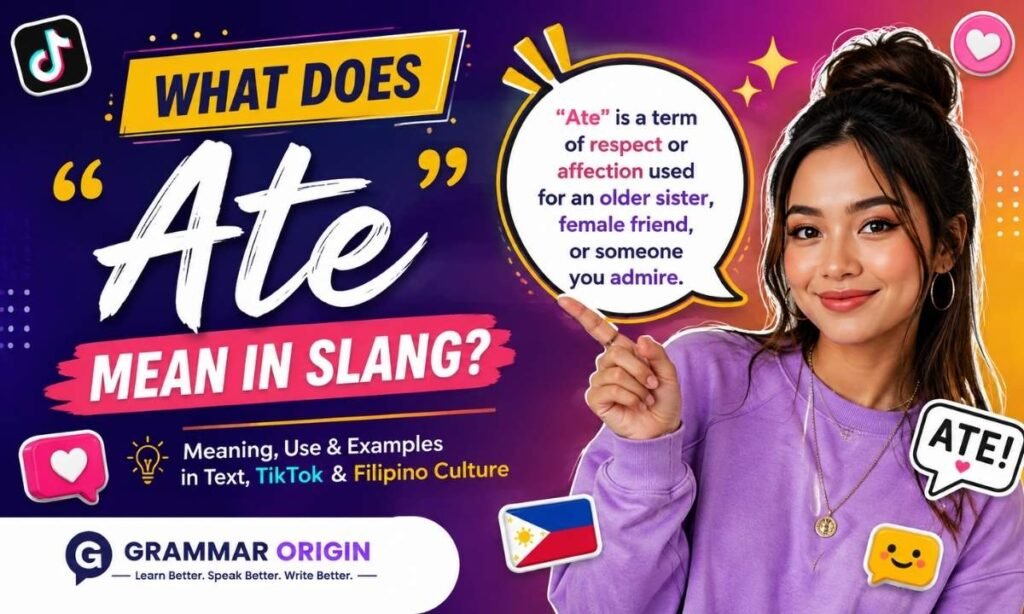
In slang, “ate” means someone did something extremely well. It’s a compliment used to praise a great performance, outfit, or achievement.
When someone says “you ate,” they’re saying you nailed it, impressed everyone, or completely owned the moment. The word has nothing to do with literally eating food.
This is one of the most common Gen Z slang terms online. You’ll see it most often in TikTok comments, Instagram captions, and casual text messages.
Ate Meaning in Text and Chat
The “ate” meaning in text is simple: someone did something flawlessly. It works as a short, punchy compliment.
It’s similar to saying “you nailed it” or “you crushed it,” just shorter and more casual.
Example: A: Did you see her speech? B: Yeah, she ate. Everyone was talking about it.
In chat, “ate” can respond to almost anything impressive — a comeback, an outfit, a decision, or a bold move.
A: I finally told my boss how I felt. B: And? A: He agreed with me. B: You ate.
Ate Meaning on Instagram, TikTok, Snapchat & WhatsApp
The slang “ate” shows up across nearly every major platform, though the context shifts slightly depending on where you see it.
On Instagram
It’s mostly used in comments to praise photos or outfits: “She ate this photoshoot.”
On TikTok
It became especially popular. Users comment “ATE” or “she ate and left no crumbs” under dance videos, transformations, and confident speeches.
On Snapchat
Since it’s visual-first, “ate” usually praises appearance: “You ate that look.”
On WhatsApp
It’s used more casually between friends: “You passed your test? You ate!”
Across all these platforms, the meaning stays the same — it’s always praise.
READ MORE RELATED POSTS CLICK ME
Is “Ate” an Acronym, Short Form, or Something Else?
No, “ate” is not an acronym or a short form. It’s a metaphorical slang expression.
The word doesn’t stand for anything, and it isn’t shortened from a longer phrase. Instead, it uses the idea of “eating” a performance or moment as a metaphor for dominating it.
Think of it like saying someone “devoured” the spotlight. That’s the imagery behind the slang.
Where Did “Ate” Come From? (Origin)
The slang “ate” originated in Black and LGBTQ+ ballroom culture in the early 2000s. It was used to praise standout performances in drag shows and dance competitions.
Within the ballroom scene, saying someone “ate” meant they dominated the stage with style and confidence. Over time, the phrase moved beyond ballroom culture into mainstream social media.
TikTok played a major role in spreading it further. Short-form videos made quick, expressive comments like “ATE” easy to type and share, helping the term reach a much wider audience by the mid-2020s.
Is “Ate” Also a Filipino Word?
Yes — but it means something completely different. In Filipino (Tagalog), “Ate” (pronounced ah-teh) is a respectful term for an older sister or older female relative.
This is not slang. It’s a common cultural honorific used across the Philippines, similar to how “Kuya” refers to an older brother.
The two words look identical in spelling but come from entirely different languages and contexts:
- Gen Z slang “ate” = past tense of “eat,” used as praise
- Filipino “Ate” = title of respect for an older sister
If you see “Ate” used before someone’s name, like “Ate Maria,” it almost certainly refers to the Filipino meaning, not the slang one.
Examples of “Ate” in Real Life
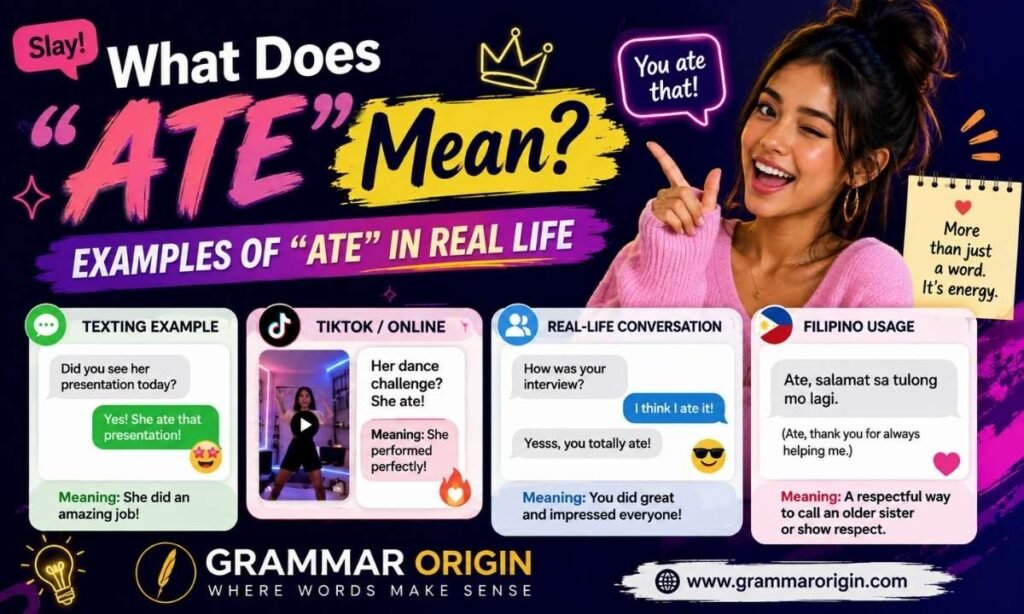
Example 1: Fashion
“You ate that outfit today. Where did you get that jacket?”
Example 2: Performance
“Her dance routine was insane. She ate that choreography.”
Example 3: Confidence
“I finally stood up for myself in that meeting.” “Good for you. You ate.”
Example 4: Everyday Wins
“I passed my driving test on the first try!” “You ate that test!”
These examples show the pattern clearly: something goes well, and “ate” captures the praise in one word.
Ate Slang Synonyms & Comparison Table
“Ate” isn’t the only slang word used for praise. Here’s how it compares to similar terms:
| Term | Meaning | Tone | Popularity |
| Ate | Did something extremely well | Praise | Very high |
| Slay | Did something with style or confidence | Praise | High |
| Snatched | Looked flawless, especially in appearance | Praise | High |
| Iconic | Memorable or impressive | Praise | Medium |
| Ate and left no crumbs | Performed so well there’s nothing to critique | Praise (stronger) | High |
While these words overlap, “ate” is unique because it works as a single-word reply on its own, without needing extra context.
Is “Ate” Still Used in 2026?
Yes, “ate” is still widely used in 2026. It hasn’t faded the way some older slang terms have.
The phrase remains common in TikTok comments, Instagram captions, and everyday texting among Gen Z and younger millennials. Its short, expressive nature keeps it relevant, since it fits naturally into fast-paced digital conversations.
Slang trends do shift over time, but “ate” has stayed consistent because it’s simple, versatile, and easy to use across almost any context.
READ MORE RELATED POSTS CLICK ME
Who Uses “Ate”? (Age Groups & Platforms)
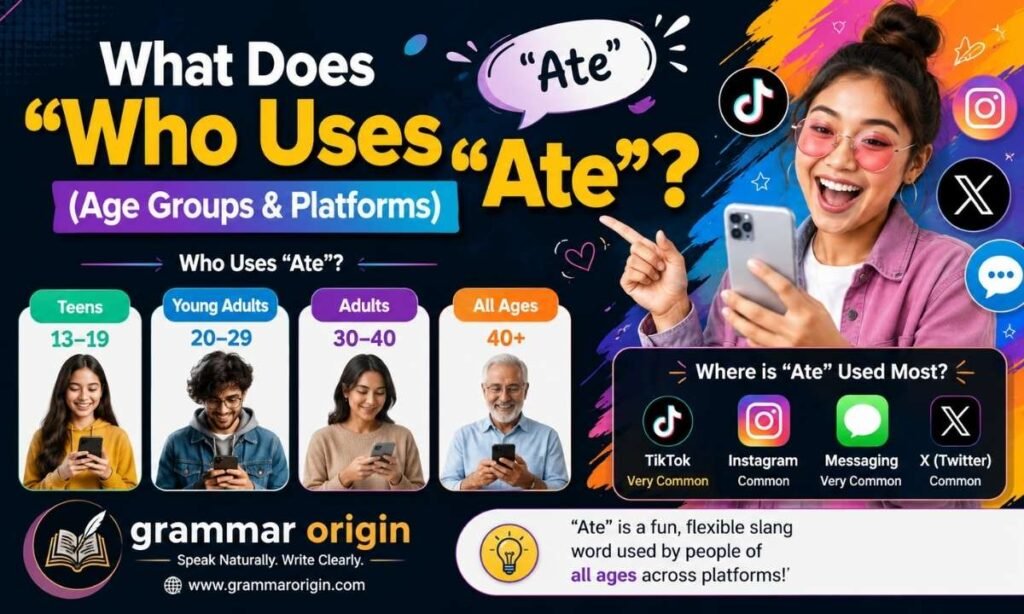
“Ate” is used mostly by Gen Z and younger millennials. It’s less common among older generations, who may not recognize it as slang at all.
Age Groups
- Teenagers and young adults use it the most
- Millennials understand it but use it less often
- Older generations may not recognize the slang meaning
Platforms Where It’s Common
- TikTok
- Instagram comments
- Snapchat replies
- Twitter/X
- Group chats and texting
TikTok, in particular, helped push the term into mainstream use well beyond its original ballroom-culture roots.
Frequently Asked Questions
What does “ate” mean in slang?
“Ate” means someone did something extremely well. It’s used as a compliment for a great performance, outfit, or achievement.
Is “ate” the same as the Filipino word Ate?
No. The Filipino word “Ate” means older sister and is used as a sign of respect. The slang “ate” is unrelated and simply means someone did great.
Is “ate” rude or offensive?
No. “Ate” is a positive, complimentary term. It’s never used to insult someone.
What does “ate and left no crumbs” mean?
It means someone performed so perfectly that there’s nothing left to criticize. It’s an intensified version of “ate.”
Is “ate” outdated slang?
No. As of 2026, “ate” is still commonly used across TikTok, Instagram, and everyday texting.
How do you reply when someone says “you ate”?
A simple “thank you” works fine. You can also reply casually, like “I try” or “appreciate it.”
Final Thoughts
“Ate” is a popular slang term that means someone did something impressively well. It’s most common on TikTok and Instagram, where it’s used to praise outfits, performances, and confident moments.
It’s worth remembering that “Ate” also has a completely different meaning in Filipino, where it respectfully refers to an older sister. Knowing both meanings helps you avoid confusion and use the word correctly, whether you’re chatting online or talking about culture.