

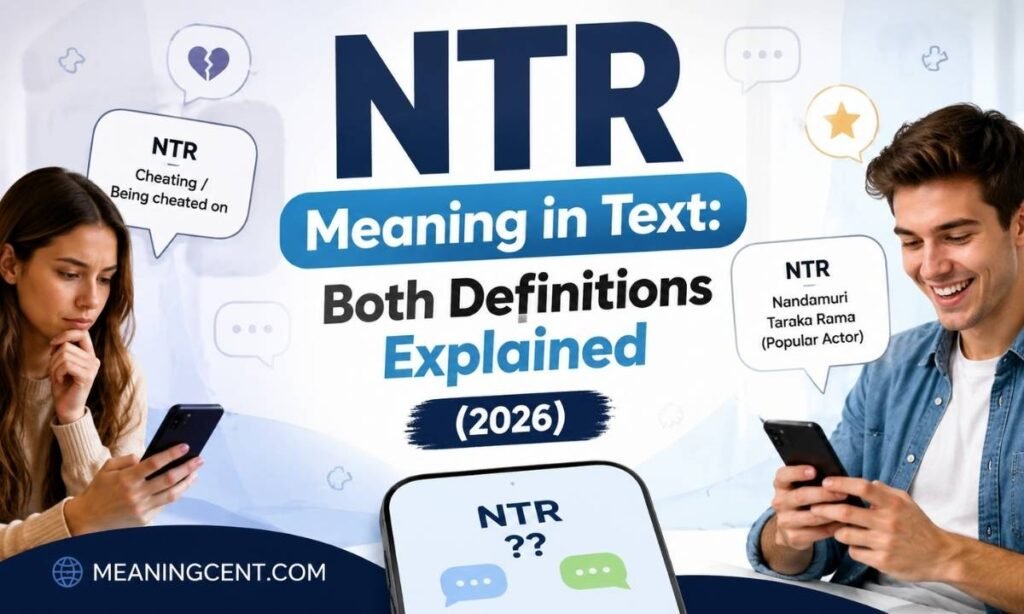
You spot “NTR” in a text and freeze for a second — what is this supposed to mean? The NTR meaning splits into two completely unrelated answers: “Nothing to Report” or “Netorare,” and which one fits depends entirely on where you saw it.
This guide walks through both definitions, shows you how to tell them apart in under five seconds, and gives you real chat, TikTok, and Discord examples so you never have to guess this internet slang term twice.
What Does NTR Mean?
NTR carries two accepted meanings, and both are correct depending on context. It’s either “Nothing to Report,” a workplace-born shorthand, or “Netorare,” a Japanese anime term.
Everyday texters lean toward “Nothing to Report” almost automatically. Anime and manga fans reach for “Netorare” the moment the conversation turns to a show, character, or plot twist — the same way any niche chat abbreviation shifts meaning by community.
There’s no single “correct” answer here — the surrounding conversation decides the NTR meaning for you.
NTR Meaning: Nothing to Report
“Nothing to Report” is the everyday version of NTR, and it simply means nothing new has happened. It works as a fast, low-effort status update.
The phrase has roots in military and shift-based reporting, where a quick “NTR” confirmed a patrol or inspection had nothing worth flagging. Texting culture picked it up for the exact same reason: speed.
A few natural examples:
- “How’d the interview go?” — “NTR, went fine.”
- “Any news on the delivery?” — “NTR, still en route.”
- “How’s your week been?” — “Pretty NTR, honestly.”
It’s safe territory — coworkers, parents, group chats, all fair game.
NTR Meaning: Netorare (Anime and Manga)
In fandom spaces, NTR stands for “Netorare,” a Japanese genre label describing a character losing their partner to someone else. The literal translation is closer to “being taken away from.”
What sets Netorare apart isn’t just the betrayal itself — it’s the emotional weight around it. Jealousy, grief, and loss get far more attention than the act of cheating.
Fans also treat NTR as a spoiler tag. Slapping “NTR” on a title tells other readers exactly what emotional territory they’re walking into before they commit.
Not everyone enjoys this genre. Plenty of fans actively avoid NTR-tagged content because the betrayal arc hits too close to real discomfort.
How to Tell Which Meaning Applies
Context does almost all the work here, so you rarely have to sit and wonder. Ask yourself one question: what’s actually being discussed?
- Talking about a show, comic, or character? That’s Netorare.
- Talking about your day, a task, or a check-in? That’s Nothing to Report.
Most people pick up on the correct NTR meaning within the first line or two of a conversation, without even thinking about it consciously.
NTR Meaning Across Platforms
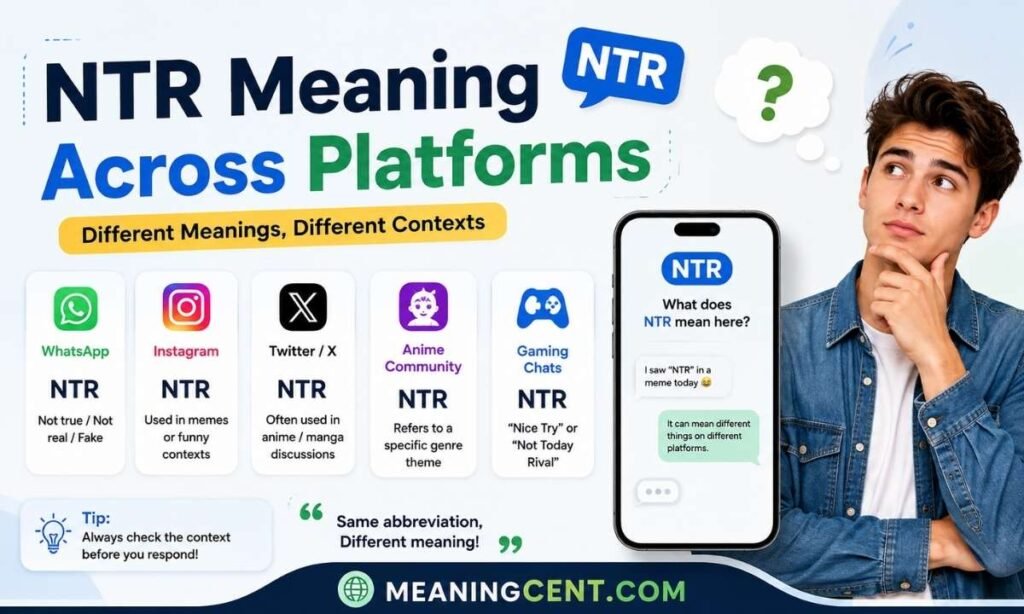
The NTR meaning doesn’t behave identically everywhere — each platform’s internet culture nudges it toward one definition more than the other.
Instagram — DMs and general comments default to “Nothing to Report,” though anime fan accounts flip it to Netorare in their own threads.
TikTok — This is Netorare territory more often than not, especially in comment sections under manga recaps and anime edits.
Discord — Depends on the server type. Gaming and general servers use NTR as a quick status update; anime and manga servers use it as a spoiler warning before betrayal-heavy plot discussion.
Snapchat — Casual, fast-moving chats stick to “Nothing to Report” almost exclusively.
WhatsApp — Family and work groups treat NTR as a status update, rarely anything else.
Also Read This What Does Tesoro Mean?
NTR’d — Using It as a Verb
People sometimes stretch NTR into a verb: “NTR’d.” It means someone got betrayed or lost a partner to another character — or, jokingly, lost something to someone in real life.
“He got NTR’d in that route” refers to a character losing their partner within a story. Outside anime talk, “I got NTR’d for that promotion” is just exaggeration for comic effect, not a real claim of betrayal.
Is NTR an Acronym or an Initialism?
NTR is an initialism, not a true acronym, since you say the letters individually instead of blending them into a new word.
As “Nothing to Report,” it behaves like ETA or ASAP — read letter by letter in normal speech. As “Netorare,” it works more like a clipped translation than a built acronym.
Either way, you’re saying N-T-R, not a single spoken word.
Real Examples of NTR in Chats
- “How was the checkup?” — “NTR, doctor gave the all-clear.”
- “Anything happen at work today?” — “NTR, quiet shift.”
- “Did you catch the new episode?” — “Yeah, that NTR twist wrecked me.”
- “Why’d you drop that manga?” — “Went full NTR and I tapped out.”
The topic of the sentence gives away the meaning far more reliably than the word itself.
How to Reply When Someone Sends NTR
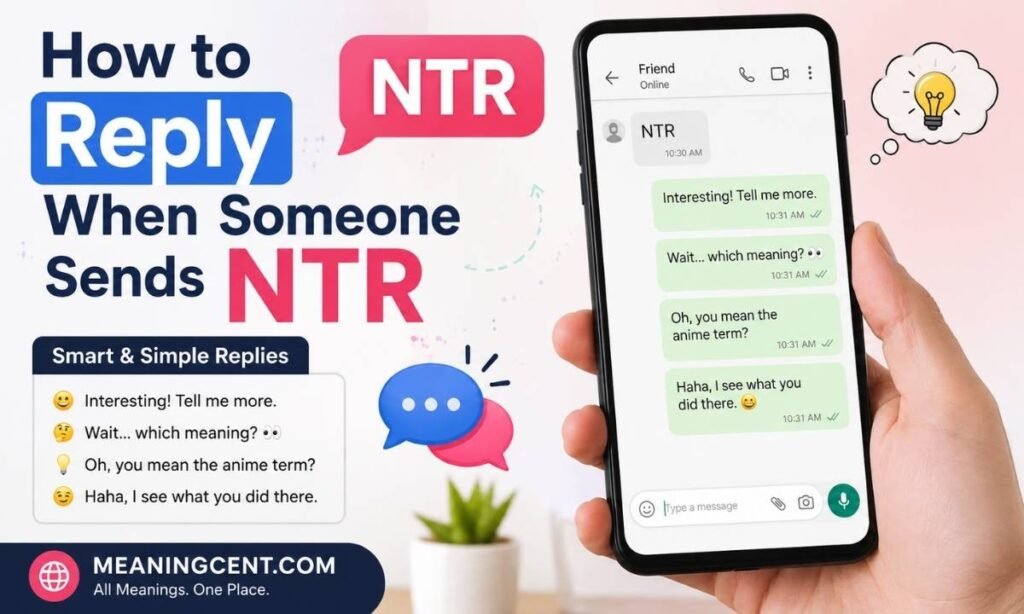
Matching your reply to the right meaning keeps the conversation from going sideways.
For “Nothing to Report”: a simple “Good, glad it’s quiet” or “Thanks for the update” closes the loop cleanly.
For “Netorare”: something like “That arc was brutal” or “Yeah, I couldn’t finish that one either” keeps you in the right emotional lane.
NTR in Relationship Talk
Outside fandom spaces, people occasionally borrow NTR for relationship banter — almost always as a joke, not a real accusation.
“She’s been replying to him fast, don’t start the NTR jokes” is teasing, not a genuine claim of cheating. Real relationship concerns deserve a direct conversation, not a slang label.
NTR Compared to Similar Slang
| Term | Meaning | Common Context | Tone |
| NTR | Nothing to Report / Netorare | Texting, anime, work chats | Casual to emotional |
| NVM | Never mind | General texting | Casual |
| TBH | To be honest | Instagram, Snapchat | Direct |
| OTP | One true pairing | Fandom spaces | Enthusiastic |
| Ghosted | Suddenly ignored | Dating, texting | Negative |
NTR is unusual because its two meanings don’t overlap at all — most dual-meaning slang terms at least share some emotional tone, but NTR genuinely splits into “nothing happened” and “something painful happened.”
Who Actually Uses NTR
Teens and young adults, roughly 16 to 30, use this slang term most often, since this age range overlaps heavily with both texting culture and anime fandoms.
Gen Z toggles between both meanings without much thought. Millennials tend to default to “Nothing to Report,” having picked it up through workplace or messaging habits first.
Geographically, it shows up most in the US, UK, Philippines, India, and Southeast Asia — regions where English texting and anime fandom culture overlap heavily. TikTok, Discord, Reddit, and WhatsApp carry most of the traffic.
Where NTR Came From
The two meanings trace back to entirely separate origins. “Nothing to Report” grew out of military and shift-reporting language, confirming a patrol or inspection had no issues worth flagging.
“Netorare” comes straight from Japanese manga and visual novel culture, where it’s been a recognized genre tag for years. TikTok and Reddit are largely responsible for pushing that meaning into English-speaking spaces that had never touched anime before.
Also Read This What Does Tesoro Mean?
Is NTR Rude to Use?
NTR itself isn’t profanity — it’s just shorthand, and context decides how it lands.
“Nothing to Report” is fine anywhere, including school or work messages. “Netorare” references mature story themes, so it fits better in fan communities than professional settings, though it isn’t offensive on its own.
If you’re texting someone unfamiliar with anime slang, default to “Nothing to Report” to avoid confusion.
Frequently Asked Questions
What does NTR mean in a text message?
NTR usually means “Nothing to Report” in everyday texting, switching to “Netorare” once anime or manga comes up.
Is NTR always related to anime?
No — most everyday chats use NTR strictly as “Nothing to Report,” with zero connection to anime.
What does “NTR’d” mean?
It means someone got betrayed or lost a partner to someone else, mostly used in anime contexts or as a joke about real-life situations.
Is NTR considered offensive?
Not inherently. “Nothing to Report” is fully appropriate everywhere, while “Netorare” is better suited to fan spaces due to its mature themes.
Is NTR an acronym or an initialism?
It’s an initialism — you pronounce N, T, and R separately rather than as one blended word.
Can NTR come up in relationship conversations?
Yes, but almost always as a joke about someone “losing” a partner’s attention rather than a real accusation of cheating.
How do I quickly figure out which NTR meaning is being used?
Check the topic first. Anime or manga talk points to Netorare; everyday check-ins point to Nothing to Report.
Final Thoughts
The NTR meaning comes down entirely to context — “Nothing to Report” in daily texting, “Netorare” the moment anime or manga enters the conversation.
Once you clock the topic being discussed, picking the right meaning takes seconds, not guesswork.