

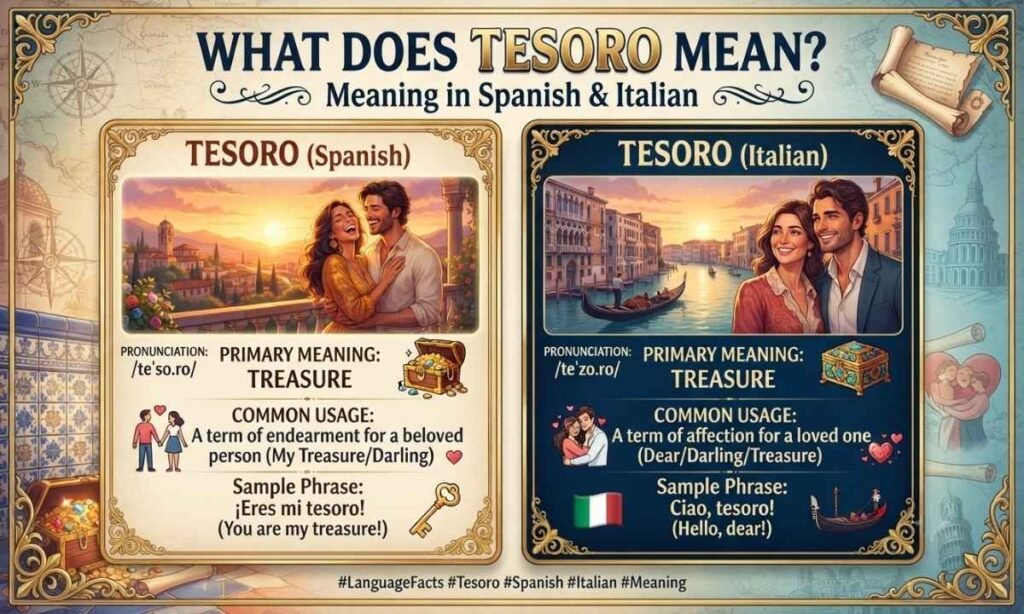
Someone just called you tesoro — and now you’re wondering what it actually means. What does tesoro mean? It’s a word you’ll hear in both Spanish and Italian, and while the two languages don’t use it the exact same way, it always carries warmth.
In this guide, you’ll learn the real meaning of tesoro in Spanish and Italian, where the word comes from, and how to know if it’s romantic, friendly, or just affectionate.
What Does Tesoro Mean – Quick Meaning
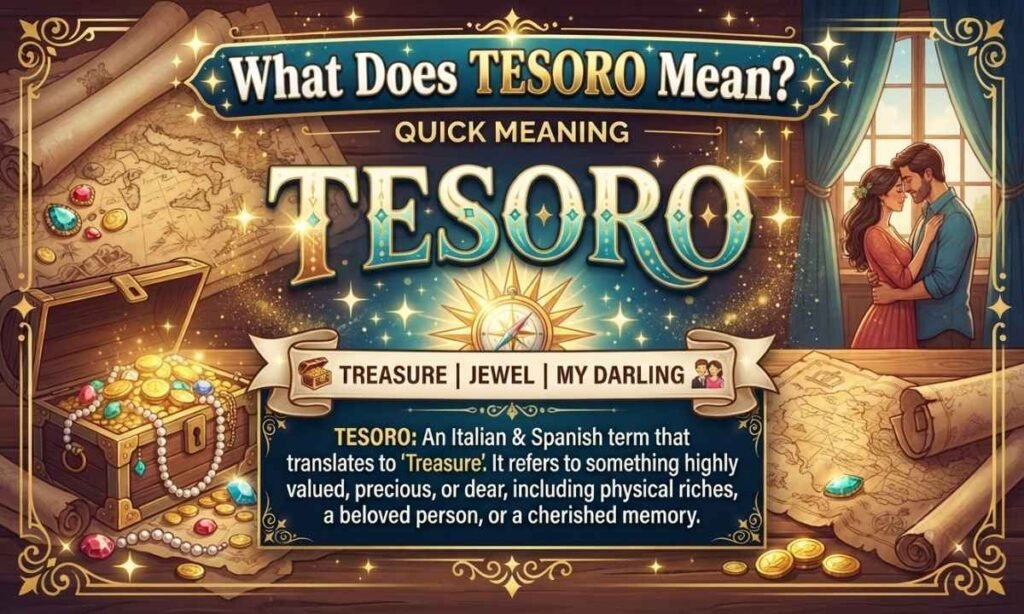
Tesoro means “treasure.” It’s a word used in both Spanish and Italian, and in both languages, it’s also used as a term of endearment.
In simple terms:
- Literal meaning: treasure, something precious or valuable
- Common meaning: darling, sweetheart, my love
Quick examples:
- “Buenos días, tesoro.” (Spanish – Good morning, sweetheart.)
- “Ciao, tesoro!” (Italian – Hi, darling!)
So when someone calls you tesoro, they’re not talking about gold. They’re telling you that you matter to them.
Is Tesoro Spanish or Italian?
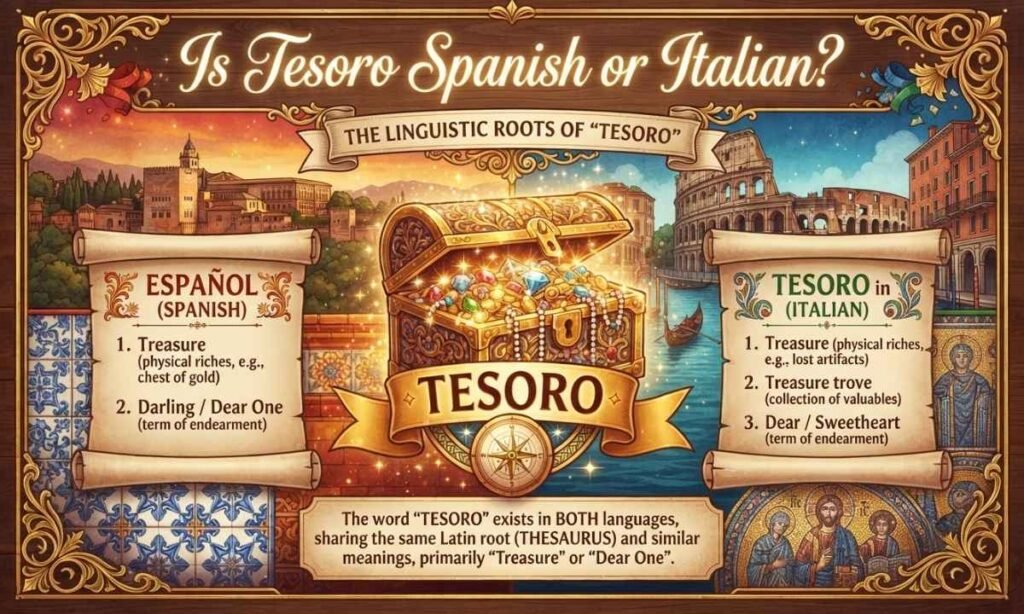
Tesoro is both Spanish and Italian. The word exists in both languages with the same spelling and a very similar meaning.
This is exactly why so many people get confused when they hear it. It’s not slang from one country — it’s a shared word with roots in Latin.
Quick comparison:
- In Spanish, tesoro is common in daily affection — from partners, parents, and close friends.
- In Italian, tesoro carries the same warmth, but it also has an older, formal meaning tied to money (like “Ministero del Tesoro,” Italy’s former Ministry of the Treasury).
So if you heard tesoro in a Spanish song, a WhatsApp text, or an Italian conversation, you weren’t imagining things — it belongs to both languages.
Origin & Background
The word tesoro comes from the Latin word thesaurus, meaning a storehouse of valuable things. Latin borrowed this from the Greek word thesauros, which meant “treasure” or “storehouse.”
Both Spanish and Italian kept the word almost unchanged from Latin. Over time, it grew beyond gold and riches. It came to represent emotional wealth too.
Parents started calling their children tesoro. Partners used it romantically. Grandparents said it gently. Today, tesoro travels through music, movies, and social media, reaching people who don’t even speak Spanish or Italian.
Real-Life Conversations

Here’s how tesoro naturally shows up in everyday messages.
WhatsApp – Mother and Daughter
Mom: Did you eat lunch, tesoro?
Daughter: Yes, mamá. Don’t worry ❤️
Instagram DM – Romantic
Person A: Miss you already.
Person B: I miss you more, tesoro.
Text – Grandparent
Grandma: Happy birthday, tesoro. I’m so proud of you.
Italian Text – Friend
Friend: Grazie mille per il tuo aiuto.
You: Sei un vero tesoro. (You’re a real treasure.)
Notice how the tone shifts depending on who is speaking. From a mother, it feels nurturing. From a partner, it feels romantic. From a grandparent, it feels tender. From a friend, it feels playful.
READ MORE RELATED POSTS CLICK ME
Emotional & Psychological Meaning
Calling someone tesoro means more than saying “I like you.” It sends a clear emotional signal.
It usually communicates:
- Emotional safety
- Value and appreciation
- Warmth and closeness
- Protection
When someone hears a word that literally means “treasure,” it can trigger a feeling of being wanted and cherished. This is why the word feels so personal, even in a short text message.
In relationships, small affectionate words like tesoro help build emotional bonding. In families, they reinforce closeness. In romantic settings, tesoro signals devotion without sounding dramatic.
Comparison Table
Tesoro exists in both Spanish and Italian, but the everyday feel is slightly different in each language.
| Term | Language | Literal Meaning | Common Tone | Typical Use |
| Tesoro | Spanish | Treasure | Warm, affectionate | Partners, parents to children |
| Tesoro | Italian | Treasure | Warm, versatile | Family, friends, partners |
| Cariño | Spanish | Affection | Gentle | Romantic or friendly |
| Amore | Italian | Love | Deep, intimate | Mostly romantic |
| Mi Amor | Spanish | My love | Strong romantic | Romantic partners |
Key insight: Tesoro focuses on value and preciousness. It’s less about passion and more about how much the person is cherished.
Variations & Related Terms (10 Types)
Both Spanish and Italian have close variations of tesoro. Here are the most common ones.
- Mi tesoro (Spanish) – “My treasure,” a more personal version.
- Tesoro mio (Italian) – A poetic way to say “my treasure.”
- Cariño (Spanish) – Means affection, softer than tesoro.
- Mi amor (Spanish) – “My love,” stronger romantic tone.
- Amore (Italian) – “Love,” often interchangeable with tesoro romantically.
- Cielo (Spanish) – Literally “sky,” used sweetly.
- Caro / Cara (Italian) – Means “dear,” used for close friends or partners.
- Corazón (Spanish) – “Heart,” an affectionate term.
- Cuore mio (Italian) – “My heart,” tender and versatile.
- Princesa / Príncipe (Spanish) – Playful affectionate terms.
Each variation carries a slightly different emotional weight, but all of them sit in the same family as tesoro.
How to Respond When Someone Uses It
If someone calls you tesoro, your reply depends on how you feel about it.
Casual replies
- “Aww, thank you.”
- “That’s sweet of you.”
Friendly replies
- “You’re a treasure too.”
- “That made my day.”
Confident replies
- “That’s really kind of you.”
- “I appreciate that.”
If you want to match the tone
- “Gracias, tesoro.” (Spanish)
- “Grazie, tesoro.” (Italian)
There’s no single “correct” reply. The right response simply matches the warmth of the person who said it.
Regional & Cultural Usage
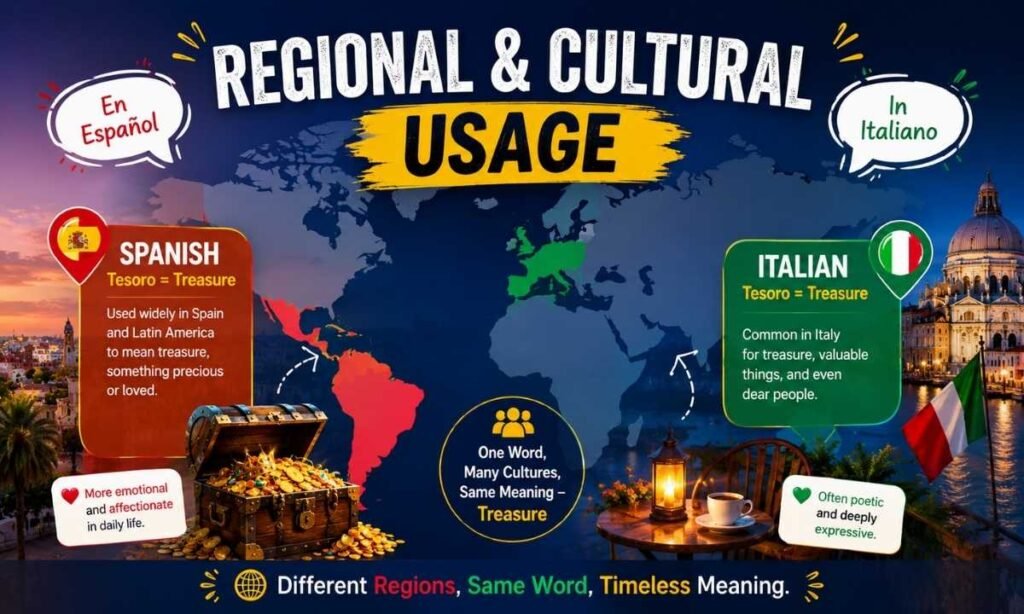
Tesoro is used differently depending on the country and the language.
In Spain
Tesoro is common in daily speech. It’s used casually between friends and family, not only romantically.
In Latin America
Usage varies by country. It can feel slightly more intimate in some regions, but it’s still common in family conversations.
In Italy
Tesoro is used across the whole country. It appears in everyday affection, historical contexts, and even in pop culture.
On social media
Through music, movies, and influencers, tesoro has become recognizable worldwide. Even non-native speakers now use it in captions and comments.
What Does Tesoro Mean in English
Tesoro means “treasure” in English. This is the direct translation from both Spanish and Italian.
In everyday use, English speakers understand tesoro as similar to:
- Darling
- Sweetheart
- My love
So when translated into English, tesoro keeps both meanings: the literal one (treasure) and the emotional one (a term of endearment).
Mi Tesoro Meaning in Italian
“Mi tesoro” is not standard Italian. In Italian, the correct phrase is “il mio tesoro” or simply “tesoro mio,” both meaning “my treasure.”
“Mi tesoro” is actually the Spanish version of the phrase. This mix-up happens often because Spanish and Italian share so many similar words.
Quick comparison:
- Spanish: “Mi tesoro” (My treasure)
- Italian: “Il mio tesoro” or “Tesoro mio” (My treasure)
Both phrases mean the same thing emotionally — someone extremely valuable to you.
MORE RELATED POTS CLICK ME
What Does Tesoro Mean in Italian
In Italian, tesoro means “treasure.” It’s used in two main ways.
Literal meaning
Tesoro describes something valuable, like historical treasure or wealth.
- “Hanno trovato un tesoro antico.” (They found an ancient treasure.)
Term of endearment
Italians use tesoro to address people they care about — partners, children, close friends, and even grandchildren.
- “Tesoro, come stai?” (Darling, how are you?)
Italian also has expressions built around this word, like “fare tesoro di qualcosa” (to treasure something, or to learn from an experience) and “chi trova un amico, trova un tesoro” (who finds a friend, finds a treasure).
Tesoro Meaning in Love
In romantic relationships, tesoro means “my love” or “my darling.” It’s one of the most common affectionate words used between partners in both Spanish and Italian.
When used romantically, tesoro signals:
- Deep affection
- Emotional closeness
- Comfort within the relationship
Example:
- “Buenos días, tesoro.” (Good morning, my love.)
However, tesoro on its own is not always a declaration of romantic love. Family members and close friends use it too. The romantic meaning depends on who says it, the tone, and the context of the relationship.
Tesoro Pronunciation
Tesoro is pronounced the same way in both Spanish and Italian:
teh-SOH-roh
Break it down:
- Teh – like the “te” in “test”
- SOH – the stressed syllable, like “so” in “sofa”
- roh – a soft, rolled “r” sound
The stress falls on the second syllable: te-SO-ro. Practicing it slowly, syllable by syllable, is the easiest way to get it right.
What Does Tesoro Mio Mean
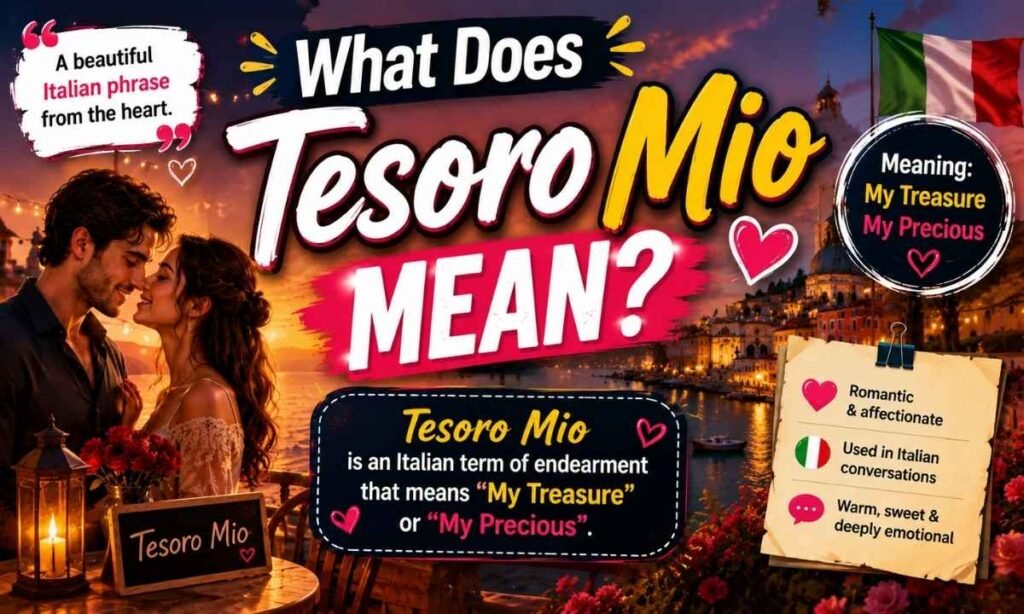
“Tesoro mio” is Italian for “my treasure.” It’s a poetic and personal way of saying tesoro, often used in close relationships.
Where it’s used:
- Romantic partners: “Tesoro mio, ti amo.” (My treasure, I love you.)
- Parents to children: A gentle, loving way to address a child
- Close friends: Occasionally used to express deep appreciation
“Tesoro mio” carries slightly more emotional weight than tesoro alone, similar to how “my darling” feels stronger than just “darling” in English.
Tesoro Meaning in Japanese
Tesoro is not a native Japanese word. It comes from Latin through Spanish and Italian, not Japanese.
That said, Japanese does have a similar concept. The word “takara” (宝) means “treasure” in Japanese, and it’s used in a comparable way — both literally and as a term of value, such as in “takaramono” (treasured thing).
If you’ve seen tesoro used in a Japanese context, it’s likely borrowed from Spanish or Italian branding or pop culture, rather than being part of the Japanese language itself.
Tesora or Tesoro
“Tesoro” is the correct and standard word. “Tesora” is not recognized in standard Spanish or Italian.
Here’s why the confusion happens:
- In Italian, adjectives often change endings based on gender (like caro for male, cara for female).
- Tesoro, however, is a noun, not an adjective. It stays as “tesoro” regardless of who you’re speaking to or about.
So even when addressing a woman, the correct word is still “tesoro,” not “tesora.” If you see “tesora” online, it’s most likely a spelling mistake or informal slang.
Is Tesoro a Name? (Tesoro as a Brand or Place)
Yes, tesoro is also used as a proper name. Beyond its meaning as “treasure,” it appears as a surname, a brand name, and a place name.
Some real-world examples:
- Tesoro Corporation — a former American oil and gas company (later renamed Andeavor)
- Tesoro High School — located in Las Flores, California
- Tesoro railway station — a train station in Bari, Italy
So if you came across “Tesoro” in a business or location context, it’s simply using the word’s original meaning — something valuable — as a name.
Frequently Asked Questions
Is there an energy company called Tesoro?
Yes. Tesoro Corporation was a major American oil and gas company. It later became known as Andeavor before being acquired by Marathon Petroleum.
Does tesoro mean gold?
No. Tesoro means “treasure” in general, not gold specifically. Treasure can include gold, but the word itself doesn’t refer only to gold.
What is the plural of tesoro?
In Italian, the plural is “tesori.” In Spanish, the plural is “tesoros.” Both mean “treasures.”
Is tesoro formal or informal?
Tesoro is informal and affectionate. It’s not used in professional or formal settings — it’s meant for personal relationships.
Can friends say tesoro to each other?
Yes. Close friends, especially in Spanish and Italian cultures, often use tesoro to express appreciation without any romantic meaning.
Is tesoro only used in romantic relationships?
No. Parents, grandparents, and friends use it too. The meaning shifts based on who says it and the relationship behind it.
Conclusion
So, what does tesoro mean? Literally, it means treasure. In both Spanish and Italian, it’s also a warm, affectionate word used for people you care about.
Whether it comes from a partner, a parent, or a close friend, tesoro always says the same thing: you are valued. Next time you hear it, you’ll know exactly what it means.